
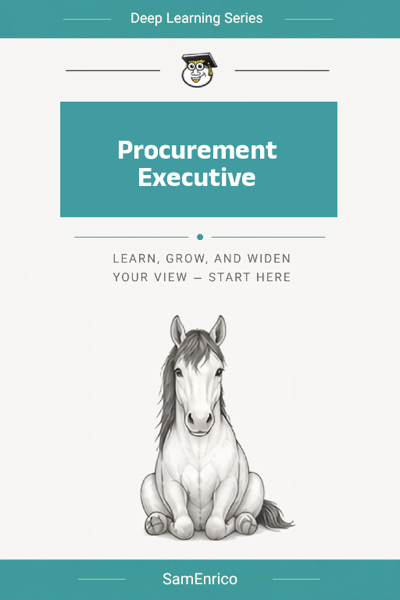
Non-FictionInformativeEducational
Procurement Executive eBook
A Coursebook on Procurement Executive
A Coursebook on Procurement Executive
Formats
Free sample
Chapter 1: The Invisible Kingdom...--–- Every morning, the world wakes up and buys things. Coffee beans from Colombia. Microchips from Taiwan. Steel from South Korea. Cotton from India.
Lumber from Canada. Your morning coffee traveled an average of 3,000 miles to reach your cup. The phone in your pocket contains components sourced from more than a dozen countries across four continents. The car in your driveway represents over 30,000 individual parts, each procured from somewhere, each negotiated by someone, each tracked by a system that most executives cannot name and do not understand.Yet when something goes wrong—when shelves go empty, when costs spike, when a supplier collapses—the world points one finger. It points at procurement.Not the CEO.
Not the board. Not the sales team that promised delivery dates without checking inventory. Procurement.This chapter is not an apology for procurement. It is an indictment of how most organizations have systematically underinvested in, misunderstood, and marginalized the very function that keeps their promises alive. And it is an invitation to rebuild.The myth of procurement as a clerical backwater has cost global industry trillions of dollars in inefficiency, risk, and missed opportunity.
The global semiconductor shortage of 2021 alone cost automakers more than $200 billion in lost revenue—not because chips didn't exist, but because procurement lacked the strategic position, data visibility, and supplier relationships to secure them before competitors did.This is the story of how the most ignored function in business became its most important. And why your career depends on understanding the difference between buying and procuring.The Four-Letter Word That Ruined a Profession Somewhere in the 1980s, American business made a catastrophic error. It decided that purchasing was a cost center. Not a strategic function. Not a source of competitive advantage.
A cost center—something to be minimized, automated, outsourced, or eliminated.The logic seemed sound at the time. Manufacturing was moving offshore. Just-in-time inventory was the new religion. And if you could squeeze suppliers for a few percentage points of price reduction each year, you could report "savings" to the board and collect your bonus.But that logic contained a fatal flaw. Price is not value.
And cost reduction is not value creation.The purchasing agent of the 1980s and 1990s was measured on one thing: purchase price variance. Did you pay less this year than last year? If yes, you succeeded. If no, you failed. This single metric—narrow, short-term, and dangerously incomplete—transformed procurement from a profession of strategic thinkers into a tribe of price hammers.
Every problem looked like a negotiation. Every supplier looked like an adversary. Every relationship was transactional by design.The damage was profound and cumulative. Suppliers learned to hide costs rather than share them. Innovation migrated away from collaborative development and toward secretive internal R&D.
Supply chains grew longer and more fragile because no one was paid to consider resilience—only price.Then the world changed.The Five Shocks That Made Procurement Essential Starting in the early 2000s, a series of shocks exposed the fragility of the price-only procurement model. Each shock punished organizations that had neglected procurement and rewarded those that had elevated it.Shock One: The Telecom Bust (2000-2002)When the dot-com bubble burst, suddenly price wasn't the only thing that mattered. Suppliers collapsed overnight. Companies that had negotiated brutal price concessions found themselves with no suppliers at all. Those that had maintained strategic relationships—even at slightly higher prices—kept production running while competitors scrambled.Shock Two: The Financial Crisis (2008-2009)Credit froze.
Raw material prices swung wildly. Some suppliers went bankrupt; others hoarded cash and refused to extend payment terms. Procurement organizations with deep supplier intelligence—who knew which suppliers were financially healthy and which were over-leveraged—navigated the crisis. Those without it made bets in the dark.Shock Three: The Fukushima Disaster (2011)A single earthquake in Japan shut down global production of critical automotive and electronics components. The world learned a new phrase: "single point of failure." Companies that had diversified their supplier bases across regions and built redundancy into their supply chains recovered in weeks.
Those that had chased the lowest price by consolidating volume with one supplier in one location recovered in months—or not at all.Shock Four: The Trade Wars (2018-2020)Tariffs on steel, aluminum, and thousands of Chinese-made goods rewrote the rules of global trade overnight. Procurement organizations that could rapidly model tariff impacts, shift sourcing to alternative countries, and renegotiate landed costs gained massive competitive advantages. Those that could not watched their margins evaporate.Shock Five: The COVID-19 Pandemic (2020-2022)Nothing could have prepared the world for a global supply chain collapse. But some procurement organizations were less unprepared than others. Those with strong supplier relationships got advance warning of shutdowns.
Those with digital visibility into multi-tier supply chains could predict shortages before they arrived. Those with strategic inventory buffers kept producing while competitors idled.The pandemic was not the beginning of procurement's rise. It was the moment everyone else noticed.What Best-in-Class Procurement Actually Does Before we go any further, we need to clear something up. When most people think of procurement, they imagine someone behind a desk, processing purchase orders, asking for three bids, and sending spreadsheets. That is not procurement.
That is clerical purchasing.Real procurement—the kind that wins battles, protects margins, and drives innovation—operates at four levels simultaneously.Level One: Transactional Excellence At its foundation, procurement must execute. Purchase orders must be accurate. Invoices must be matched. Goods must be received. Payments must be made.
This is not glamorous, but it is essential. When transaction processing fails, nothing else works.However—and this is critical—transactional excellence is a prerequisite, not a destination. Many organizations stop here. They invest in Procure-to-Pay software, automate the basics, and declare victory. They have not begun to compete.Level Two: Category Management Category management is the first step beyond clerical purchasing.
A category manager owns a specific spend area—packaging, logistics, IT hardware, professional services—and develops deep expertise in that market. They understand the supplier landscape. They know cost drivers. They can forecast price movements. They build relationships with key suppliers and manage competitive tension among alternatives.Category managers deliver value through strategic sourcing.
They run RFPs, negotiate contracts, and manage supplier performance. They are the workhorses of a mature procurement organization.Level Three: Strategic Sourcing Strategic sourcing goes beyond individual categories to optimize the entire supply base. A strategic sourcing professional asks: What supplier portfolio gives us the best balance of cost, risk, quality, and innovation? How do we segment suppliers by strategic importance? Which suppliers deserve long-term partnerships, and which should be kept at arm's length?This is where the Kraljic Matrix (which we will explore in Chapter 8) becomes a critical tool.
Strategic sourcing classifies suppliers into four quadrants based on profit impact and supply risk. Each quadrant demands a different management approach. One size fits none.Level Four: Supply Chain Orchestration The highest level of procurement transcends buying entirely. At this level, procurement orchestrates the entire supply chain—from raw material extraction to final delivery—in service of corporate strategy. The procurement executive at this level sits at the boardroom table, not the…
This is the end of the free sample. Get the eBook to keep going. Buy now
About this book
Details
- Author
- Hornsby Alena
- Publisher
- SamEnrico
- Language
- English
- Genre
- Non-Fiction, Informative, Educational
- Released
- 2026-05-08
- Pages (approx.)
- 152
- Available as
- eBook, Audiobook

Read better in the ZLOADR app
Your eBooks on your phone or tablet. Sign in with your SamEnrico account and start reading.
More by Hornsby Alena
 Marine Cargo Insurance BrokersHornsby Alena$11.99
 Stress Induced Nagging Cycle GuideHornsby Alena$11.99
 Metta for Climate Anxiety GuideHornsby Alena$11.99
 Loving Kindness for Chronic SufferingHornsby Alena$11.99
 Fitness for Overweight BeginnersHornsby Alena$11.99
 The Spark of Genius: Tesla, Westinghouse, and the War of CurrentsHornsby Alena$11.99
 The Silk Road's Forgotten Empress: Wu Zetian's Shadow EmpireHornsby Alena$11.99
 How to Become a TreaterHornsby Alena$11.99
 Turkish Weather Student GuideHornsby Alena$12.99
 Clinical Lab Improvement RulesHornsby Alena$12.99
 Understanding Dental FluorosisHornsby Alena$17.99
You may also like
 Hong Kong Handover 1997Dunn Johnnie$11.99
 Zumba For Postnatal Recovery CourseNeal Christian$11.99
 Zumba for BeginnersLadner Nikia$11.99
 YouTube Comment Mining GuideHumes Pandora$12.99
 Worry Box MeditationCarlin Rudy$11.99
 Workplace Stress MeditationNguyen Lynn$11.99
 Workplace Stress and Sleep RepairHawley Ivory$11.99
 Workplace Perfectionism CureDelaney Jeffry$11.99
 Workplace Injustice Anger GuideWallen Isabelle$11.99
 Work Addiction and Burnout LinkGreenwood Ester$11.99
 Women in Yoga and WellnessBeattie Galina$11.99
 Women in Stand Up ComedyChun Evangeline$11.99