
Non-FictionSelf-HelpArchitecture
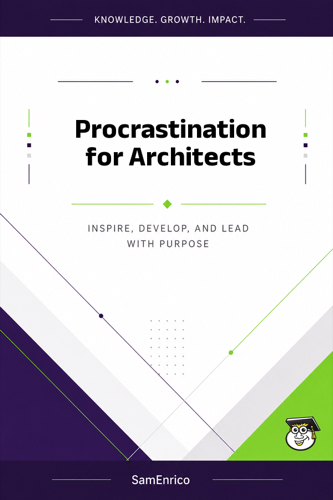
Procrastination for Architects eBook
Beats drafting and revision delay.
by Page Richard
Beats drafting and revision delay.
Formats
Free sample
Chapter 1: The Fallingwater Lie–- It begins, as it always does, with a legend.The year is 1934. Frank Lloyd Wright is seventy years old, broke, and largely forgotten by the architectural establishment. He has not built a significant public commission in years. His career is, by any reasonable measure, over. Then the phone rings.
Edgar Kaufmann, a wealthy Pittsburgh department store magnate, wants Wright to design a weekend house at a property called Fallingwater—a dramatic waterfall in the Pennsylvania woods. Wright accepts. Then he does absolutely nothing.For nine months, Wright produces no drawings. Kaufmann grows anxious. He calls.
He writes letters. Wright reassures him with the kind of vague confidence that would get any modern architect fired: "I'm thinking," he says. "The design is incubating." Kaufmann, against all business sense, waits. Finally, on a September morning in 1935, Wright sits down at his drafting table. In two hours, he produces the complete working drawings for Fallingwater—the cantilevered concrete slabs, the stone walls, the dramatic suspension over the waterfall.
The house is built. It becomes the most famous residence in American architectural history. The moral of the story, repeated in every architecture school and every firm's mythology, is this: genius procrastinates. The best work comes in a burst of panic. Do not rush the artist.This is a lie.Not a small lie.
Not an exaggeration for effect. A dangerous, career-destroying, project-killing lie that has cost architects millions of hours of unnecessary overtime, thousands of nights of lost sleep, and an incalculable toll in liability claims, RFIs, and construction defects. The truth about Fallingwater—the truth that architecture schools conveniently omit—is that Wright's nine months of "incubation" produced drawings that were structurally catastrophic. The cantilevered terraces were under-reinforced. The main beam was undersized.
Within a decade, Fallingwater was sagging dangerously. By the 1990s, it required a multi-million dollar structural intervention just to keep it from collapsing into the stream. The "last-minute masterpiece" was, in fact, a last-minute disaster that only survived because of heroic field adjustments by contractors and decades of post-construction remediation.The myth persists because it flatters us. It tells architects that our procrastination is not a failure of discipline but a sign of genius—that we are not avoiding work but "incubating." This chapter dismantles that myth. It introduces the single most important framework you will learn in this book: the Unified Taxonomy of Delay.
This framework will permanently change how you understand your own procrastination, transforming it from a source of shame into a manageable set of choices. By the end of this chapter, you will know exactly which delays are serving you, which delays are destroying you, and—most critically—how to tell the difference before your drawings go out the door.The Anatomy of a Disaster: The Redline Hangover Before we can fix procrastination, we have to understand what it actually costs. Not in vague terms like "lost productivity" or "missed opportunities." Concrete, measurable, billable costs.Consider a typical scenario in any architecture firm. A project manager returns a redlined section to a junior architect on a Tuesday morning. The redline is simple: "Move the shear wall 18 inches east to align with the grid below." This is a fifteen-minute fix.
The junior architect looks at the redline. She thinks, "I'll do it after lunch." Lunch comes and goes. An urgent email from the client arrives. Then a coordination meeting. Then a fire drill on a different project.
The shear wall redline slips to Wednesday. On Wednesday, the structural engineer sends an updated model. The junior architect now has to reconcile the new model with the redline. The fifteen-minute fix becomes a forty-five-minute fix. She postpones again.
On Thursday, the project manager asks, "Did you move that shear wall?" The junior architect says, "Almost done." That evening, she opens the file and discovers that the grid she was aligning to has shifted because of the new consultant model. The redline now requires moving not just the shear wall but also four adjacent columns, two footings, and a beam pocket. The fifteen-minute fix has become a four-hour nightmare. She works until midnight. On Friday, the project manager reviews the changes and finds three new errors introduced by the rush job.
The cycle repeats.This is the Redline Hangover. And it has a mathematical reality.Based on time-tracking studies from major architecture firms, the cost of a redline increases by approximately 40 percent for every day it remains untouched. This is not because the redline itself becomes more complex. It is because the context around the redline continues to evolve. Consultants update models.
Clients request changes. Grids shift. Coordinates drift. The longer you wait to implement a revision, the more the building moves around it. A fifteen-minute fix delayed two days becomes a ten-hour nightmare because the original geometry is now buried under new work, shifted grids, or updated consultant models.
The Redline Hangover is the single most expensive form of architectural procrastination—not because it happens rarely, but because it happens constantly, invisibly, on every project, in every firm.The 15-Minute Rule: If you can fix a redline in under fifteen minutes, do it the moment you see it. Not after lunch. Not after this email. Not after you finish your coffee. Now.
The cost of delay is too high. If the redline takes longer than fifteen minutes, schedule it into a dedicated revision block. But never, under any circumstances, simply ignore it. Ignoring a redline is not a decision. It is a decision to let the problem compound at 40 percent per day until it becomes catastrophic.The Unified Taxonomy of Delay: Four Kinds of "Not Yet"Here is the central insight of this book, and it is the framework that will underpin every chapter that follows.
Not all delay is procrastination. In fact, some delay is not only acceptable but essential to good architectural thinking. The problem is that architects have no vocabulary for distinguishing between productive delay and destructive delay. We feel guilty about all of it, so we either condemn ourselves unfairly or—more commonly—defend all delay as "thinking." The Unified Taxonomy of Delay gives you a precise language for understanding what is actually happening when you are not working.There are exactly four types of delay in architectural practice. Three are legitimate, strategic, and valuable.
One is the enemy.Type One: Strategic Incubation Definition: Intentional, time-bound periods of subconscious problem-solving where the architect deliberately steps away from a problem to allow spatial, formal, or programmatic relationships to resolve themselves in the background of the mind.What it looks like: Walking the site without a sketchbook. Staring out the window. Taking a shower. Driving home in silence. Reading something unrelated.
Sleeping on a problem.How to know it is legitimate: Strategic Incubation is scheduled or intentional, not reactive. You decide, "I am going to step away from this massing study for two hours and let it settle." You set a time boundary. You return. Strategic Incubation is never a response to anxiety or boredom—it is a response to complexity that has exceeded your conscious processing capacity.How it becomes destructive: Strategic Incubation mutates into Destructive Avoidance when the time boundary dissolves. "I'll think…
This is the end of the free sample. Get the eBook to keep going. Buy now
About this book
Details
- Author
- Page Richard
- Publisher
- SamEnrico
- Language
- English
- Genre
- Non-Fiction, Self-Help, Architecture
- Released
- 2026-06-11
- Pages (approx.)
- 152
- Available as
- eBook, Audiobook

Read better in the ZLOADR app
Your eBooks on your phone or tablet. Sign in with your SamEnrico account and start reading.
More by Page Richard
 Transcending Thoughts ProcessPage Richard$11.99
 Anger And Forgiveness GuidePage Richard$11.99
 Moscow Metro Construction FraudPage Richard$11.99
 Customer Anger ManagementPage Richard$11.99
 The Stockout Cost CalculatorPage Richard$11.99
 Senior Medication EsteemPage Richard$11.99
 Cave Symbolism in DreamsPage Richard$11.99
 The Bloodied Silk Road: The Fall of the Ming Dynasty (1644)Page Richard$11.99
 The Golden Voices of Byzantium: Chanting the DivinePage Richard$11.99
 Kholrabi: Kohlrabi Bulb HarvestingPage Richard$11.99
 How to Produce a DVDPage Richard$11.99
 Mobile Freemium Conversion TacticsPage Richard$12.99
You may also like
 Hong Kong Handover 1997Dunn Johnnie$11.99
 Zumba For Postnatal Recovery CourseNeal Christian$11.99
 Zumba for BeginnersLadner Nikia$11.99
 YouTube Comment Mining GuideHumes Pandora$12.99
 Worry Box MeditationCarlin Rudy$11.99
 Workplace Stress MeditationNguyen Lynn$11.99
 Workplace Stress and Sleep RepairHawley Ivory$11.99
 Workplace Perfectionism CureDelaney Jeffry$11.99
 Workplace Injustice Anger GuideWallen Isabelle$11.99
 Work Addiction and Burnout LinkGreenwood Ester$11.99
 Women in Yoga and WellnessBeattie Galina$11.99
 Women in Stand Up ComedyChun Evangeline$11.99