
Non-FictionSelf-HelpOperations
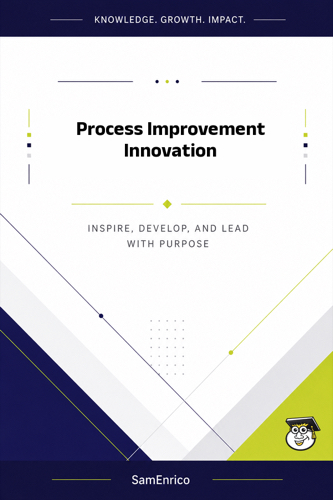
Process Improvement Innovation eBook
Apply creative thinking to optimize workflows and
by Cramer Jone
Apply creative thinking to optimize workflows and systems.
Formats
Free sample
Chapter 1: The Efficiency Trap--–- In a factory outside Cleveland, a plant manager named David achieved the impossible. He reduced production cycle time by 31 percent in less than four months. His bonus check arrived with a handwritten note from the regional vice president: "This is exactly what we need. Roll this out to all shifts by Friday."David framed the bonus letter and hung it above his desk. He was a hero.
Lean consultants praised him at a quarterly review. His name appeared in an internal newsletter under the headline "Optimization Champion." Six Sigma belts were awarded. Metrics were celebrated. The data was undeniable: products were moving from raw materials to finished goods faster than ever before in the plant's forty-two-year history.Six months later, the plant closed.Not because sales dropped. Not because the market shifted.
Not because of a recession or a trade war or a supply chain collapse. The plant closed because David optimized a process that should never have been optimized. He made a broken system run faster, and in doing so, he accelerated the plant's destruction. Defects, which had been running at 4 percent, climbed to 11 percent. Rework backlog grew from three days to eleven.
Customer returns doubled. The speed he created was not the speed of value. It was the speed of waste moving more efficiently toward the customer's door and then bouncing back as returns, chargebacks, and furious phone calls.David's story is not a cautionary tale about a single incompetent manager. It is a story about a systemic disease that infects nearly every organization on the planet. The disease has a name: the Efficiency Trap.The Paradox at the Heart of Modern Management We have been taught, for decades, that efficiency is an unqualified good.
Faster is better. Cheaper is better. Leaner is better. These beliefs are drilled into business students, reinforced by quarterly earnings reports, and rewarded with promotion after promotion. But there is a paradox hiding in plain sight: the very tools organizations use to become more efficient—standardization, repetition, metrics, automation—often destroy their ability to innovate.
And without innovation, efficiency becomes a slow poison rather than a performance elixir.Let me be precise about what I mean. This book is not arguing against efficiency. That would be absurd. No organization should aspire to be slow, wasteful, or chaotic. The argument is more subtle and more dangerous: efficiency applied to the wrong target is worse than useless.
It is actively destructive.Consider the difference between two types of thinking. The first is what I call mechanical optimization. This is the act of making an existing process run faster, cheaper, or more predictably without changing its fundamental design. Mechanical optimization asks questions like: How can we reduce cycle time? How can we eliminate waste in this step?
How can we automate this manual task? These are good questions—when asked at the right time.The second type is adaptive innovation. This is the act of changing the process design itself, even if those changes temporarily slow things down. Adaptive innovation asks different questions: Does this process need to exist at all? What problem are we actually trying to solve?
What would we build if we started from scratch today?The tragedy of modern management is that we have become extraordinarily good at mechanical optimization and extraordinarily bad at adaptive innovation. We have optimized our way into a corner, and we are so proud of our speed that we have not noticed the walls closing in.The Red Queen Effect: Running Faster to Stay in the Same Place Lewis Carroll understood this problem more than a century before business schools discovered Lean Six Sigma. In Through the Looking-Glass, the Red Queen explains a peculiar feature of her kingdom to Alice:"Now, here, you see, it takes all the running you can do, to keep in the same place. If you want to get somewhere else, you must run at least twice as fast as that!"This is the Red Queen Effect. In biology, it explains why species must constantly evolve just to survive in an environment where predators and competitors are also evolving.
In business, it explains why mechanical optimization creates a treadmill that never stops. You reduce cycle time by 10 percent, and customer expectations rise by 15 percent. You cut costs by 20 percent, and competitors cut costs by 25 percent. You automate one process, and three new manual workarounds appear.The Red Queen Effect is not a bug. It is a feature of competitive markets.
The problem is not that competition exists. The problem is that most organizations respond to the Red Queen Effect by running faster on the same path, rather than asking whether the path leads anywhere worth going.David, the plant manager in Cleveland, was a master of running faster. He studied the production line frame by frame. He eliminated every pause between steps. He cross-trained workers to cover for one another.
He installed sensors to monitor machine downtime. By every mechanical measure, he succeeded brilliantly. But the path he was optimizing was a cow path—a meandering, inefficient, historically contingent route that had emerged over decades of small decisions, political compromises, and forgotten workarounds. He paved the cow path and called it a highway. Then he was surprised when it led to a cliff.The Status Quo Bias: Why We Keep Paving Cow Paths If mechanical optimization is so often misapplied, why do we keep doing it?
The answer lies in a cognitive bias that psychologists have studied for decades: the Status Quo Bias.In a famous experiment, researchers gave participants a choice between two hypothetical healthcare plans. Plan A had moderate benefits and moderate costs. Plan B had better benefits and lower costs—objectively superior by every measure. Yet when participants were told that Plan A was their current plan, a majority chose to stick with it. The mere fact that something is already in place makes it more attractive, even when better alternatives exist.The Status Quo Bias operates in organizations with tremendous force.
A process that has been used for five years feels safer than a new process, even if the new process is demonstrably better. A workflow that everyone knows feels less risky than a workflow that requires learning, even if the known workflow is full of waste. A system that has never failed catastrophically feels reliable, even if it fails annoyingly every single day.This bias is not simply laziness or resistance to change. It is rooted in how our brains process loss versus gain. Behavioral economists Daniel Kahneman and Amos Tversky demonstrated that losses loom larger than gains.
The pain of losing something familiar is psychologically more intense than the pleasure of gaining something better. So when a manager contemplates replacing a legacy process with an innovative design, the brain amplifies the potential losses (what if it fails? what if people resist? what if I look stupid?) and discounts the potential gains (faster, cheaper, better, happier customers).The result is organizational paralysis disguised as pragmatism. "We've always done it this way" becomes an unassailable argument.
"If it ain't broke, don't fix it" becomes a philosophy. And slowly, over years and decades, the cow paths harden…
This is the end of the free sample. Get the eBook to keep going. Buy now
About this book
Details
- Author
- Cramer Jone
- Publisher
- SamEnrico
- Language
- English
- Genre
- Non-Fiction, Self-Help, Operations
- Released
- 2026-06-07
- Pages (approx.)
- 156
- Available as
- eBook, Audiobook

Read better in the ZLOADR app
Your eBooks on your phone or tablet. Sign in with your SamEnrico account and start reading.
More by Cramer Jone
 Survey Question Performance with AICramer Jone$11.99
 OCD And Panic Disorder OverlapCramer Jone$11.99
 Power Poses And Confidence HandbookCramer Jone$11.99
 Parenting Only Child GuideCramer Jone$11.99
 The Great Moon Hoax: How a Newspaper Fooled the WorldCramer Jone$11.99
 How to Start a Construction of Irrigation Systems (canals) Business (Beginners Guide)Cramer Jone$11.99
 Clinical Research PhysicianCramer Jone$11.99
 Peer Review Experience Without PapersCramer Jone$12.99
 Italian University Master GuideCramer Jone$12.99
You may also like
 Hong Kong Handover 1997Dunn Johnnie$11.99
 Zumba For Postnatal Recovery CourseNeal Christian$11.99
 Zumba for BeginnersLadner Nikia$11.99
 YouTube Comment Mining GuideHumes Pandora$12.99
 Worry Box MeditationCarlin Rudy$11.99
 Workplace Stress MeditationNguyen Lynn$11.99
 Workplace Stress and Sleep RepairHawley Ivory$11.99
 Workplace Perfectionism CureDelaney Jeffry$11.99
 Workplace Injustice Anger GuideWallen Isabelle$11.99
 Work Addiction and Burnout LinkGreenwood Ester$11.99
 Women in Yoga and WellnessBeattie Galina$11.99
 Women in Stand Up ComedyChun Evangeline$11.99