
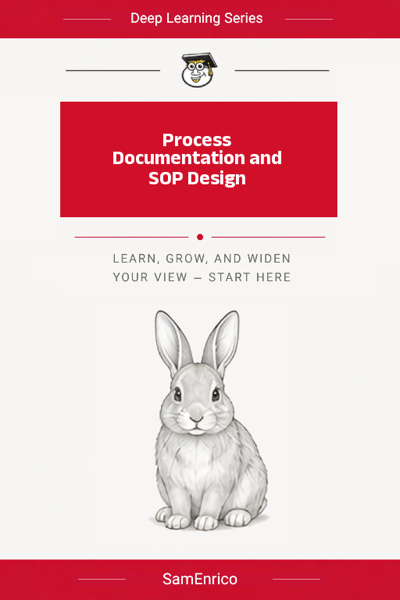
Non-FictionInformativeEducational
Process Documentation and SOP Design eBook
A Coursebook on Process Documentation and SOP Desi
A Coursebook on Process Documentation and SOP Design
Formats
Free sample
Chapter 1: The Invisible Software--–- Most organizations are running on software that no one wrote, no one backs up, and no one can explain. This software does not live on servers or in the cloud. It lives in the heads of employees, passed from person to person through whispered instructions, sticky notes on monitors, and the unspoken assumption that "everyone knows how this works." When this software crashes—when the one person who knows the password leaves, when the shift change handoff fails, when the undocumented exception becomes the new normal—the entire operation can grind to a halt.This chapter is about that invisible software. It is about the difference between organizations that scale and organizations that stall, between processes that survive employee turnover and processes that collapse. And it begins with a simple, uncomfortable truth: you cannot improve what you cannot see, and you cannot see what you have not written down.The Myth of the Obvious Walk into almost any workplace and ask a simple question: "How do you do that?" The answer will almost always begin with the phrase, "It's obvious."It is obvious that the blue button starts the machine.
It is obvious that the warehouse scanner must be held at a specific angle to read damaged barcodes. It is obvious that the second Tuesday of every month is when the financial reconciliation report runs. It is obvious that the backup key is in the third drawer of the filing cabinet behind the coffee machine.But here is the truth about obvious knowledge: it is only obvious to the people who already have it. To a new employee, to a temporary worker, to someone from another department covering a shift, there is nothing obvious about any of it. The blue button might be labeled "Start" or it might be labeled "Initiate" or it might be unlabeled entirely.
The warehouse scanner trick is not written in any manual. The monthly report schedule is not on any calendar. The backup key location is not in any security log.This is tribal knowledge—information that is known by some members of an organization but is not documented, not accessible to all, and therefore not reliable. Tribal knowledge is not inherently bad. In fact, some forms of tribal knowledge represent the deepest expertise in an organization: the technician who can diagnose a machine's problem by its sound, the salesperson who knows exactly which client needs a follow-up call on which day, the engineer who remembers a十年前 failure mode that no one has documented.
This is valuable tacit expertise, and it is a genuine competitive advantage.But there is another form of tribal knowledge that is purely dangerous. This is the information that represents a single point of failure—the one person who knows how to run the critical report, the one folder where the template lives, the one workaround that keeps the broken process moving. When that knowledge walks out the door, the organization does not just lose an employee. It loses a piece of its operational memory.The $500 Million Lesson In 2012, a multinational financial services firm experienced a trading loss of approximately $500 million over a period of six weeks. The cause was not a market crash, not a rogue trader, not a systems failure.
The cause was a missing sign-off procedure.Here is what happened. A junior trader had been manually entering a specific class of derivative trades using a spreadsheet that lived on his personal desktop—not on the firm's shared drive, not in the document management system, not backed up by IT. When that trader took a previously scheduled vacation, the spreadsheet was not accessible to anyone else. The cover trader, following the written procedure (which assumed the spreadsheet was on a shared drive), entered trades using a different method. The two methods produced different valuations.
No one noticed for three weeks because the reconciliation step—the step that compared the two valuation methods—was documented only in the vacationing trader's memory. He had never written down how to perform the reconciliation. He had never trained anyone else. The written SOP simply said "perform reconciliation" without specifying who, when, or how.By the time the error was discovered, the firm had reported incorrect financial data to regulators for two consecutive reporting periods. The fine, the legal fees, the customer compensation, and the internal investigation cost approximately half a billion dollars.This is not an isolated incident.
In manufacturing, undocumented procedures cause product recalls. In healthcare, undocumented medication administration steps cause patient harm. In software development, undocumented deployment procedures cause outages. In logistics, undocumented warehouse processes cause shipping errors. The common thread is not incompetence or laziness.
The common thread is the assumption that "everyone knows" or that "it's obvious" or that "we don't need to write that down."Two Kinds of Tribal Knowledge: A Critical Distinction Before we go further, we must make a distinction that will inform every chapter of this book. Not all undocumented knowledge is created equal.Dangerous tribal knowledge has three characteristics. First, it is a single point of failure: if the person who holds it leaves or forgets, the process breaks. Second, it is invisible to anyone outside the immediate circle: no one has documented it, and no one has been trained on it. Third, its absence would cause meaningful harm—financial loss, safety risk, compliance violation, or customer impact.
Examples include: the one person who knows how to reset the server password; the undocumented workaround that bypasses a broken approval step; the verbal handoff that determines which batch of raw material gets used first.Valuable tacit expertise, by contrast, has different characteristics. It represents skill, judgment, or intuition that cannot be fully reduced to text. It is distributed across multiple people rather than concentrated in one. And it is adaptive—it changes in response to new conditions. Examples include: the quality inspector who can identify defects by touch; the customer service agent who knows how to de-escalate an angry caller through tone and timing; the engineer who develops a "feel" for when a machine needs maintenance.
This type of knowledge should be respected, cultivated, and shared through apprenticeship and mentoring—not forcibly crammed into an SOP where it will lose its value.The goal of process documentation is not to eliminate all tribal knowledge. The goal is to identify and document the dangerous tribal knowledge while preserving and leveraging the valuable tacit expertise. An SOP that tries to capture every nuance of expert judgment will be too long, too rigid, and ultimately ignored. An SOP that fails to capture critical single points of failure will leave the organization vulnerable. The art is in the distinction.Policy, Process, Procedure, and Work Instruction: The Hierarchy Before we can document anything, we need a common language.
Most organizations use the terms "policy," "process," "procedure," and "work instruction" interchangeably. They should not. These four concepts exist in a hierarchy, each serving a different purpose and each aimed at a different audience.Policy sits at the top. A policy is a governing principle—a rule that answers the question "what must we do, and why?" Policies are typically brief, high-level, and relatively stable. They are written for…
This is the end of the free sample. Get the eBook to keep going. Buy now
About this book
Details
- Author
- Mccormick Loren
- Publisher
- SamEnrico
- Language
- English
- Genre
- Non-Fiction, Informative, Educational
- Released
- 2026-06-02
- Pages (approx.)
- 155
- Available as
- eBook, Audiobook

Read better in the ZLOADR app
Your eBooks on your phone or tablet. Sign in with your SamEnrico account and start reading.
More by Mccormick Loren
 Anapanasati Meditation FoundationsMccormick Loren$11.99
 Stress Communication for IntrovertsMccormick Loren$11.99
 Listening In Diplomacy GuideMccormick Loren$11.99
 The Performance ReviewMccormick Loren$11.99
 Lucid Dream Journal MethodMccormick Loren$11.99
 Workplace Mental Health AccessMccormick Loren$11.99
 The English Rose GardenMccormick Loren$11.99
 Overcoming Negativity Bias NaturallyMccormick Loren$11.99
 Muhammad Ali RopeMccormick Loren$11.99
 The Tsar’s Enlightened Court: Catherine the Great and the Russian RenaissanceMccormick Loren$11.99
 The Hollow Echoes: The Forgotten Patients of Danvers State HospitalMccormick Loren$11.99
 The Harmonic Crown: Black Composers Who Defied the SymphonyMccormick Loren$11.99
You may also like
 Hong Kong Handover 1997Dunn Johnnie$11.99
 Zumba For Postnatal Recovery CourseNeal Christian$11.99
 Zumba for BeginnersLadner Nikia$11.99
 YouTube Comment Mining GuideHumes Pandora$12.99
 Worry Box MeditationCarlin Rudy$11.99
 Workplace Stress MeditationNguyen Lynn$11.99
 Workplace Stress and Sleep RepairHawley Ivory$11.99
 Workplace Perfectionism CureDelaney Jeffry$11.99
 Workplace Injustice Anger GuideWallen Isabelle$11.99
 Work Addiction and Burnout LinkGreenwood Ester$11.99
 Women in Yoga and WellnessBeattie Galina$11.99
 Women in Stand Up ComedyChun Evangeline$11.99