
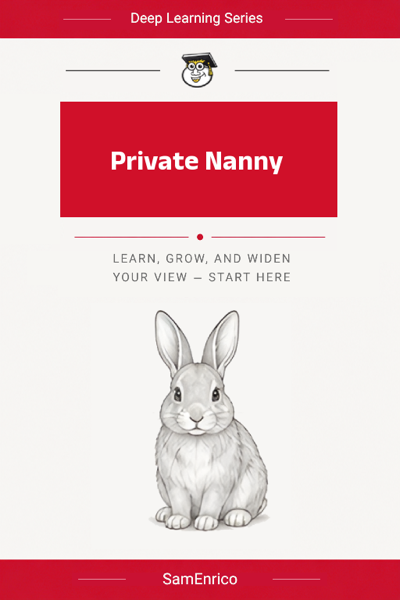
Non-FictionInformativeEducational
Private Nanny eBook
A Coursebook on Private Nanny
A Coursebook on Private Nanny
Formats
Free sample
Chapter 1: The Identity Shift--–- The first time a parent introduces you as “our babysitter,” something inside you flinches. It’s not about ego. It’s about accuracy. You have completed three certifications, you track developmental milestones in a dedicated notebook, and you can de-escalate a toddler’s public meltdown faster than most emergency responders. Yet the world still lumps you into the same category as a teenager who watches Netflix while the kids sleep.
That flinch is the beginning of your professional identity. It is the signal that you are ready to move beyond babysitting and into the ranks of the professional private nanny.This chapter is not about how to change diapers or prepare bottles. Those skills are necessary but not sufficient. This chapter is about transforming how you see yourself and how families see you. The difference between a babysitter and a professional nanny is not primarily about experience or age.
It is about framework, intention, and boundaries. A babysitter keeps children safe and entertained for a few hours. A professional nanny partners with parents to support the child’s development across physical, cognitive, emotional, and social domains. One is reactive. The other is proactive.
One waits for instructions. The other brings expertise. One is a temporary solution. The other is a career.The goal of this chapter is to equip you with the foundational understanding you need to operate as a professional from day one. You will learn how the nanny role has evolved over the past fifty years, how private household work differs fundamentally from daycare center employment, what core competencies define a true professional, and how to navigate the unique ethical challenges of working inside someone’s home.
By the end of this chapter, you will have completed a self-assessment that reveals whether you are currently operating as a babysitter or a professional, and you will have written a personal ethics statement that will guide every decision you make in a family’s home.The Private vs. Public Difference The most fundamental distinction between a private nanny and a daycare teacher is the setting. That might seem obvious, but the implications run deeper than most people realize. In a daycare center, you work in a public or semi-public space designed specifically for children. The furniture is bolted down.
The outlets are covered. The bathrooms have changing stations at adult height. There are cameras in every room. There are other adults within earshot at all times. There is a director who sets policies.
There is a handbook that covers almost every scenario. You are an employee of an organization, not of a family.In a private home, none of those conditions exist. The environment is designed for adults first and children second, so you must constantly adapt the space for safety. You are often the only adult present. There are no cameras (or if there are, you may not know where they are).
There is no handbook. There is no director. There is just you, the children, and the parents who employ you. That proximity creates opportunities for deep trust and collaboration, but it also creates vulnerabilities.Consider ratios. In most states, a daycare teacher caring for toddlers operates at a ratio of one adult to four to six children.
An infant room might be one to three or one to four. A private nanny, by contrast, typically cares for one to three children, often from the same family. That lower ratio allows for individualized attention, but it also means you cannot rely on another adult to step in when a child has a meltdown or when you need a bathroom break. You are the entire system.Consider autonomy. A daycare teacher follows a curriculum handed down by the director.
Activities are planned weeks in advance. The schedule is rigid because it must coordinate twenty children and four adults. A private nanny has enormous flexibility. You can decide that today is a park day or a museum day or a baking day. You can extend tummy time because the baby is showing interest.
You can abandon the planned activity because the toddler is exhausted. That flexibility is liberating, but it also requires judgment. No one is telling you what to do next. You must decide.Consider intimacy. In a daycare, parents drop off and pick up.
There might be a five-minute conversation at each transition. The teacher knows the parent as a collaborator but not as a person living a messy, complicated life. A private nanny sees everything. She sees the parent crying in the kitchen after a difficult phone call. She sees the marriage strain during a tense dinner.
She sees the wine bottles accumulating in the recycling bin. She sees the chaos of a home that is not prepared for visitors. That intimacy is the price of entry to private household work. You cannot do this job well if you require pristine, professional distance at all times. But you also cannot survive without boundaries.The Evolution of the Nanny: From Housekeeper to Early Childhood Educator To understand where you are going, you need to understand where the profession has been.
Fifty years ago, the woman who cared for children in a private home was not called a nanny in most American households. She was called “the girl” or “the help” or simply by her first name. She was expected to clean the house, do the laundry, prepare the meals, and watch the children in whatever time remained. Childcare was not her primary function. It was her secondary function, performed while completing domestic labor.That model began to shift in the 1980s and 1990s as dual-income families became the norm rather than the exception.
Two working parents meant more money for specialized help, but it also meant that parents had less time for housework. The solution, for many families, was to hire separate people: a housekeeper for the cleaning and a nanny for the children. This bifurcation allowed the nanny role to emerge as something distinct. For the first time, there were families paying someone to focus exclusively on the children.The real transformation, however, came from research. In the late 1990s and early 2000s, neuroscience revealed what early childhood educators had long suspected: the first three years of life are a period of extraordinary brain development.
Synapses form at a rate of millions per second. Language exposure in infancy predicts vocabulary size at age three. Secure attachment in the first year predicts emotional regulation in adolescence. Parents reading these studies realized that the person caring for their children was not just a warm body. That person was literally building their child’s brain.This realization drove demand for nannies with training.
Agencies began requiring certifications. Professional organizations formed. The Professional Nanny and Childcare Provider (PNCP) standards were developed. Suddenly, a nanny could earn credentials that signaled expertise in child development, not just experience with children. The role evolved from domestic worker to early childhood educator.But the evolution is not complete.
Many families still do not understand what a professional nanny does. Many nannies still struggle to assert their professional identity. You will encounter parents who ask you to scrub their toilets or…
This is the end of the free sample. Get the eBook to keep going. Buy now
About this book
Details
- Author
- Castellano Jeffie
- Publisher
- SamEnrico
- Language
- English
- Genre
- Non-Fiction, Informative, Educational
- Released
- 2026-05-04
- Pages (approx.)
- 137
- Available as
- eBook, Audiobook

Read better in the ZLOADR app
Your eBooks on your phone or tablet. Sign in with your SamEnrico account and start reading.
More by Castellano Jeffie
 Cloudflare CDN Outage GuideCastellano Jeffie$11.99
 Anger Restructuring WorkbookCastellano Jeffie$11.99
 Scott Peterson Jury SelectionCastellano Jeffie$11.99
 The Sole Proprietorship GuideCastellano Jeffie$11.99
 Gadget Addiction Recovery GuideCastellano Jeffie$11.99
 The Healing Hands of Timbuktu: The Secret Love Story Behind the City of ScholarsCastellano Jeffie$11.99
 Understanding Vitamn B12 Responsive MethylmalonicaciduriaCastellano Jeffie$17.99
 Startup Visa Processing TimesCastellano Jeffie$12.99
 Membership Site Terms GuideCastellano Jeffie$12.99
 How to Start a Nightlight Business (Beginners Guide)Castellano Jeffie$11.99
You may also like
 Hong Kong Handover 1997Dunn Johnnie$11.99
 Zumba For Postnatal Recovery CourseNeal Christian$11.99
 Zumba for BeginnersLadner Nikia$11.99
 YouTube Comment Mining GuideHumes Pandora$12.99
 Worry Box MeditationCarlin Rudy$11.99
 Workplace Stress MeditationNguyen Lynn$11.99
 Workplace Stress and Sleep RepairHawley Ivory$11.99
 Workplace Perfectionism CureDelaney Jeffry$11.99
 Workplace Injustice Anger GuideWallen Isabelle$11.99
 Work Addiction and Burnout LinkGreenwood Ester$11.99
 Women in Yoga and WellnessBeattie Galina$11.99
 Women in Stand Up ComedyChun Evangeline$11.99