
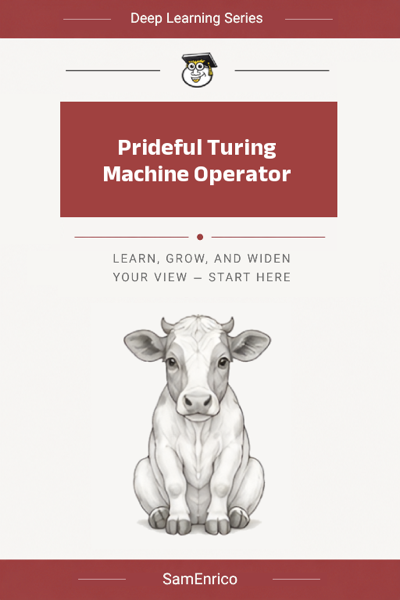
Non-FictionInformativeEducational
Prideful Turing Machine Operator eBook
A Coursebook on Prideful Turing Machine Operator
by Hitt Tandy
A Coursebook on Prideful Turing Machine Operator
Formats
Free sample
Chapter 1: The Quiet Slap of the Switch...--You are about to learn something that no coding bootcamp will teach you, that no Leet Code subscription can train you for, and that no promotion to “Senior Distinguished Architect of the Galactic Empire of Java Script” will ever make unnecessary. The lesson is simple, brutal, and—if you take it seriously—transformative. Here it is: the machine does not know who you are. It does not know your salary, your title, the number of followers you have on a technical social network, or the elegance of the solution you just explained to a rapt audience of junior engineers. The machine knows exactly two things: the symbol currently under the read/write head, and the state it is currently in.
That is the entire universe of its awareness. Everything else—your pride, your reputation, your past successes, your future ambitions—is irrelevant noise. The machine filters all of it out. It has no choice. It was built that way.You have been trained, probably for years, to believe that intelligence is the primary virtue of a programmer.
You have been told that the best engineers are the ones who think fastest, who produce the most elegant abstractions, who can hold the entire system in their heads while writing code that looks like poetry to the initiated. This book exists to tell you that this training is not merely incomplete. It is dangerously wrong. The primary virtue of a Turing machine operator—and make no mistake, every programmer is a Turing machine operator, regardless of how many layers of abstraction you have piled on top—is not intelligence. It is not speed.
It is not cleverness. The primary virtue is humility. Specifically, the humility to check the tape. The humility to verify each step. The humility to admit, before the machine forces you to admit, that you might have made a mistake.This chapter will build the philosophical and historical foundation for everything that follows.
You will meet Alan Turing’s original machine, not as a historical curiosity but as a living critique of your own assumptions. You will learn why the machine’s indifference to your ego is not a limitation to be overcome but a feature to be celebrated. And you will begin the slow, painful process of unlearning the myth of the “10x engineer”—a myth that has damaged more careers than it has ever elevated. By the end of this chapter, you will understand why a proud operator is a dangerous operator, why the tape does not lie, and why the first step toward mastery is the admission that you are not the master at all. You are a servant.
Serve the logic. Not your ego.The Thought Experiment That Broke the World In 1936, a twenty-three-year-old mathematician named Alan Turing published a paper with the unassuming title “On Computable Numbers, with an Application to the Entscheidungsproblem.” Most people who encounter Turing’s name today think of codebreaking, of the Enigma machine, of Benedict Cumberbatch in a movie that took significant liberties with historical accuracy. But the 1936 paper was something quieter and, in its way, more revolutionary. It did not break codes. It broke the very concept of what a machine could be.Before Turing, the word “computer” referred to a person—usually a woman, often working in a laboratory or an observatory—who performed calculations by hand.
Computers were human. They followed algorithms written by mathematicians and physicists, grinding through pages of arithmetic with pencils and erasers and the occasional cup of tea. Turing’s insight was to ask: what if the computer were not a person? What if the process of computation could be stripped down to its absolute essentials and handed over to a mechanism?The mechanism he imagined was almost comically simple. Picture an infinitely long tape, divided into squares.
Each square contains a symbol—perhaps a 0, perhaps a 1, perhaps something else. Above the tape sits a read/write head that can examine the symbol in the current square, erase it, write a new symbol, and then move left or right by one square. The head also contains a small amount of memory: a finite set of states, like moods or modes, that determine what it will do next. And finally, there is a table of rules—a lookup table that tells the head: “If you are in state A and you see symbol X, then write symbol Y, move left, and enter state B.”That is all. There are no loops in the mechanism—loops emerge from states that point back to earlier states.
There are no variables—variables emerge from conventions about which sections of the tape represent which data. There is no recursion, no object orientation, no functional purity, no type system, no garbage collector, no package manager, no continuous integration pipeline, no cloud deployment, no serverless anything. There is a tape, a head, a finite set of states, and a table of rules. Turing proved that this machine—now called a Turing machine—could compute anything that was computable at all. Every algorithm that could be written down precisely, every function that could be calculated by a human following a finite set of instructions, could be performed by this absurdly simple device.This is the machine you operate.
Every computer you have ever touched—your laptop, your phone, the server in a data center running a Kubernetes cluster, the embedded controller in your car’s anti-lock braking system—is, at its core, a Turing machine made of silicon instead of abstract tape. The layers of software that sit on top of that silicon are elaborate illusions. They are conveniences, designed to make you feel like you are doing something more sophisticated than shuffling symbols on a tape. But the tape is still there. The head is still there.
The states are still there. And the machine, in its fundamental nature, still does not care about you.The Indifference of the Infinite Tape Let us linger on that indifference for a moment, because it is the single most important fact about the machine you operate. The Turing machine has no agency. It does not want anything. It does not hope anything.
It cannot be impressed by a clever solution, because it has no concept of cleverness. It cannot be offended by a clumsy solution, because it has no concept of elegance. It simply follows the rules. If you give it the right rules and a tape that starts in the right configuration, it will produce the right answer. If you give it the wrong rules, or if you misconfigure the tape, it will produce nonsense—or it will run forever, spinning through states without ever reaching a conclusion.
The machine does not distinguish between these outcomes. It does not experience frustration when it runs forever, because it does not experience anything.This indifference is not a bug. It is a feature. It is the source of the machine’s power. Because the machine does not care about you, it will execute your instructions with perfect fidelity, every time, without variation, without complaint, without editorial comment.
It will do exactly what you told it to do, not what you wanted it to do, not what you…
This is the end of the free sample. Get the eBook to keep going. Buy now
About this book
Details
- Author
- Hitt Tandy
- Publisher
- SamEnrico
- Language
- English
- Genre
- Non-Fiction, Informative, Educational
- Released
- 2026-05-08
- Pages (approx.)
- 160
- Available as
- eBook, Audiobook

Read better in the ZLOADR app
Your eBooks on your phone or tablet. Sign in with your SamEnrico account and start reading.
More by Hitt Tandy
 I Must Say MemoirHitt Tandy$11.99
 Teen Neurodivergent ConfidenceHitt Tandy$11.99
 Depression Support GroupsHitt Tandy$11.99
 The Bipolar Rapid Cycling GuideHitt Tandy$11.99
 Indian Child Welfare Act JourneyHitt Tandy$11.99
 The Rape of Nanking: Japan's Darkest Hour of ConquestHitt Tandy$11.99
 The Breeder's Guide to Shetland GeeseHitt Tandy$11.99
 Minority Firm Annual Review 2025Hitt Tandy$12.99
 CTO for Marketplace StartupsHitt Tandy$12.99
 10 Ways to Use French-style Green Beans (Recipe Book)Hitt Tandy$11.99
You may also like
 Hong Kong Handover 1997Dunn Johnnie$11.99
 Zumba For Postnatal Recovery CourseNeal Christian$11.99
 Zumba for BeginnersLadner Nikia$11.99
 YouTube Comment Mining GuideHumes Pandora$12.99
 Worry Box MeditationCarlin Rudy$11.99
 Workplace Stress MeditationNguyen Lynn$11.99
 Workplace Stress and Sleep RepairHawley Ivory$11.99
 Workplace Perfectionism CureDelaney Jeffry$11.99
 Workplace Injustice Anger GuideWallen Isabelle$11.99
 Work Addiction and Burnout LinkGreenwood Ester$11.99
 Women in Yoga and WellnessBeattie Galina$11.99
 Women in Stand Up ComedyChun Evangeline$11.99