
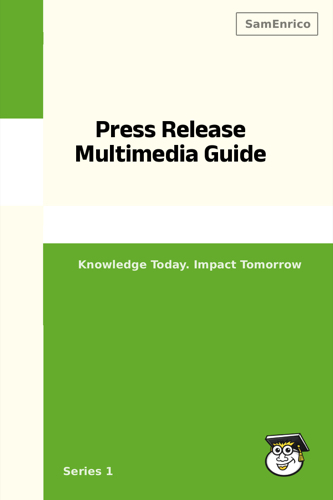
Non-FictionProfessional's Cheat Sheet / Multimedia
Press Release Multimedia Guide eBook
undefined
undefined
Formats
Free sample
Chapter 1: The Invisible Epidemic...--–- On October 23, 1906, a public relations executive named Ivy Lee stood before a crowd of reporters in Atlantic City, New Jersey, and handed them a single sheet of paper. The Pennsylvania Railroad had just suffered a catastrophic train wreck that killed more than fifty people. Lee's statement—factual, concise, and written for immediate publication—is widely considered the first modern press release. It was 400 words of pure text. No images.
No video. No infographics. And it worked. Newspapers ran the statement verbatim. The public read every word.
The railroad's version of events became the official record.That was 1906.For nearly a century, the text-only press release was sufficient. It was not optimal, not innovative, but it was enough. A company could issue a statement, a newswire would distribute it, and journalists would write stories based on those words. The public, accustomed to reading news in newspapers and on desktop computers, consumed text without complaint.Then everything changed.The internet became mobile. Social media rewired attention spans.
Google and Apple News began ranking content not by who paid the most but by what users actually engaged with. And somewhere along the way—sometime around 2015, by most industry estimates—the text-only press release died.Nobody told the PR industry.Today, thousands of organizations continue to issue text-only releases with the same format Ivy Lee used in 1906. They pay newswires hundreds or thousands of dollars. They email journalists with attachments. And then they wonder why nobody covers their story.This chapter is the autopsy.
We will examine exactly why text-only releases fail, what the data says about multimedia performance, and how the rules of press release distribution have fundamentally changed. By the end of this chapter, you will understand why treating multimedia as an "add-on" is not just a missed opportunity—it is a strategic failure that guarantees invisibility.The Birth and Death of a Format To understand why text-only releases no longer work, we must first understand why they did work for so long. The press release was born in an era of information scarcity. In 1906, the average person had access to one or two local newspapers, a radio if they were fortunate, and little else. When a company issued a statement, journalists had few alternative sources to check against.
They published what they received because the alternative was publishing nothing.That scarcity created a dynamic that PR professionals took for granted for generations: journalists needed you more than you needed them.If you were a publicly traded company, you were legally required to issue press releases for material events. If you were a consumer brand, your product announcements filled column inches that newspapers desperately needed. The relationship was asymmetrical in your favor. You could send a wall of text, and a reporter would mine it for quotes because their job depended on producing content.The internet inverted that asymmetry.Today, we live in an era of information abundance. A journalist receives an average of 150 pitches per day, according to the Cision State of the Media Report.
A single news desk has access to thousands of potential stories. The scarcity is no longer in the supply of news—it is in the attention of the people who report it.When a journalist opens their inbox and sees a text-only press release, they do not think, "How fortunate, a statement from a company." They think, "How lazy, a wall of words with nothing to help me visualize this story."The format that worked for ninety years became obsolete not because the people changed, but because the ecology of news changed. Text-only releases survived the fax machine. They survived email. But they could not survive the smartphone, the social media feed, and the algorithmic news aggregator.The Hard Data: What the Numbers Actually Say Let us move from narrative to evidence.
The data on multimedia versus text-only releases is not ambiguous. It is not "suggestive." It is overwhelming.Viewership: Multimedia releases generate up to 9.7 times more views than text-only versions. This statistic comes from an analysis of thousands of releases distributed across major newswires. The mechanism is simple: newswires and news aggregators prioritize rich content in their algorithms. A release with an image appears higher in search results.
A release with video gets featured in "trending" sections. A release with an infographic is more likely to be shared on social media. Each of these effects compounds. The 9.7x figure is not an outlier—it is the median for releases that include at least one original image and one video asset.Journalist behavior: More striking than the viewership numbers is the change in journalist behavior. According to a survey of 2,500 journalists conducted by Muck Rack, 20% of reporters now refuse to pursue a story at all if the press release lacks visuals.
Let that number sink in. One in five journalists will not even consider your story if you do not include an image or video. Not "they will deprioritize it." Not "they will read it but maybe not write about it." They will refuse to pursue it entirely.The remaining 80% still need visuals to engage, but they will at least open the release. However, among that 80%, the presence of visuals increases the likelihood of coverage by a factor of 3.4. In other words, a text-only release has a baseline chance of coverage.
Add a single high-quality image, and that chance more than triples.Consumer behavior: Journalists are not making these choices in a vacuum. They are responding to their own audiences. Data from Pew Research Center shows that 31% of global audiences now prefer to watch news rather than read it. Among adults under 35, that number rises to 54%. The phrase "reading the news" is becoming an anachronism.
People watch news. They scroll news. They listen to news. They do not, for the most part, read news in the traditional sense of sitting with a newspaper or scrolling through a text-heavy website.Search engine performance: Google's algorithm updates over the past decade have consistently favored rich content. Pages with images rank higher than pages without.
Pages with video rank higher than pages with images alone. Pages with structured data (metadata that describes images and video) rank higher than pages without. A text-only release is competing against releases that have all of these advantages. It is like showing up to a drag race in a sedan and wondering why the sports cars are winning.The Attention Economy and the 8-Second Myth You have probably heard the statistic: the average human attention span is now eight seconds, down from twelve seconds in 2000. This statistic is frequently cited and frequently misunderstood.
It comes from a Microsoft study that measured attention spans in digital environments, not a universal decline in human cognitive ability. The eight-second figure is not a biological fact. It is an environmental fact.Here is what has actually changed: the cost of switching attention has dropped to zero.In 1906, if you were reading a newspaper and wanted to switch your attention to something else, you had to physically put down the newspaper, stand up, and find another activity. In 2025, switching attention requires the movement of a thumb. A notification appears.
A link presents itself. A video autoplays. The friction that once protected sustained attention has been engineered away.For press releases…
This is the end of the free sample. Get the eBook to keep going. Buy now
About this book
Details
- Author
- Kent Heriberto
- Publisher
- SamEnrico
- Language
- English
- Genre
- Non-Fiction, Professional's Cheat Sheet / Multimedia
- Released
- 2026-06-10
- Pages (approx.)
- 147
- Available as
- eBook, Audiobook

Read better in the ZLOADR app
Your eBooks on your phone or tablet. Sign in with your SamEnrico account and start reading.
More by Kent Heriberto
 Drug Dependency and Family HealingKent Heriberto$11.99
 The Elevator Pitch PerfectedKent Heriberto$11.99
 Post Game Recovery Self HypnosisKent Heriberto$11.99
 Test Anxiety Meditation PrepKent Heriberto$11.99
 Improv for Actors GuideKent Heriberto$11.99
 The Sandwich Generation SaverKent Heriberto$11.99
 Dream Work MechanismsKent Heriberto$11.99
 Jewish Refugee Shanghai StoryKent Heriberto$11.99
 The Cosmic Visionaries: Black Pioneers of the Quantum FrontierKent Heriberto$11.99
 The Ballad of the Vanishing Lake: The Miraculous Disappearance of Lake PeigneurKent Heriberto$11.99
 The Laundromat: How the Pandora Papers Exposed the World's Dirty MoneyKent Heriberto$11.99
 How to Produce BentoniteKent Heriberto$11.99
You may also like
 Hong Kong Handover 1997Dunn Johnnie$11.99
 Zumba For Postnatal Recovery CourseNeal Christian$11.99
 Zumba for BeginnersLadner Nikia$11.99
 YouTube Comment Mining GuideHumes Pandora$12.99
 Worry Box MeditationCarlin Rudy$11.99
 Workplace Stress MeditationNguyen Lynn$11.99
 Workplace Stress and Sleep RepairHawley Ivory$11.99
 Workplace Perfectionism CureDelaney Jeffry$11.99
 Workplace Injustice Anger GuideWallen Isabelle$11.99
 Work Addiction and Burnout LinkGreenwood Ester$11.99
 Women in Yoga and WellnessBeattie Galina$11.99
 Women in Stand Up ComedyChun Evangeline$11.99