
Non-FictionFinancial CommunicationReporting
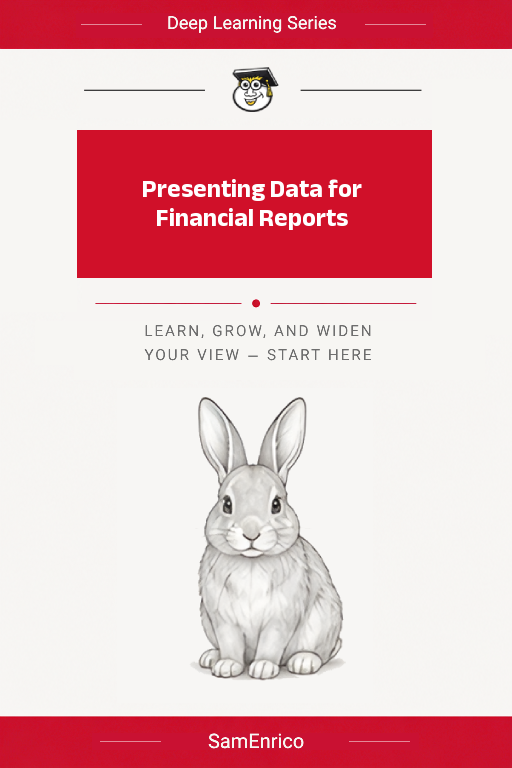
Presenting Data for Financial Reports eBook
Show financial trends, variances, and forecasts wi
Show financial trends, variances, and forecasts with clarity that CFOs respect. Master the waterfall chart for bridges, the sparkline for trends, and the heatmap for variance tracking across business units.
Formats
Free sample
Chapter 1: The 90‑Second Test...--–- The spreadsheet was flawless.Every cell reconciled. Every formula traced back to source data. Every variance calculated to four decimal places. The junior analyst, fresh from a top MBA program and six months into her rotation at a Fortune 500 consumer goods company, had spent forty‑seven hours building a fifty‑three‑page financial report. She had color‑coded each business unit.
She had added footnotes for every anomaly. She had cross‑checked the P&L against the balance sheet and the cash flow statement three times.She walked into the CFO’s office, placed the printed deck on the polished mahogany desk, and stood back with a quiet sense of pride.The CFO, a twenty‑year veteran of private equity and boardrooms, looked up from her monitor. She smiled briefly, flipped through the first five pages in approximately eight seconds, paused at page twenty‑three, sighed, and asked a question that would echo in the analyst’s memory for the rest of her career:“So what?”Not “thank you.” Not “good work.” Not “tell me more about page twenty‑three.” Just: So what?The analyst stammered. She pointed to page four, then page twelve, then the appendix. She explained that the West region was 7 percent below budget and that the Southeast region had a favorable variance of 3 percent and that corporate overhead was exactly on target.
The CFO listened for forty‑five seconds, nodded, and said: “Come back when you can tell me what I need to do differently tomorrow morning.”The analyst walked out of the office with a fifty‑three‑page report in her hands and a sick feeling in her stomach. She had done everything right—by every technical measure. And yet she had failed.This book exists because that scene plays out every single day in thousands of companies, from startups to the Fortune 500. Finance professionals are trained to calculate, reconcile, and audit. They are rarely trained to communicate.
And in the modern corporation, the gap between technical accuracy and executive insight is the single largest barrier to career advancement in finance.The Insight Gap: Where Data Goes to Die Let us name the problem. The Insight Gap is the space between raw financial data and actionable executive understanding. On one side of the gap sits everything you know how to produce: general ledgers, trial balances, variance reports, rolling forecasts, sensitivity analyses, and fifty‑three‑page decks. On the other side of the gap sits what the CFO actually needs: a clear, confident, data‑driven answer to the question “What do I do now?”Most financial reports never cross this gap. They arrive on the executive’s desk as data dumps—accurate, comprehensive, and utterly useless for decision‑making.
The analyst in our opening story produced a perfect data dump. She confused effort with impact and completeness with clarity.Consider the scale of the problem. A typical Fortune 500 CFO reviews between twenty and forty financial reports every week. That is between one thousand and two thousand reports per year. Most of those reports receive less than ninety seconds of active attention.
According to a 2023 survey by the Association for Financial Professionals, 67 percent of finance leaders say that the internal reports they receive are “too detailed to be useful,” and 54 percent say that analysts “bury the key message” somewhere after page ten.The numbers are damning. But they also point to an enormous opportunity.The analyst who learns to cross the Insight Gap does not just produce better reports. She becomes the CFO’s trusted partner. She gets invited to strategy meetings. She is promoted from calculator to advisor.
The technical skills that got her hired are necessary but not sufficient. The communication skills that she develops next will determine how far she rises.Reactive Reporting Versus Proactive Insight To understand the Insight Gap, we must distinguish between two fundamentally different modes of financial communication.Reactive reporting states what happened. It is factual, backward‑looking, and context‑free. A reactive report says: “Revenue was $10 million, which is 5 percent below budget.” This statement is mathematically correct. It is also useless for decision‑making because it provides no answer to the question “Why did this happen?” and no guidance for “What should I do about it?”Reactive reporting dominates corporate finance because it feels safe.
You cannot be criticized for a statement of fact. You cannot be wrong about a historical number. The analyst who delivers reactive reports is protected from blame—and also invisible. She is a human spreadsheet, interchangeable with any other analyst who can produce the same numbers.Proactive insight connects data to action. It explains causality, evaluates alternatives, and recommends a path forward.
A proactive insight says: “Revenue was 5 percent below budget because the West region lost two enterprise clients in Q2. The East region, which uses a different retention playbook, lost zero clients. If we apply the East region’s retention strategy to the West region by mid‑Q3, we forecast a full recovery by Q4.”This statement contains the same historical fact as the reactive version—revenue was 5 percent below budget. But it adds three critical elements: causality (why it happened), comparison (what works elsewhere), and recommendation (what to do next). The CFO reading the proactive insight does not have to ask “So what?” because the analyst has already answered the question before it was asked.Proactive insight is riskier to produce.
You might be wrong about causality. Your recommendation might fail. But the finance professionals who rise to the highest levels are not the ones who are never wrong; they are the ones who are consistently useful. And usefulness requires crossing the Insight Gap.Why Finance Teams Default to Reactive Reporting If proactive insight is so valuable, why do so many analysts produce reactive reports? The answer lies in three powerful forces that shape financial culture.Force One: The Safety of Certainty Numbers feel safe.
A historical variance is a fact. A forecast, by contrast, is an opinion. Many finance professionals have been trained—explicitly or implicitly—that their job is to report facts, not to offer opinions. This training comes from well‑intentioned managers who value accuracy above all else. The result is a culture of defensive reporting: give them the numbers and let them draw their own conclusions.But the CFO does not have time to draw her own conclusions.
She has twenty‑seven other reports to review before her next meeting. If you do not interpret the data for her, she will interpret it herself—often incorrectly, and almost always without giving you credit for the underlying work.Force Two: The Habit of Excel as a Calculation Tool Excel is a miracle of modern software. It is also the enemy of clear communication—when used incorrectly. Most finance professionals learn Excel as a calculation tool. They build models with nineteen tabs, nested IF statements, and arrays of numbers that span from column A to column XFD.
Then they print those spreadsheets and hand them to executives.But a spreadsheet designed for calculation is almost never designed for communication. Gridlines, borders, merged cells, and tiny fonts are all appropriate for the analyst building the model.…
This is the end of the free sample. Get the eBook to keep going. Buy now
About this book
Details
- Author
- Haskins Faviola
- Publisher
- SamEnrico
- Language
- English
- Genre
- Non-Fiction, Financial Communication, Reporting
- Released
- 2026-05-29
- Pages (approx.)
- 144
- Available as
- eBook, Audiobook

Read better in the ZLOADR app
Your eBooks on your phone or tablet. Sign in with your SamEnrico account and start reading.
More by Haskins Faviola
 The Pain Body Scan VariationsHaskins Faviola$11.99
 Creative Problem Solving For Non ArtistsHaskins Faviola$11.99
 Fair Trade Social Entrepreneur StoryHaskins Faviola$11.99
 Emotional Eating for MenHaskins Faviola$11.99
 Pediatric Oncologist StressHaskins Faviola$11.99
 The First Footprints: Uncovering Humanity’s Ancient JourneysHaskins Faviola$11.99
 The Silk Road Scam: How a Fake Emperor Fooled an EmpireHaskins Faviola$11.99
 Understanding Familial ALS With DementiaHaskins Faviola$17.99
 Ghana Mobile Money GuideHaskins Faviola$12.99
 Post Production CoordinatorHaskins Faviola$11.99
 How to Start a Feather Purifying Business (Beginners Guide)Haskins Faviola$11.99
You may also like
 Hong Kong Handover 1997Dunn Johnnie$11.99
 Zumba For Postnatal Recovery CourseNeal Christian$11.99
 Zumba for BeginnersLadner Nikia$11.99
 YouTube Comment Mining GuideHumes Pandora$12.99
 Worry Box MeditationCarlin Rudy$11.99
 Workplace Stress MeditationNguyen Lynn$11.99
 Workplace Stress and Sleep RepairHawley Ivory$11.99
 Workplace Perfectionism CureDelaney Jeffry$11.99
 Workplace Injustice Anger GuideWallen Isabelle$11.99
 Work Addiction and Burnout LinkGreenwood Ester$11.99
 Women in Yoga and WellnessBeattie Galina$11.99
 Women in Stand Up ComedyChun Evangeline$11.99