
Non-FictionSelf-HelpPublic Speaking
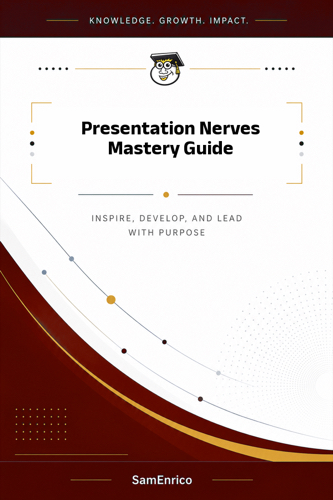
Presentation Nerves Mastery Guide eBook
Learn proven techniques to calm anxiety and channe
by Parra Jammie
Learn proven techniques to calm anxiety and channel nervous energy into confident delivery.
Formats
Free sample
Chapter 1: The Engine Underneath--–- You are not broken. Your body is not betraying you. And that feeling you call "stage fright" is not a weakness to be eliminated—it is 200 horsepower of untapped rocket fuel waiting to be channeled. This single reframe is the foundation of everything that follows in this book. If you absorb nothing else, absorb this: the sweaty palms, the racing heart, the trembling hands, the voice that threatens to crack—these are not signs that you are about to fail.
They are signs that your body is preparing for a gold medal.Let me say that again, because it contradicts almost everything you have been told about speaking anxiety. Your nervous system is not malfunctioning. It is performing exactly as designed. The question is not how to shut it down. The question is how to steer it.The Moment Everything Changed I spent the first twelve years of my professional life believing I was fundamentally unsuited for public speaking.
Every presentation was a siege. Every meeting where I might be called upon was a threat to be avoided or survived. I developed an elaborate system of excuses—"I'm better in writing," "I contribute more in small groups," "I'm just not a natural speaker"—that I mistook for self-awareness but were actually self-protection.The worst moment came without warning. I was twenty-eight years old, three years into a role that required quarterly presentations to the executive team. I had prepared for two weeks.
I knew the material cold. I had practiced in front of my bathroom mirror so many times that my wife threatened to remove the mirror. And then I walked into the conference room, saw the long table with twelve executives already seated, and my mind went completely, terrifyingly blank.Not metaphorically blank. Actually blank. The kind of blank where you cannot remember your own name.
The kind of blank where the words on your slides look like a foreign language. The kind of blank where you open your mouth and nothing comes out except a small, strangled sound that is not quite a word.I stood there for what felt like five minutes. It was probably eight seconds. I said something like "I'll just… give me one moment…" and I took a sip of water that seemed to last an eternity. I eventually stumbled through the presentation.
No one mentioned the pause. No one fired me. No one laughed. The world did not end.But that night, lying in bed, I made a decision that changed everything. I decided that I would never feel that powerless again.
I decided that I would learn everything there was to learn about the science of speaking anxiety. And I decided that I would not rest until I could walk into any room, look at any audience, and feel not terror but readiness.Twelve years later, I have delivered hundreds of presentations to audiences ranging from five people to five thousand. I have spoken at conferences, to boards of directors, to hostile crowds, to exhausted teams, to skeptical investors. And I still feel the physical sensations of anxiety before every single one. My heart still pounds.
My palms still sweat. My hands still tremble slightly when I hold the remote clicker.The difference is that I no longer interpret those sensations as danger signals. I interpret them as my engine warming up. And that single shift—from "I am afraid" to "I am ready"—is available to you starting right now.What Is Actually Happening Inside Your Body?To understand why speaking anxiety feels so overwhelming, you need to understand the oldest, most primitive part of your brain. Deep within your skull, behind your eyes and slightly toward the center, sits a small, almond-shaped cluster of nuclei called the amygdala.
Neuroscientists sometimes call it the "lizard brain" because it evolved hundreds of millions of years ago, long before the cerebral cortex—the part of the brain responsible for language, logic, and planning.The amygdala has one job: survival. It constantly scans your environment for threats. When it detects a potential threat, it initiates a cascade of physiological responses designed to prepare your body for one of three actions: fight, flight, or freeze. This is the fight-or-flight response, and it is one of the most powerful biological systems in the human body.Here is the critical insight: the amygdala cannot distinguish between a physical threat and a social threat. From your amygdala's perspective, being asked to speak in front of forty colleagues is neurologically similar to being chased by a saber-toothed tiger.
The same alarm system activates. The same hormones flood your bloodstream. The same physical sensations appear.Let me walk you through exactly what happens, step by step, from the moment you learn you will be speaking to the moment you open your mouth.Step One: Threat Detection. You learn that you will be presenting at next week's team meeting, or you walk into a room and see the audience, or your name is called unexpectedly. Your amygdala processes this information in milliseconds and decides: threat.Step Two: Hormone Release.
Your amygdala signals your hypothalamus (the brain's command center for the endocrine system), which activates your adrenal glands. Your adrenal glands release three key hormones: epinephrine (adrenaline), norepinephrine (noradrenaline), and cortisol.Step Three: Physical Activation. These hormones trigger a cascade of physical changes designed to optimize your body for survival:Your heart rate increases to pump oxygen-rich blood to your large muscle groups (in case you need to fight or run). This feels like a pounding heart.Your blood vessels constrict in your extremities and dilate in your core. This feels like cold hands and feet.Your sweat glands activate to cool your body for sustained physical exertion.
This feels like sweaty palms and underarms.Your breathing rate increases and becomes shallower to take in more oxygen. This feels like shortness of breath or chest tightness.Your pupils dilate to take in more visual information. This can feel like tunnel vision or light sensitivity.Your digestion slows or stops to redirect energy to muscles. This feels like butterflies or nausea.Your blood glucose rises for immediate energy. This can feel like jitteriness or trembling.Your muscles tense throughout your body.
This feels like stiffness, shaking, or a quivering voice.Every single one of these responses is adaptive for physical survival. If you were actually being chased by a tiger, you would want your heart pounding, your muscles tense, your sweat cooling you, your pupils dilated. You would be grateful for these responses.But you are not being chased by a tiger. You are standing in front of a room full of people who are probably hoping you succeed. And your body is treating the situation as a life-or-death emergency.This is the gap.
This is the mismatch. And this is what we will spend the rest of this book closing.The Critical Reframe: Arousal Is Arousal Here is where everything changes. Physiological arousal is physiologically identical to excitement. Your body cannot tell the difference between "I am terrified" and "I am thrilled." The physical sensations are exactly the same. The only difference is the cognitive label you attach…
This is the end of the free sample. Get the eBook to keep going. Buy now
About this book
Details
- Author
- Parra Jammie
- Publisher
- SamEnrico
- Language
- English
- Genre
- Non-Fiction, Self-Help, Public Speaking
- Released
- 2026-06-10
- Pages (approx.)
- 152
- Available as
- eBook, Audiobook

Read better in the ZLOADR app
Your eBooks on your phone or tablet. Sign in with your SamEnrico account and start reading.
More by Parra Jammie
 Obituary Writing GuideParra Jammie$11.99
 Parent of Teen DriversParra Jammie$11.99
 IBS And Fibromyalgia OverlapParra Jammie$11.99
 Teresas Visions of Christ HumanityParra Jammie$11.99
 Disappointment Journal PromptsParra Jammie$11.99
 Parenting on Night ShiftParra Jammie$11.99
 Post Meal Cigarette ReplacementParra Jammie$11.99
 The Skyward Visionaries: Black Industrialists Who Built EmpiresParra Jammie$11.99
 The Phantom of the Opera House: Vienna's Blackmailing Maestro (1880s)Parra Jammie$11.99
 A Collector's Handbook to the Humber 16-50Parra Jammie$11.99
 Portfolio Career Contract TemplatesParra Jammie$12.99
 Delegation of Calendar ManagementParra Jammie$12.99
You may also like
 Hong Kong Handover 1997Dunn Johnnie$11.99
 Zumba For Postnatal Recovery CourseNeal Christian$11.99
 Zumba for BeginnersLadner Nikia$11.99
 YouTube Comment Mining GuideHumes Pandora$12.99
 Worry Box MeditationCarlin Rudy$11.99
 Workplace Stress MeditationNguyen Lynn$11.99
 Workplace Stress and Sleep RepairHawley Ivory$11.99
 Workplace Perfectionism CureDelaney Jeffry$11.99
 Workplace Injustice Anger GuideWallen Isabelle$11.99
 Work Addiction and Burnout LinkGreenwood Ester$11.99
 Women in Yoga and WellnessBeattie Galina$11.99
 Women in Stand Up ComedyChun Evangeline$11.99