
Non-FictionSelf-HelpCommunication Skills
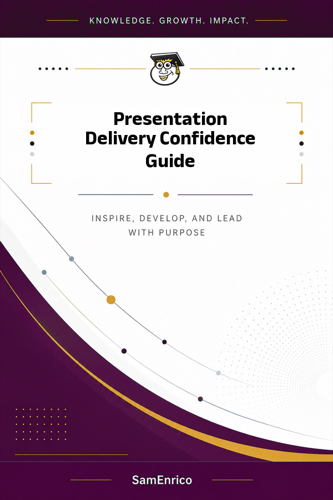
Presentation Delivery Confidence Guide eBook
Teaches proven techniques to reduce anxiety and pr
by Weed Trey
Teaches proven techniques to reduce anxiety and project confidence during any presentation or speech.
Formats
Free sample
Chapter 1: The Adrenaline Lie--–- You are standing in the hallway outside a conference room. Inside, there are fourteen people. You cannot see them yet, but you can hear the muffled sound of chairs scraping, voices murmuring, a laptop being plugged into a projector. Your heart is pounding so hard you can feel it in your throat. Your palms are damp.
Your mouth is dry. A voice in your head—calm, cruel, and utterly convincing—is telling you that you are about to fail.This is not a bad dream. This is Tuesday morning.And here is the first thing this book needs you to understand: that pounding heart, those damp palms, that cruel voice—none of them mean what you think they mean.You have been taught, by years of cultural osmosis and bad advice, that a racing heart before a presentation means you are afraid. That fear is the enemy. That confident speakers feel calm, relaxed, and in control.
That if you feel nervous, you are not ready. That you need to eliminate your nerves before you can possibly succeed.Every single one of those beliefs is wrong.The Adrenaline Paradox Let us run a small experiment. Think back to the last time you felt your heart race before something important. Not a presentation—something else. The moment before a roller coaster drops.
The seconds before a first kiss. The final minute of a close game you were playing. The instant before you opened an envelope that contained life-changing news.What did that heart racing feel like? Exciting? Thrilling?
Alive?Now think back to the last time your heart raced before a presentation. What did that feel like? Terrifying? Debilitating? Shameful?Here is the secret that changes everything: your body produced the exact same physiological response in both situations.
Increased heart rate. Dilated pupils. Shallow breathing. Sweating. Heightened awareness.
A surge of glucose into your bloodstream. Your body preparing for something important.The only difference is the label you attached to it.In one case, you called it excitement. In the other, you called it fear. The chemistry was identical. The interpretation was not.This is what I call the Adrenaline Lie.
It is the false belief that nervous energy is a sign of weakness, unpreparedness, or impending failure. It is a lie that has been sold to you by every movie, every bad manager, and every self-help guru who promised you could "eliminate stage fright forever" if you just visualized the audience in their underwear.You cannot eliminate stage fright. You should not want to. Because stage fright is not the problem. The problem is what you have been taught to believe it means.The Amygdala Hijack: Why Your Brain Thinks a Conference Room Is a Tiger To understand why your body betrays you before a presentation, you need to meet a small, almond-shaped cluster of neurons deep inside your brain called the amygdala.
The amygdala is one of the most ancient parts of your nervous system. It evolved hundreds of millions of years ago, long before humans existed, long before language, long before boardrooms and Power Point slides.The amygdala has one job: keep you alive.It does this by constantly scanning your environment for threats. When it detects a potential threat—a rustle in the bushes, a sudden movement, a loud noise—it initiates what scientists call the "fight-or-flight response." Your sympathetic nervous system activates. Adrenaline floods your bloodstream. Your heart rate increases to pump oxygen to your muscles.
Your pupils dilate to take in more visual information. Your breathing becomes shallow and fast. Non-essential systems—digestion, salivation, rational thinking—shut down to conserve energy for survival.This is a brilliant system. For a savanna-dwelling hominid, it was the difference between life and death. A rustle in the bushes might be a saber-toothed tiger.
Better to run first and ask questions later.Here is the problem: the amygdala cannot tell the difference between a saber-toothed tiger and a conference room.To your amygdala, a room full of people staring at you is a threat. It does not know that these people are your colleagues, that they want you to succeed, that the stakes are a quarterly review and not a predatory attack. All your amygdala knows is that it has detected a situation involving high arousal, focused attention, and potential judgment. That is enough. Alarm bells ring.
Adrenaline flows. Your body prepares for battle.This is the Amygdala Hijack. It is not a flaw. It is not a weakness. It is an evolutionary feature that has simply outlived its context.
Your brain is doing exactly what it evolved to do. It is trying to protect you from a tiger that does not exist.The moment you stop fighting your amygdala and start understanding it, everything changes.Why "Calm Down" Is the Worst Advice in the World Think about every piece of advice you have ever received about presentation nerves. I will wager that most of it boiled down to some version of "just calm down."Take deep breaths. Relax. Imagine the audience in their underwear.
Drink some water. Count to ten.This advice fails for one simple reason: it asks you to do something your nervous system is physiologically incapable of doing on command. You cannot "calm down" any more than you can "speed up" your heartbeat by thinking about it. The autonomic nervous system—the part that controls heart rate, breathing, and adrenaline release—operates largely outside your conscious control.Telling a nervous speaker to calm down is like telling a drowning person to stop being so wet. It is not helpful.
It is not possible. And it makes the person feel worse because now, in addition to being nervous, they feel like a failure for not being able to stop being nervous.The paradox is this: the more you try to suppress your nerves, the more powerful they become. This is what psychologists call "ironic process theory." When you try not to think about a white bear, you cannot think about anything else. When you try not to be nervous, your brain interprets the effort as evidence that there must be something genuinely dangerous happening. Why else would you be trying so hard to calm down?The solution is not to eliminate nerves.
The solution is to change what you think they mean.Reframing: The Single Most Powerful Tool You Have There is a concept in cognitive psychology called "reframing." It is the practice of changing the meaning you attach to an event without changing the event itself. Reframing does not deny reality. It does not pretend that you are not nervous. It simply asks: what else could this feeling be?Here is a practical exercise. The next time you feel your heart racing before a presentation, pause.
Do not try to slow it down. Do not tell yourself to calm down. Simply notice it. Then ask yourself three questions:First: Is my body preparing for danger, or is my body preparing for importance?Second: What would this feeling be called if I were about to do something exciting rather than something terrifying?Third: Can I borrow that label?Let me give you an example. A few…
This is the end of the free sample. Get the eBook to keep going. Buy now
About this book
Details
- Author
- Weed Trey
- Publisher
- SamEnrico
- Language
- English
- Genre
- Non-Fiction, Self-Help, Communication Skills
- Released
- 2026-06-10
- Pages (approx.)
- 139
- Available as
- eBook, Audiobook

Read better in the ZLOADR app
Your eBooks on your phone or tablet. Sign in with your SamEnrico account and start reading.
More by Weed Trey
 Drug Addiction Stigma GuideWeed Trey$11.99
 Expedition Leader In Chilean FjordsWeed Trey$11.99
 Sleep For HypertrophyWeed Trey$11.99
 The Bloodied Stars of Austerlitz: Napoleon's Marshals vs. the Third CoalitionWeed Trey$11.99
 How to Start a Mincemeat Business (Beginners Guide)Weed Trey$11.99
 How to Produce Canned and Dry MilkWeed Trey$11.99
 Price Bundling During High InflationWeed Trey$12.99
 Kayak BuilderWeed Trey$11.99
You may also like
 Hong Kong Handover 1997Dunn Johnnie$11.99
 Zumba For Postnatal Recovery CourseNeal Christian$11.99
 Zumba for BeginnersLadner Nikia$11.99
 YouTube Comment Mining GuideHumes Pandora$12.99
 Worry Box MeditationCarlin Rudy$11.99
 Workplace Stress MeditationNguyen Lynn$11.99
 Workplace Stress and Sleep RepairHawley Ivory$11.99
 Workplace Perfectionism CureDelaney Jeffry$11.99
 Workplace Injustice Anger GuideWallen Isabelle$11.99
 Work Addiction and Burnout LinkGreenwood Ester$11.99
 Women in Yoga and WellnessBeattie Galina$11.99
 Women in Stand Up ComedyChun Evangeline$11.99