
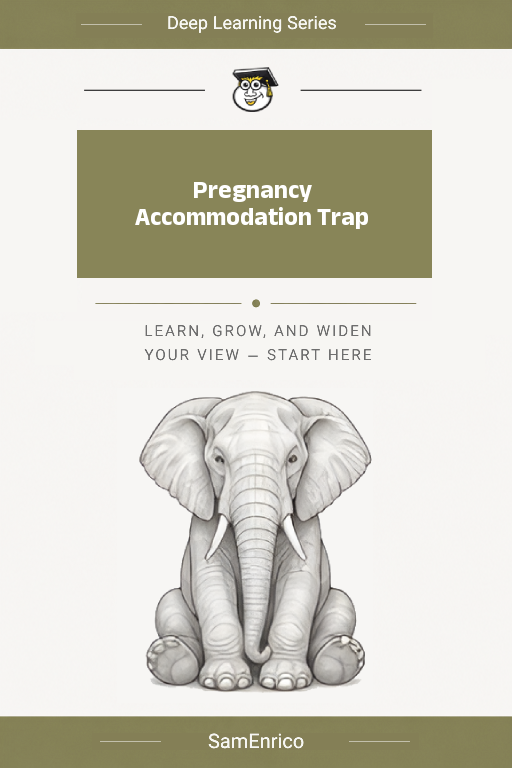
Non-FictionBusiness BriefPregnancy Rights
Pregnancy Accommodation Trap eBook
Provide light duty for pregnant workers if offered
by Lane Chelsea
Provide light duty for pregnant workers if offered to other disabled employees. PWFA requires reasonable accommodations for pregnancy childbirth and related conditions.
Formats
Free sample
Chapter 1: The Parking Lot...--Krystal Young sat in her UPS delivery truck in the parking lot of a suburban Atlanta shopping center, gripping the steering wheel with both hands, trying to stop the shaking. She was five months pregnant. Her doctor had given her a note that morning restricting her to lifting no more than twenty pounds. She had been a driver for UPS for nearly four years, and she had never asked for anything. Not once.She walked into the supervisor's office and handed over the note.
The supervisor glanced at it, then at her belly, then back at the note. He didn't say "congratulations" or "let's figure this out." He said, "We don't have light duty for pregnancy. You can take unpaid leave."Krystal asked about the other drivers. She knew, because everyone knew, that a driver who had lost his commercial driver's license due to a DUI was working light duty in the warehouse. A driver who had broken his thumb playing softball was on light duty.
A driver who had injured his back off the job was on light duty. She asked why she couldn't have the same.The supervisor's answer would eventually cost UPS millions of dollars, would travel all the way to the United States Supreme Court, and would force Congress to rewrite federal law. But in that moment, his answer was simple: "Pregnancy isn't an injury."Krystal walked back to her truck, sat in the driver's seat, and cried. Then she called a lawyer.The Old Rule: Pregnancy as Invisible Before we can understand the Pregnancy Accommodation Trap, we have to understand the world that Krystal Young walked into. For nearly forty years, from the passage of the Pregnancy Discrimination Act in 1978 until the PWFA took effect in 2023, pregnancy occupied a bizarre legal limbo.
It was protected against discrimination—you couldn't fire a woman for being pregnant—but it was not protected for accommodations.This distinction matters more than most people realize. Discrimination law says you cannot treat someone worse because of a characteristic. Accommodation law says you must change the workplace to help someone succeed despite a limitation. The first is passive: don't be cruel. The second is active: redesign the job.Under the Americans with Disabilities Act, employers must provide reasonable accommodations to qualified employees with disabilities.
But pregnancy, the Supreme Court had ruled repeatedly, is not a disability. In a 1976 case, General Electric Co. v. Gilbert, the Court held that excluding pregnancy from disability insurance programs did not violate civil rights law because pregnancy was "not a disease or accident" but a "voluntary" condition. Congress overrode that specific ruling with the Pregnancy Discrimination Act of 1978, but the underlying logic persisted: pregnancy was different.
Pregnancy was normal. Pregnancy was not a disability.That sounds compassionate on its face. Pregnancy is not a disease. Pregnancy is a natural, healthy condition. But the legal consequence was devastating.
If pregnancy is not a disability, then employers have no duty to accommodate it. A pregnant worker who cannot lift heavy boxes, who needs to sit down, who needs extra bathroom breaks, who is suffering from severe morning sickness—none of these limitations trigger any accommodation duty under federal law.The only protection was the Pregnancy Discrimination Act's prohibition on "treating pregnancy worse than other temporary disabilities." But that protection was weak. It didn't require employers to offer light duty. It only required that if an employer offered light duty to some employees, they couldn't categorically exclude pregnant workers. And that is where Krystal Young's case began.The UPS Policy: Light Duty for Everyone Except Pregnant Women UPS had a detailed, formal light duty policy.
The policy applied to employees who had lost their commercial driver's licenses due to DUIs. It applied to employees who were injured off the job. It applied to employees who had on-the-job injuries that qualified for workers' compensation. It applied to employees who had ADA disabilities. The policy did not apply to pregnant workers.This was not an accident.
UPS had explicitly excluded pregnancy from its light duty policy because, the company argued, pregnancy was not an injury, not a disability, and not a workplace accident. The company believed it was following the law. And in a narrow, technical sense, before the Supreme Court ruled, they were probably right.The Pregnancy Discrimination Act said you couldn't treat pregnancy worse than other temporary disabilities. But UPS argued that pregnancy was not a disability at all, so the comparison didn't apply. They offered light duty to workers with DUIs, broken feet, and bad backs because those workers had something—an injury, a disability, a license restriction—that pregnant workers did not have.
Pregnancy, in UPS's view, was simply not in the same category.Krystal Young's lawyers argued the opposite. They said that UPS had created a category of "workers who cannot perform their normal job duties for a temporary period." That category included DUIs, off-the-job injuries, and ADA disabilities. It should also include pregnancy. If UPS gave light duty to anyone in that category, they had to give it to everyone in that category. Excluding pregnancy was discrimination.The case wound its way through the federal courts for years.
In 2014, the Sixth Circuit Court of Appeals ruled against Krystal, holding that UPS's policy was legal because pregnancy was not a disability. She appealed to the Supreme Court.The Supreme Court Speaks: Young v. UPS (2015)On March 25, 2015, the Supreme Court issued its decision in Young v. United Parcel Service, Inc., 575 U.S. 206.
The decision was 6-3, with Justice Stephen Breyer writing the majority opinion. The Court did not give Krystal everything she wanted, but it gave her enough to change the law.The Court held that the Pregnancy Discrimination Act required employers to treat pregnant workers at least as well as they treat other workers who are similar in their ability or inability to work. If an employer offers light duty to workers with off-the-job injuries, or workers with ADA disabilities, or workers who have lost their licenses due to DUIs, then the employer must offer light duty to pregnant workers who are similarly unable to perform their normal job functions.The Court rejected UPS's argument that pregnancy was categorically different from disabilities or injuries. Justice Breyer wrote: "The second clause of the Pregnancy Discrimination Act says that employers must treat 'women affected by pregnancy' the same as 'other persons not so affected but similar in their ability or inability to work.' That language suggests that Congress intended to require equal treatment for pregnant workers who are similar in their ability to work to other workers."The Court did not say that every pregnant worker is entitled to light duty. It said that if an employer offers light duty to any other class of workers who are temporarily unable to perform their jobs, then pregnant workers must be included in that class.The case was sent back to the lower courts to apply this new standard.
UPS eventually settled with Krystal Young for an undisclosed amount. But the legal earthquake had already begun.The Problem with Young: A Case-by-Case Nightmare The Young decision was a victory for pregnant workers, but it was also a…
This is the end of the free sample. Get the eBook to keep going. Buy now
About this book
Details
- Author
- Lane Chelsea
- Publisher
- SamEnrico
- Language
- English
- Genre
- Non-Fiction, Business Brief, Pregnancy Rights
- Released
- 2026-06-01
- Pages (approx.)
- 156
- Available as
- eBook, Audiobook

Read better in the ZLOADR app
Your eBooks on your phone or tablet. Sign in with your SamEnrico account and start reading.
More by Lane Chelsea
 Deep Sea Diver StressLane Chelsea$11.99
 Comparison Culture for CaregiversLane Chelsea$11.99
 Transcendental Meditation ScienceLane Chelsea$11.99
 Orchid Greenhouse GuideLane Chelsea$11.99
 Breath for ParentsLane Chelsea$11.99
 Carnegie Libraries TodayLane Chelsea$11.99
 Grip Strength Sarcopenia TestLane Chelsea$11.99
 Salon Worker Toxin PreventionLane Chelsea$11.99
 Hip Osteoarthritis SolutionsLane Chelsea$11.99
 The Helvetian Visionaries: Switzerland's Path to PrecisionLane Chelsea$11.99
 The Last Stand: The Miracle of the 1999 U.S. Women's World CupLane Chelsea$11.99
 The Riddle of the Sphinx: Justice in Stone and ShadowLane Chelsea$11.99
You may also like
 Hong Kong Handover 1997Dunn Johnnie$11.99
 Zumba For Postnatal Recovery CourseNeal Christian$11.99
 Zumba for BeginnersLadner Nikia$11.99
 YouTube Comment Mining GuideHumes Pandora$12.99
 Worry Box MeditationCarlin Rudy$11.99
 Workplace Stress MeditationNguyen Lynn$11.99
 Workplace Stress and Sleep RepairHawley Ivory$11.99
 Workplace Perfectionism CureDelaney Jeffry$11.99
 Workplace Injustice Anger GuideWallen Isabelle$11.99
 Work Addiction and Burnout LinkGreenwood Ester$11.99
 Women in Yoga and WellnessBeattie Galina$11.99
 Women in Stand Up ComedyChun Evangeline$11.99