
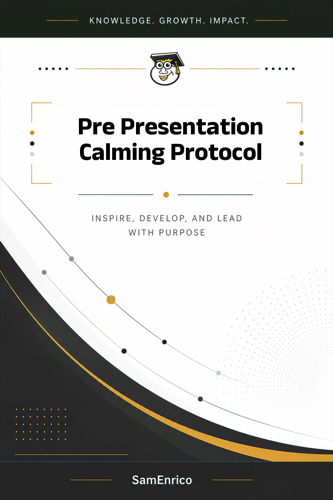
Pre Presentation Calming Protocol eBook
Follow a 15-minute nervous system regulation seque
Follow a 15-minute nervous system regulation sequence before you take the stage.
Formats
Free sample
Chapter 1: The Lion on the Savanna--–- Imagine for a moment that you are standing in the middle of an open savanna. The sun is high. The grass is dry. And approximately fifty yards away, a lion is staring directly at you. Its muscles are coiled.
Its eyes are locked onto yours. There is no fence. No weapon. No exit. What happens inside your body?Your heart pounds against your ribs like a fist on a door.
Your breathing becomes shallow and fast. Your palms sweat. Your stomach clenches. Your field of vision narrows until all you can see is the lion—those eyes, those teeth, the impossible weight of its silence. Your legs might feel either glued to the ground or desperately ready to run.
Your hands might shake. Your throat might tighten. And every single cell in your body will be screaming one message: Threat. Threat. Threat.Now imagine that you are standing backstage at a conference.
In thirty seconds, you will walk onto a stage and face two hundred people. There is no lion. There is no physical danger. The audience is sitting in chairs, holding coffee cups, checking their phones. They did not come to hurt you.
In fact, most of them hope you succeed because a good presentation makes their hour more valuable. And yet, as you stand there, your heart pounds. Your breathing becomes shallow. Your palms sweat. Your stomach clenches.
Your vision narrows. Your legs feel unsteady. Your hands shake. Your throat tightens.Why?Because your nervous system cannot tell the difference between a lion and a lectern.The Most Important Sentence You Will Read in This Book Here it is. Read it twice.
Remember it when your mind goes blank before a presentation:Your body is not trying to sabotage you. It is trying to save you from a threat that does not exist.Every sensation you feel before a presentation—the racing heart, the shaky voice, the sweaty palms, the churning stomach, the urge to run or freeze—is not a sign of weakness, failure, or incompetence. It is a sign that your nervous system is working exactly as it was designed to work. It is doing its job. The problem is not your body's response.
The problem is that your body has misidentified the situation. It has categorized a room full of seated, coffee-drinking, phone-checking human beings as a survival threat equivalent to a lion on the savanna.This chapter will teach you why that misidentification happens, how your nervous system actually works, and why understanding these mechanisms is the first and most essential step toward regulating your pre-presentation anxiety. No techniques yet. No breathing exercises. No power poses.
First, you need to understand the machinery you are about to recalibrate.The Three-Part Nervous System You Were Never Taught About Most people believe the nervous system has two states: stressed and calm. Fight-or-flight versus rest-and-digest. This is not wrong, but it is dangerously incomplete. It leaves out an entire category of response that affects millions of people who struggle with public speaking: the shutdown response.The most accurate and useful model for understanding pre-presentation anxiety comes from polyvagal theory, developed by Dr. Stephen Porges in the 1990s and popularized for everyday readers by Deb Dana in Anchored.
This theory describes three distinct neural circuits, each associated with a different response to threat. Think of them as three gears your nervous system can shift into, depending on how safe or threatened you feel.Gear One: Ventral Vagal (Safe and Connected)This is your home base. This is where you want to be before a presentation, though you may never have experienced it in that context. When your ventral vagal system is active, you feel calm, present, curious, and socially engaged. Your voice is warm and varied in pitch.
Your facial expressions are natural and responsive. Your heart rate is steady but not sluggish. You can make eye contact without effort. You can think clearly. You can access your memory and your vocabulary.
You can laugh. You can breathe easily. In this state, your nervous system is telling your brain: There is no threat. You are among your people. You can connect, share, and explore.Most people have experienced ventral vagal activation in low-stakes situations: talking with a close friend over coffee, playing with a pet, walking in nature, or listening to music that moves them.
The goal of this book is to help you access this same state before a presentation—not by eliminating your nerves, but by giving your nervous system enough evidence of safety to shift gears.Gear Two: Sympathetic (Fight or Flight)This is the gear most people associate with public speaking anxiety. When your sympathetic nervous system activates, your body prepares for physical combat or rapid escape. Your adrenal glands release epinephrine and norepinephrine. Your heart rate increases. Your blood pressure rises.
Your breathing becomes fast and shallow to oxygenate your muscles. Your pupils dilate. Your digestion slows or stops. Your palms sweat to improve grip. Your blood shifts away from your digestive tract and toward your large muscle groups.
Your hearing becomes more acute. Your peripheral vision narrows into tunnel vision, focusing all of your attention on the perceived threat.This is the lion response. And it is magnificent—if you are actually facing a lion. The problem is that your body cannot tell the difference between a predator and a presentation. So it activates the same system.
You feel the racing heart, the shallow breath, the tunnel vision, the urge to flee. And because you are in a conference room and not on the savanna, you cannot fight and you cannot run. So the energy has nowhere to go. It circulates inside you as pure, undischarged activation. That is what we call "anxiety."Gear Three: Dorsal Vagal (Shutdown or Freeze)This is the gear that most self-help books ignore, but it is essential for understanding why some people experience public speaking not as racing panic but as total collapse.
When the dorsal vagal system activates, the body does the opposite of fight-or-flight. It slows everything down. Heart rate drops. Blood pressure drops. Breathing becomes shallow but slow.
You may feel numb, detached, heavy, or unreal. Your mind may go blank. Your voice may become flat or disappear entirely. You may feel like you are watching yourself from outside your body. You may feel an overwhelming urge to sit down, hide, or simply disappear.This is the freeze response.
It is the nervous system's last resort. When fight-or-flight is not possible and escape is impossible, the dorsal vagal system activates as a form of conservation. In animals, this looks like playing dead. In humans, it looks like dissociation, brain fog, and physical collapse. Many people with severe public speaking anxiety describe exactly this experience: walking onto stage, opening their mouth, and finding nothing there.
That is not a character flaw. That is dorsal vagal activation.The Social Threat That Feels Like a Broken Bone Why would your nervous system treat an audience like a lion? The answer lies in human evolution. For the vast majority of human history—hundreds of thousands of years—social rejection was a survival threat.…
This is the end of the free sample. Get the eBook to keep going. Buy now
About this book
Details
- Author
- Williamson Doug
- Publisher
- SamEnrico
- Language
- English
- Genre
- Non-Fiction, Mental Wealth, Anxiety
- Released
- 2026-06-05
- Pages (approx.)
- 142
- Available as
- eBook, Audiobook

Read better in the ZLOADR app
Your eBooks on your phone or tablet. Sign in with your SamEnrico account and start reading.
More by Williamson Doug
 The Orphaned Adult WorkbookWilliamson Doug$11.99
 The Financial Handover CourseWilliamson Doug$11.99
 Hawking Simpsons CameosWilliamson Doug$11.99
 Remote Freelancer CommunicationWilliamson Doug$11.99
 Cannabis Craving ManagementWilliamson Doug$11.99
 Fiverr Video Introduction GuideWilliamson Doug$11.99
 The Delivery Driver OverdoseWilliamson Doug$11.99
 Posture Growth Hormone ConnectionWilliamson Doug$11.99
 The Gates of Susa: Darius’ Shadow Over the LevantWilliamson Doug$11.99
 Rum & Rebellion: The Secret War of the Caribbean's Rum RunnersWilliamson Doug$11.99
 Love in the Depths: The Secret Romance Behind the First Underwater RobotsWilliamson Doug$11.99
 Eating OutWilliamson Doug$11.99