
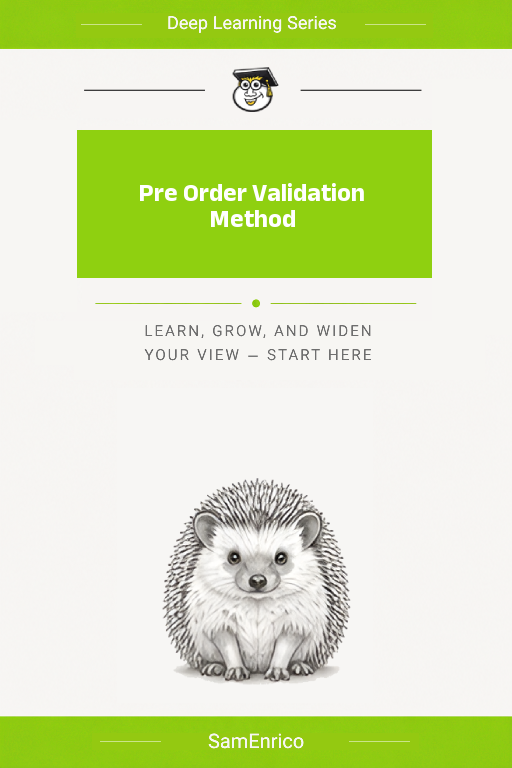
Pre Order Validation Method eBook
Collect pre orders or deposits for your product be
Collect pre orders or deposits for your product before building to prove real paying customer demand at zero cost.
Formats
Free sample
Chapter 1: The Graveyard of Good Intentions--–- Every year, over 500,000 new businesses launch worldwide. Within five years, 90% of them will be dead. Not because they ran out of money. Not because the founder wasn’t passionate. Not because the team didn’t work hard.
They will die because they built something nobody wanted to buy. This chapter is not about motivation. It is not about mindset hacks or manifesting success. It is about one brutal, liberating truth: you can know, with certainty, whether customers will pay you before you spend a single dollar on inventory, manufacturing, or code. And the most successful entrepreneurs in the world already do this.
They just don’t talk about it.The Silent Epidemic of Built-But-Never-Bought Let’s walk through a scenario you will recognize. A founder has an idea. It feels electric. They stay up late sketching features, sourcing materials, or hiring developers. They pour three months and fifteen thousand dollars into a minimum viable product.
They launch with a celebration. And then… silence. A few friends buy out of pity. One or two strangers stumble in and bounce. The founder runs Facebook ads.
Nothing. They lower the price. Still nothing. Eventually, they shut down, convinced the market was wrong, or the timing was bad, or the algorithm changed.But here is the question the post-mortems never ask: What if the market was right to ignore you?Most entrepreneurs build first and ask for payment later. This is the build-then-sell model, and it is the single largest driver of startup failure.
According to research cited in Eric Ries’s The Lean Startup, over 75% of product features built in traditional software companies are rarely or never used. For physical products, the failure rate is even worse. A 2019 Harvard Business School study found that 95% of new consumer packaged goods fail within their first year. Not because they were poorly made. Because nobody wanted them badly enough to pay.The tragedy is that almost all of this failure is preventable.
You do not need a factory. You do not need a development team. You do not need a warehouse. You need one thing: a customer willing to hand over their credit card before you build.Meet the Customer-Funded Business John Mullins, professor at London Business School and author of The Customer-Funded Business, studied hundreds of startups that succeeded without taking outside investment. He found that the most resilient businesses shared one characteristic: they convinced customers to pay before the product was fully built.
Mullins identified five distinct models of customer-funded businesses. Each one flips the traditional risk equation.The first is the Matchmaker Model. Companies like Airbnb and Etsy take a cut of transactions between buyers and sellers. They don’t own the inventory. They don’t manufacture anything.
They simply connect two parties and collect a fee. The validation happens in real time: if no one transacts, the business dies fast, with very little capital lost.The second is the Pay-in-Advance Model. This is the core of pre-order validation. Customers pay partially or fully before delivery. Think of Tesla collecting deposits for the Cybertruck years before production.
Think of Kickstarter campaigns that only charge cards if the funding goal is met. The customer becomes the investor.The third is the Subscription Model. By charging monthly or annually upfront, businesses like Netflix or The New York Times validate demand continuously. A customer who pays for twelve months is making a much stronger commitment than one who clicks a “like” button.The fourth is the Scarcity Model. Limited runs, flash sales, and one-time drops create artificial urgency.
Fashion brand Supreme built a billion-dollar business by making products in quantities so small they sell out in seconds. Every drop is a validation test: if it sells out, they make more next time. If it doesn’t, they kill the design.The fifth is the Service-to-Product Model. This is the most underrated path. You start by selling your time as a consultant or freelancer.
You serve clients manually. Over time, you notice patterns. You productize the most common requests. By the time you build the software or the course or the physical good, you already have a waiting list of paying customers. This is how Basecamp started.
This is how countless B2B Saa S companies began.Every single one of these models has a common thread. The entrepreneur collects evidence of real demand—in the form of money—before scaling production. They do not guess. They do not hope. They test.The 20-10-7 Rule: Your First Validation Milestone You do not need a sophisticated landing page or a Kickstarter campaign to start.
You need conversations. The 20-10-7 Rule is a simple, repeatable framework that will become the heartbeat of your validation process.Here is how it works. Identify twenty people who fit your target customer profile. Not friends. Not family.
Not people who will be nice to you. Strangers who have the problem you want to solve. You find them on Linked In, Reddit, industry forums, or even in coffee shop lines. You ask for fifteen minutes of their time. No pitch.
No product. Just curiosity.Your goal in these conversations is not to sell. It is to listen. You ask open-ended questions. “What is the hardest part of your job right now?” “How are you currently solving this problem?” “What have you tried that didn’t work?” “If a solution existed, what would you be willing to pay?” You take notes.
You do not argue. You do not defend your idea. You listen.After you have spoken to twenty prospects, you will have a much sharper understanding of the problem. You will also have identified the ten people who seemed most engaged. These are the ones who leaned in, who described their frustration in vivid detail, who asked when your solution would be ready.Now you go back to those ten.
You say, “I am considering building a solution. If I could deliver exactly what you described, would you commit to buying it at [price] before I build it?” You are not asking for a promise. You are asking for a credit card or a signed letter of intent.If seven of those ten say yes—and ideally, if five of them actually pay a deposit—you have passed the first gate. You have evidence that is stronger than any survey, any focus group, any “would you buy this?” hypothetical. You have real, if preliminary, validation.Do not skip this step.
Do not convince yourself that your idea is too complex or too innovative for this approach. The 20-10-7 Rule works for physical products, digital courses, B2B software, and even six-figure consulting engagements. If a customer will not commit before you build, they almost certainly will not buy after you build either.Why “Would You Buy This?” Is a Useless Question Most entrepreneurs start validation by asking the worst possible question. “Would you buy this?” is a question that invites politeness. People want to be nice.
They do not want to hurt your feelings. So they say, “Yeah, that sounds great,” and then they never open their wallet.This phenomenon is so well documented that…
This is the end of the free sample. Get the eBook to keep going. Buy now
About this book
Details
- Author
- Nesmith Jasper
- Publisher
- SamEnrico
- Language
- English
- Genre
- Non-Fiction, Startup Guide, Pre Order, Customer Commitment
- Released
- 2026-06-01
- Pages (approx.)
- 112
- Available as
- eBook, Audiobook

Read better in the ZLOADR app
Your eBooks on your phone or tablet. Sign in with your SamEnrico account and start reading.
More by Nesmith Jasper
 Singapore Green Mark IncentiveNesmith Jasper$11.99
 Work Addiction Root Cause GuideNesmith Jasper$11.99
 The White Noise Machine GuideNesmith Jasper$11.99
 Walking Weight Loss ProtocolNesmith Jasper$11.99
 Innocence Project Montana CasesNesmith Jasper$11.99
 The Unbreakable Streak: The 1975 Cincinnati Reds' 41-9 StartNesmith Jasper$11.99
 Island of Hope: The Maldives Mental Health RevolutionNesmith Jasper$11.99
 Understanding Chromosome 22, Trisomy Q11 Q13Nesmith Jasper$17.99
 Industrial Washer TechnicianNesmith Jasper$11.99Industrial Washer TechnicianNesmith Jasper$11.99
 How to Become a Cable PullerNesmith Jasper$11.99
 Business Phone Number SetupNesmith Jasper$12.99