
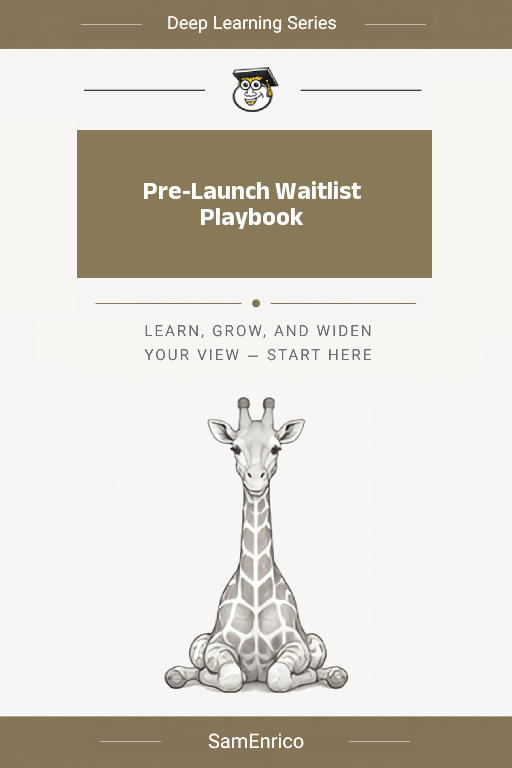
Non-FictionStartup GuideWaitlist StrategyAction Guide
Pre-Launch Waitlist Playbook eBook
Build a landing page, capture emails, and grow you
Build a landing page, capture emails, and grow your first 1,000 signups before coding. Covers referral mechanics, social proof, and launch day notification sequences.
Formats
Free sample
Chapter 1: The Empty Room Problem--–- Four years ago, I sat in a coffee shop in Austin, Texas, staring at my laptop screen. I had just spent six months of nights and weekends building a Saa S product called "Flow State" — a productivity tool for freelance designers. The code was beautiful. The UI was polished. The onboarding flow was buttery smooth.
I had even filed for an LLC and bought a custom domain. There was just one problem: on launch day, exactly twelve people signed up. Eleven of them were friends who felt obligated. The twelfth was my mother. I was proud of the code.
I was embarrassed by the room. An empty room, to be precise — a digital ghost town where I had expected a bustling city square.That experience taught me a lesson that I have since watched hundreds of founders learn the hard way: the most common cause of startup failure is not a bad product — it is building a product nobody wants and launching it to an empty room. This book exists because I do not want you to make the same mistake. In fact, I want you to do the exact opposite of what I did. I want you to build your audience before you build your product.
I want you to have a thousand people waiting — not because they are your friends or your family, but because they are genuinely excited about the problem you are solving. And I want you to do all of this before you write a single line of production code.This chapter will reframe everything you think you know about launching a product. You will learn why traditional product development is a form of gambling, not entrepreneurship. You will discover the difference between a loud launch and a slow-burning fire of anticipation. You will meet founders who built millions of dollars in value from nothing but a waitlist.
And most importantly, you will learn the two most important definitions in this entire book — definitions that will save you from the confusion that plagues most pre-launch strategies. By the end of this chapter, you will understand why your first line of code should be written for your waitlist, not before it.The Silent Launch Trap: A Cautionary Tale Let me tell you about a founder named Sarah. Sarah was a brilliant engineer who had spent eight years at Google. She had an idea for an analytics tool specifically for e-commerce stores that sold physical products. Her tool would track inventory turnover, predict stockouts, and automatically reorder from suppliers.
It was a complex, ambitious product. Sarah quit her job, raised $150,000 from friends and family, and spent the next eight months coding. She hired two contractors. She filed patents. She built a mobile app, a desktop dashboard, and a Chrome extension.Then came launch day.
Sarah sent a "Product Hunt" post, tweeted from her personal account (which had 400 followers), and emailed her list of forty-seven friends and former colleagues. The result? Eighty-three signups in the first week. Seventy-two of them never logged in after day one. The remaining eleven used the product for an average of four minutes.
Six months later, Sarah had burned through her runway, had seventeen paying customers, and was back at Google applying for her old job.Sarah's story is not rare. It is the norm. According to data from CB Insights, forty-two percent of startups fail because there is no market need for their product. That is twice the rate of failure due to running out of cash. Let me say that again: building something nobody wants kills more startups than running out of money.
The "Silent Launch Trap" — launching to an empty room after months of development — is the single most predictable, preventable cause of startup failure.Why does this happen? Because founders fall in love with the solution before validating the problem. They fall in love with code, with architecture, with the feeling of building something from nothing. But code is not value. Value is a human being saying "yes, this solves my problem." And you can get that "yes" long before you write your first line of code.
In fact, you should.Anticipation Marketing vs. Traditional Launches The default approach to launching a product is what I call the "loud launch." You build in secret, you polish everything to perfection, and then on a specific Tuesday, you shout from every rooftop: "We are live!" You send press releases. You post on social media. You hope for a spike of traffic that converts into customers. This approach works for about one percent of products — usually those with massive existing brands, celebrity founders, or category-defining innovations.
For everyone else, the loud launch ends in a whimper.Anticipation marketing is the opposite. Instead of a loud, short burst, you build a slow-burning fire of curiosity over weeks or months. You let people watch you build. You invite them behind the curtain. You ask for their opinion.
You share your failures and your small wins. And most importantly, you capture their email address long before you have anything to sell. By the time you actually launch, you are not shouting into an empty room. You are opening the doors to a crowd that has been waiting in line.Let me show you two case studies that prove this works.Case Study One: Robinhood In 2014, two Stanford graduates named Vlad Tenev and Baiju Bhatt had an idea for a stock trading app with zero commissions. They had no product, no regulatory approval, and no brand.
What they had was a clever waitlist mechanic. They built a single landing page that said: "Get early access to Robinhood. Join the waitlist. Share to skip the line." That was it. No demo.
No screenshots. No pricing. Just a form field and a referral link.Within weeks, Robinhood had over one million people on their waitlist. How? Position gamification.
Every user could see their number on the list — "#452,312" — and knew that every friend they referred would move them up. People competed to get lower numbers. They shared the link on Twitter, Facebook, and Reddit without being asked. By the time Robinhood actually launched their app, they had more than a million people ready to download it on day one. The company is now worth over ten billion dollars.
And they did it with zero code and one landing page.Case Study Two: Superhuman Superhuman is an email client that costs thirty dollars per month. When most people hear that price, they laugh. "Who pays thirty dollars a month for email?" The answer: thousands of people who waited months for access. Superhuman's founder, Rahul Vohra, did not launch to the public. Instead, he built a waitlist and let people in slowly, one cohort at a time.
Every person who joined was asked to complete a survey. Every person was asked to refer three friends. Every person was treated like a VIP.By the time Superhuman opened its doors to the general public, they had a waitlist of over two hundred thousand people — people who had been talking about the product, sharing it with friends, and building anticipation for months. The result? A conversion rate…
This is the end of the free sample. Get the eBook to keep going. Buy now
About this book
Details
- Author
- Washburn Deirdre
- Publisher
- SamEnrico
- Language
- English
- Genre
- Non-Fiction, Startup Guide, Waitlist Strategy, Action Guide
- Released
- 2026-05-29
- Pages (approx.)
- 150
- Available as
- eBook, Audiobook

Read better in the ZLOADR app
Your eBooks on your phone or tablet. Sign in with your SamEnrico account and start reading.
More by Washburn Deirdre
 IBS Antispasmodic Medications CourseWashburn Deirdre$11.99
 Compulsive Sexual Behavior DSMWashburn Deirdre$11.99
 The Deer Lodge Valley DisappearanceWashburn Deirdre$11.99
 The Timbuktu Manuscripts: Africa's Forgotten Libraries of KnowledgeWashburn Deirdre$11.99
 Whispers of the Great Convergence: The Lost City of Zoroastrian FireWashburn Deirdre$11.99
 Payment Orchestration OutlookWashburn Deirdre$12.99
 Understanding Humerus Trochlea Aplasia OfWashburn Deirdre$17.99
 Regulated Pharmacy TechnicianWashburn Deirdre$11.99
 How to Start a Hobby in Modding / case modding / OverclockingWashburn Deirdre$11.99
You may also like
 Hong Kong Handover 1997Dunn Johnnie$11.99
 Zumba For Postnatal Recovery CourseNeal Christian$11.99
 Zumba for BeginnersLadner Nikia$11.99
 YouTube Comment Mining GuideHumes Pandora$12.99
 Worry Box MeditationCarlin Rudy$11.99
 Workplace Stress MeditationNguyen Lynn$11.99
 Workplace Stress and Sleep RepairHawley Ivory$11.99
 Workplace Perfectionism CureDelaney Jeffry$11.99
 Workplace Injustice Anger GuideWallen Isabelle$11.99
 Work Addiction and Burnout LinkGreenwood Ester$11.99
 Women in Yoga and WellnessBeattie Galina$11.99
 Women in Stand Up ComedyChun Evangeline$11.99