
Non-FictionMental WealthBody Language
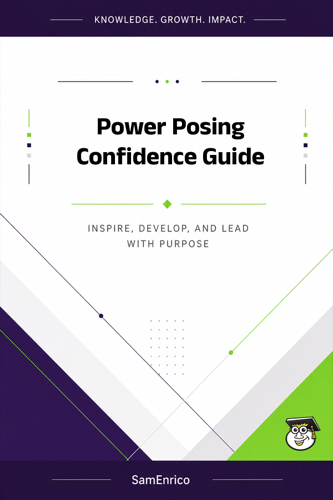
Power Posing Confidence Guide eBook
Adopt expansive body postures for two minutes to r
Adopt expansive body postures for two minutes to raise testosterone and lower cortisol.
Formats
Free sample
Chapter 1: The Silent Language...–- You are communicating before you speak. Your body is broadcasting a constant stream of data—to everyone in the room, but most importantly, to yourself. This chapter decodes the ancient, silent language of posture and reveals why your mother was right when she told you to stand up straight.Every human being on this planet is fluent in a language they were never taught. No one sat you down with a textbook to learn it. You did not memorize vocabulary lists or conjugate verbs.
And yet, you speak this language fluently, effortlessly, and continuously. You are speaking it right now, as you read these words. Your shoulders are either raised or relaxed. Your spine is either curved or straight. Your chin is either lifted or tucked.
Your arms are either open or crossed. Every single one of these choices—conscious or unconscious—is a word in a sentence you are writing about yourself. That sentence has a subject (you), a verb (are), and a predicate (confident, anxious, tired, powerful, small, or afraid). The terrifying and liberating truth is this: you are the author of that sentence, even when you think you are not.This is the silent language of posture. It is older than human speech, older than tools, older than fire.
It is the language your lizard brain learned before your frontal lobe was even a glimmer in evolution’s eye. And for the past decade, a strange and wonderful thing has happened to this ancient language: science finally turned its full attention to it. The result has been a rollercoaster of viral TED Talks, replication crises, retractions, and—most importantly—a set of durable, replicable truths that can change the way you move through the world. This chapter is not about the hype. It is not about the fairy tale that standing like a superhero for two minutes will chemically transform your blood.
That story has been told, and it has been corrected. Instead, this chapter is about the bedrock reality that remains after the hype has been swept away.The Universal Dictionary of Expansion and Contraction Let us begin with a simple observation. Watch a room full of people waiting for a job interview. What do you see? You see shoulders curling inward.
You see spines bending like question marks. You see arms wrapping around torsos like armor. You see legs crossing and uncrossing in restless, anxious rhythms. You see hands reaching for necks, for chins, for phones held close to the chest like shields. Now, watch the same people ten minutes later, after they have been told they got the job.
What changes? Shoulders pull back. Chins lift. Arms uncross and begin to gesture outward. Legs plant themselves firmly on the floor.
Hands stop fidgeting and begin to steeple, to rest on hips, to take up space. You have just witnessed the two fundamental categories of postural language: expansion and contraction.Expansive postures are those that open the body. They lengthen the spine, widen the limbs, expose the torso, and claim territory. When you expand, you tell the world—and your own brain—that you are safe, that you belong, that you have nothing to hide. Contractive postures are those that close the body.
They round the shoulders, narrow the limbs, shield the vital organs, and surrender territory. When you contract, you signal danger, submission, uncertainty, or a desire to disappear. This is not a cultural invention. It is not something Westerners do and Easterners do not. It is not a product of capitalism or patriarchy or any other social structure.
It is a biological universal, rooted in the deepest layers of our nervous system. Watch a chimpanzee who has just lost a fight. She curls into a ball, makes herself small, and avoids eye contact. Watch a toddler who has just been scolded. He does the same thing.
Watch a CEO who has just closed a billion-dollar deal. She leans back in her chair, spreads her arms across the armrests, and expands into the space around her. The script is the same across species, across cultures, across centuries.This is not to say that culture plays no role. Culture absolutely modulates the acceptable expression of expansion and contraction. In some East Asian contexts, expansive postures in certain settings can be read as aggression or disrespect, and moderate constriction can be a sign of attentiveness and respect.
But these are dialects of a universal language, not different languages entirely. The underlying emotional grammar—expansion equals confidence, contraction equals uncertainty—remains recognizable everywhere. A bow in Tokyo is not a shrug in Toronto. But a slumped, collapsed, caved-in chest is recognized as a sign of low mood in every corner of the planet. That is the power of the silent language.
It travels everywhere. And it never stops speaking.The Two Most Important Poses You Will Ever Learn Among the infinite variety of expansive postures, two specific configurations have received the most attention in both the scientific literature and the popular imagination. This book will refer to them repeatedly, so it is worth meeting them properly now. The first is called the Wonder Woman. Stand with your feet shoulder-width apart.
Place your hands on your hips. Roll your shoulders back and down. Lift your chin so that it is parallel to the floor. Breathe. That is it.
You have just assumed a posture associated with power, readiness, and confidence. The name is whimsical, but the effect is serious. This posture opens the chest, expands the diaphragm, and signals—to yourself and others—that you are prepared to act.The second is the Starfish. Stand with your feet wider than shoulder-width apart. Raise both arms overhead in a wide V-shape.
Keep your fingers spread. Lift your chin. Breathe. This posture is more extreme than the Wonder Woman. It claims more territory.
It is the posture of a victor, of someone who has just crossed a finish line or solved an impossible problem. Olympic runners do not cross the finish line and then fold into a ball. They throw their arms wide. They tip their heads back. They become starfish.
This is not a conscious decision. It is an instinctive expression of triumph. And the remarkable thing is that you can perform this posture before you have anything to triumph over. You can use the posture to invite the feeling, rather than waiting for the feeling to produce the posture.Alongside these expansive postures, it is also useful to recognize their contractive opposites. The Huddle is the posture of someone who is cold, scared, or ashamed.
Arms wrapped around the torso. Shoulders hunched up toward the ears. Chin tucked down toward the chest. Spine curved forward like a parenthesis. This posture makes you smaller.
It hides your vital organs. It tells your brain that you are under threat. The Cage is a more subtle version of the same impulse. This is the posture of someone holding a phone against their chest, or a notebook, or a purse. It is the posture of crossing your arms not because you are cold, but because you are anxious.
The Cage creates a barrier between you and the world. It says, "Do not come closer." And your brain hears…
This is the end of the free sample. Get the eBook to keep going. Buy now
About this book
Details
- Author
- Connelly Margarite
- Publisher
- SamEnrico
- Language
- English
- Genre
- Non-Fiction, Mental Wealth, Body Language
- Released
- 2026-06-09
- Pages (approx.)
- 127
- Available as
- eBook, Audiobook

Read better in the ZLOADR app
Your eBooks on your phone or tablet. Sign in with your SamEnrico account and start reading.
More by Connelly Margarite
 Nonverbal Communication CourseConnelly Margarite$11.99
 Kabaddi Kings: The Untold Story of Asia's Forgotten WarriorsConnelly Margarite$11.99
 How to Produce Canned MeatsConnelly Margarite$11.99
 Forward Pricing for Wholesale BuyersConnelly Margarite$12.99
 Kit CarsConnelly Margarite$11.99
 How to Become a Meat-grading-machine OperatorConnelly Margarite$11.99
You may also like
 Hong Kong Handover 1997Dunn Johnnie$11.99
 Zumba For Postnatal Recovery CourseNeal Christian$11.99
 Zumba for BeginnersLadner Nikia$11.99
 YouTube Comment Mining GuideHumes Pandora$12.99
 Worry Box MeditationCarlin Rudy$11.99
 Workplace Stress MeditationNguyen Lynn$11.99
 Workplace Stress and Sleep RepairHawley Ivory$11.99
 Workplace Perfectionism CureDelaney Jeffry$11.99
 Workplace Injustice Anger GuideWallen Isabelle$11.99
 Work Addiction and Burnout LinkGreenwood Ester$11.99
 Women in Yoga and WellnessBeattie Galina$11.99
 Women in Stand Up ComedyChun Evangeline$11.99