
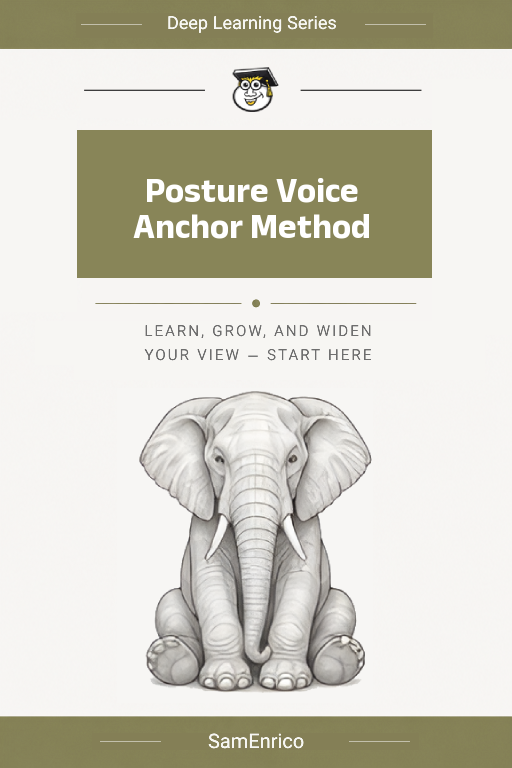
Non-FictionProfessional's Cheat SheetVocal ProjectionPhysical Presence
Posture Voice Anchor Method eBook
Stand while presenting and anchor your voice to a
by Reyes Pedro
Stand while presenting and anchor your voice to a point across the room for projection.
Formats
Free sample
Chapter 1: The Standing Betrayal--–- Sarah had been preparing for this moment for three weeks. She knew her slides cold. She had rehearsed her opening joke twice in the mirror that morning. Her shoes were comfortable, her notes were brief, and her coffee intake had been carefully calibrated to avoid jitters. She stood up from her chair, walked to the front of the conference room, and opened her mouth to speak.What came out was not the confident, warm, commanding voice she had heard in her head.
What came out was thin. Reedy. Strained. The kind of voice that makes people at the back of the room lean forward and cup a hand behind their ear. The kind of voice that makes your boss check their phone—not because they are rude, but because listening to you requires more effort than they are willing to give.Sarah froze for a single, terrible second.
She heard herself say, "Good morning, everyone," and she heard the words land about six feet away from her, dying in the air like a bird hitting a window. Someone in the third row whispered, "I can't hear her." Someone else pulled out a laptop and started typing. Sarah spent the next forty-five minutes pushing her voice, straining her throat, and finishing every sentence a little quieter than she started. By the end, she was almost whispering. She sat down, exhausted, and thought: What just happened?
I sounded fine when I was sitting.If you have ever stood up to speak and felt your voice abandon you, you know exactly what Sarah felt. And you have probably blamed the wrong things. You blamed your nerves. You blamed the room's acoustics. You blamed the lack of a microphone.
You blamed your "naturally quiet voice." You told yourself you are just not a loud person.But Sarah was not quiet. She had a perfectly normal voice. And so do you. The problem was not her volume, her nerves, or the room. The problem was something much simpler, much more physical, and—here is the good news—much more fixable.The problem was her posture.The Great Standing Paradox Here is a strange fact that most speakers never notice: you can sit in a chair, facing one other person across a table, and speak with perfect ease.
Your voice flows out of you like water from a tap. You do not think about it. You do not strain. You do not fade.But stand up to address a room of twenty people, and suddenly your voice feels like it is being squeezed through a pinhole. You push.
You strain. You run out of breath. And by the end of your second sentence, you are already quieter than you were at the start.This is what I call the Standing Betrayal. Your body, which served you perfectly well while seated, seems to turn against you the moment you rise to your feet. And the betrayal feels personal—like your voice has decided, for no good reason, to abandon you at the worst possible moment.But your voice has not abandoned you.
Your voice is a faithful servant. It does exactly what your body tells it to do. The problem is that when you stand up, your body starts telling your voice to do the wrong things—and you do not even realize it is happening.Let me show you what I mean.Sit down where you are right now. Take a normal breath. Exhale and say, "Hello, my name is [your name]." Easy, right?
Now stand up. Do not adjust anything. Do not try to stand tall. Just stand the way you normally stand when you are about to speak in front of people. Now say the same sentence: "Hello, my name is [your name]."Do you hear the difference?
For most people, the standing version is quieter, thinner, and runs out of steam by the end of the name. Some people notice that they take a smaller breath before speaking. Others notice that their throat feels tighter. A few notice that they lean back on their heels or jut their chin forward.That difference—the gap between your seated voice and your standing voice—is the Standing Betrayal. And it is not your fault.
You were never taught how to stand. You were taught how to sit in a chair for twelve years of school. You were taught how to sit at a desk for forty hours a week at work. You were never taught that standing is a skill. And speaking while standing is a completely different skill from speaking while sitting.This chapter will teach you the first and most important skill of the Posture Voice Anchor Method: how to stand so that your voice can do what it already knows how to do.
Before we talk about breath, before we talk about anchors, before we talk about resonance or volume or eye contact, we have to fix the foundation. Because if your posture is betraying you, nothing else will work.The Biomechanics of Betrayal To understand why the Standing Betrayal happens, you need to understand a little bit about how your voice actually works. Do not worry—this is not medical school. You only need to understand three things: your breath, your larynx, and your spine.Your Breath Your breath is the engine of your voice. You cannot produce sound without air moving past your vocal folds.
That much is obvious. But what is less obvious is where that air comes from. The most efficient, powerful, sustainable breath comes from your diaphragm—a dome-shaped muscle at the bottom of your rib cage. When you inhale well, your diaphragm drops down, your lungs expand downward and outward, and you fill the bottom third of your lungs with air. This is called diaphragmatic breathing, belly breathing, or—as we will call it in this book—the 360-degree breath (more on that in Chapter 3).When you sit in a chair with good back support, your diaphragm has room to move.
Your torso is relatively stable. Your spine is supported. Your body can breathe the way it was designed to breathe.When you stand with poor posture, your diaphragm gets squeezed. Your ribs compress. Your stomach muscles tighten in ways they should not.
Your breath becomes shallow, high in your chest, and short. You take in less air. You run out of breath faster. And your voice fades at the end of every sentence.Your Larynx Your larynx—your voice box—sits in your throat, right behind your Adam's apple (if you have one) or in the same location (if you do not). Inside your larynx are your vocal folds (often called vocal cords).
When you speak, air from your lungs passes between your vocal folds, causing them to vibrate. That vibration is your voice.Your larynx is suspended by muscles and ligaments. It is designed to be relatively relaxed and mobile. When your posture is good, your larynx sits in a neutral, low position—which produces a full, warm, relaxed sound. When your posture is poor, your larynx gets pulled out of alignment.
A forward head posture yanks your larynx upward. A collapsed chest pushes it forward. A tense neck squeezes it from…
This is the end of the free sample. Get the eBook to keep going. Buy now
About this book
Details
- Author
- Reyes Pedro
- Publisher
- SamEnrico
- Language
- English
- Genre
- Non-Fiction, Professional's Cheat Sheet, Vocal Projection, Physical Presence
- Released
- 2026-05-29
- Pages (approx.)
- 149
- Available as
- eBook, Audiobook

Read better in the ZLOADR app
Your eBooks on your phone or tablet. Sign in with your SamEnrico account and start reading.
More by Reyes Pedro
 Immigrant Import Export Trade SuccessReyes Pedro$11.99
 Active Listening For Elderly ParentsReyes Pedro$11.99
 Creative Block WorkbookReyes Pedro$11.99
 Civil Penalty Calculation GuideReyes Pedro$11.99
 Rock Climbing Finger Injury PreventionReyes Pedro$11.99
 Wholesaling Joint Venture GuideReyes Pedro$11.99
 Zumba Rhythms for BeginnersReyes Pedro$11.99
 Piti Joy from Breath FocusReyes Pedro$11.99
 Assertiveness At RestaurantsReyes Pedro$11.99
 The Unseen First Lady: The Hidden Legacy of Bess TrumanReyes Pedro$11.99
 El Cid: The Lion of SpainReyes Pedro$11.99
 Echoes of the Black Door: The CIA's Secret Sound ExperimentsReyes Pedro$11.99
You may also like
 Hong Kong Handover 1997Dunn Johnnie$11.99
 Zumba For Postnatal Recovery CourseNeal Christian$11.99
 Zumba for BeginnersLadner Nikia$11.99
 YouTube Comment Mining GuideHumes Pandora$12.99
 Worry Box MeditationCarlin Rudy$11.99
 Workplace Stress MeditationNguyen Lynn$11.99
 Workplace Stress and Sleep RepairHawley Ivory$11.99
 Workplace Perfectionism CureDelaney Jeffry$11.99
 Workplace Injustice Anger GuideWallen Isabelle$11.99
 Work Addiction and Burnout LinkGreenwood Ester$11.99
 Women in Yoga and WellnessBeattie Galina$11.99
 Women in Stand Up ComedyChun Evangeline$11.99