
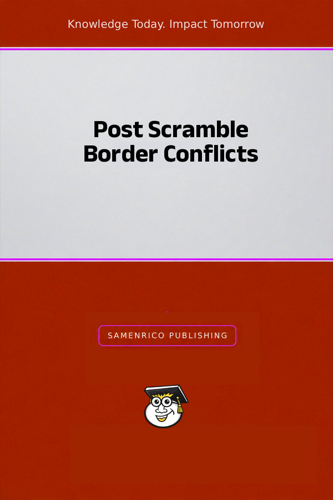
Non-FictionHistoryLegacy Studies
Post Scramble Border Conflicts eBook
How arbitrary divisions caused modern civil wars i
by Eaves Kiara
How arbitrary divisions caused modern civil wars in Africa.
Formats
Free sample
Chapter 1: The Cartographer's Crime...--The militia commander's fingers were black with coltan dust, the fine metallic powder that had seeped into every crease of his hands, his uniform, his lungs. He knelt on the red earth of eastern Congo, somewhere north of Bukavu, and unfolded a piece of paper that had outlived every government that had ever claimed to rule him. It was a map. Not a new one, bought from a shop in Goma. This one was dated 1913, printed in Brussels, stamped with the seal of the Belgian colonial ministry.
The paper was brown at the edges, softened by decades of humidity and handling, but the lines were still sharp.A lieutenant leaned over his shoulder. "Commander, the village is two kilometers that way," he said, pointing west. "The men are ready."The commander did not look up. He traced his finger along a faint black line that ran north to south through dense jungle. "This line," he said.
"It says here the mine is on this side. The village is on that side." He looked up, squinting toward the treeline. "So we burn the village first. Then we take the mine. That is the law."What law?
Not Congolese law. Not international law. The commander was following a line drawn by a Belgian cartographer named Henri Conscience, who had never set foot in Africa, who had drawn this border while sitting at a desk in Brussels in 1911, using reports from rubber collectors and missionary geographers. Conscience had been tasked with marking the boundary between the Belgian Congo and German East Africa. He had never met a Tutsi or a Hutu.
He had never seen a coltan mine. He had simply drawn a line that looked tidy on paper.Ninety years later, that line was deciding who lived and who died.This book argues that the modern African civil war is not, as Western pundits have long claimed, a product of "ancient tribal hatreds." The conflicts that have killed millions in Congo, Nigeria, Rwanda, Somalia, Sudan, Mali, and beyond are not blood feuds inherited from pre-colonial ancestors. They are the logical, predictable, and almost mechanical consequences of a single failed cartographic event: the Berlin Conference of 1884-85, where fourteen European powers carved an entire continent into fifty artificial states without a single African present.The evidence for this claim is written in the bodies. The Congo's resource wars follow colonial mining concession maps. Nigeria's Biafran secession followed a colonial merger of incompatible regions.
Rwanda's genocide followed a colonial identity-card system. The Tuareg rebellions in Mali and Niger follow colonial lines that split a single people into five countries. The Somali crisis follows colonial lines that divided one ethnic group into five territories. The Sahel's jihadist insurgencies exploit the ungoverned spaces created by colonial borders that no one can defend and no one can erase.This is not a book about Africa's failures. It is a book about Europe's crime.The Opening Wound: Berlin, 1884On November 15, 1884, representatives of Austria-Hungary, Belgium, Denmark, France, Germany, Great Britain, Italy, the Netherlands, Portugal, Russia, Spain, Sweden-Norway, the Ottoman Empire, and the United States sat down in a building on Wilhelmstrasse in Berlin to divide a continent they had never explored.
The conference was ostensibly about "free trade" and "humanitarian oversight" of the Congo Basin. In reality, it was a cartographic land grab.The rules were simple. Any European power could claim any African territory if it could demonstrate "effective occupation"—which meant signing treaties with local chiefs (often coerced or misunderstood), flying a flag, and establishing a trading post. No African signature was required. No African representative was present.
The continent was treated as terra nullius—empty land—even though it contained tens of millions of people with functioning states, legal systems, armies, and trade networks.By the time the conference ended on February 26, 1885, the map of Africa had been redrawn. The men in top hats had not walked the land. They had not asked the people who lived there. They had simply taken rulers, drawn straight lines through rainforests and deserts, and declared the job done. The Congo went to Belgium's King Leopold II (as his personal fiefdom, not even a colony).
The Sahara's straight lines went to France. East Africa was sliced between Germany and Britain. The Horn was divided among Britain, France, and Italy.Within thirty years, 90 percent of Africa was under European control. The Berlin Conference had transformed a continent of thousands of polities into fifty colonial territories, each defined by borders that prioritized resource extraction over human geography. Rubber, ivory, gold, diamonds, copper, and later oil and coltan—these were the true reasons for the lines.
People were just obstacles.What Pre-Colonial Africa Actually Looked Like To understand the crime, we must first understand what existed before the crime. Popular imagination—fed by colonial propaganda—pictures pre-colonial Africa as a chaos of warring tribes. This is false.Consider the Ashanti Confederacy (modern Ghana). By the early 18th century, the Ashanti had developed a sophisticated bureaucratic state with a constitution (the Odwira), a centralized treasury, a professional army, and a legal system that included trial by jury. Their capital, Kumasi, was described by European visitors as a city of broad streets, multistory buildings, and a palace complex that rivaled anything in Europe at the time.
The Ashanti did not have fixed borders in the European sense—their territory expanded and contracted through alliances and warfare—but they had clear cultural boundaries. They knew who was Ashanti and who was not. They knew which lands were ancestral and which were conquered.Consider the Sokoto Caliphate (modern Nigeria, Niger, Cameroon, and Benin). Founded in 1804 during a Fulani jihad, the Caliphate grew into one of the largest states in 19th-century Africa, with a population of over 10 million. It had a written legal code based on Islamic law, a centralized tax system, a postal service, and an education system with thousands of schools.
The Caliphate's borders were not straight lines but natural frontiers: rivers, mountain ranges, and desert edges. When the British conquered the Caliphate in 1903, they inherited a functioning state—and promptly broke it into pieces that suited colonial logistics.Consider the Luba Kingdom (modern DRC). The Luba developed a complex system of spiritual kingship (balopwe) that integrated dozens of ethnic groups into a single political framework. Their trade networks extended from the Atlantic to the Indian Ocean, dealing in copper, ivory, and slaves. The Luba did not have "tribal" wars—they had dynastic succession conflicts, which are no more "tribal" than the English Wars of the Roses.The point is this: pre-colonial Africa had politically fluid borders but culturally meaningful territories.
Borders shifted as alliances changed, as kingdoms rose and fell, as trade routes evolved. But people knew where they belonged. They knew who their neighbors were. They had ways of negotiating boundaries that did not involve genocide.European colonialism froze this fluidity. The straight lines drawn in Berlin and refined in colonial offices did not replace chaos with order.
They replaced negotiated, living boundaries with dead, rigid lines. And they did so without regard for who lived where.The Spectrum of Colonial Harm Not all colonial borders were drawn with the same…
This is the end of the free sample. Get the eBook to keep going. Buy now
About this book
Details
- Author
- Eaves Kiara
- Publisher
- SamEnrico
- Language
- English
- Genre
- Non-Fiction, History, Legacy Studies
- Released
- 2026-06-06
- Pages (approx.)
- 142
- Available as
- eBook, Audiobook

Read better in the ZLOADR app
Your eBooks on your phone or tablet. Sign in with your SamEnrico account and start reading.
More by Eaves Kiara
 Lighthouse Sanctuary JourneyEaves Kiara$11.99
 Tech Worker Work AddictionEaves Kiara$11.99
 Park Walking MeditationEaves Kiara$11.99
 Crucial Confrontation FrameworkEaves Kiara$11.99
 GAD And Parenting WorryEaves Kiara$11.99
 Magnesium For AnxietyEaves Kiara$11.99
 Velvet & Vengeance: The Lost Heiress of the Silk RoadEaves Kiara$11.99
 Silk and Scandal: The First Fashion Wars of Colonial AustraliaEaves Kiara$11.99
 How to Start a Mental Hospital (public Sector) Business (Beginners Guide)Eaves Kiara$11.99
 How to Produce Hedge Trimmer AccessoriesEaves Kiara$11.99
 Ubongo Kids Media ExitEaves Kiara$12.99
 Vendor Site Visit ChecklistEaves Kiara$12.99
You may also like
 Hong Kong Handover 1997Dunn Johnnie$11.99
 Zumba For Postnatal Recovery CourseNeal Christian$11.99
 Zumba for BeginnersLadner Nikia$11.99
 YouTube Comment Mining GuideHumes Pandora$12.99
 Worry Box MeditationCarlin Rudy$11.99
 Workplace Stress MeditationNguyen Lynn$11.99
 Workplace Stress and Sleep RepairHawley Ivory$11.99
 Workplace Perfectionism CureDelaney Jeffry$11.99
 Workplace Injustice Anger GuideWallen Isabelle$11.99
 Work Addiction and Burnout LinkGreenwood Ester$11.99
 Women in Yoga and WellnessBeattie Galina$11.99
 Women in Stand Up ComedyChun Evangeline$11.99