
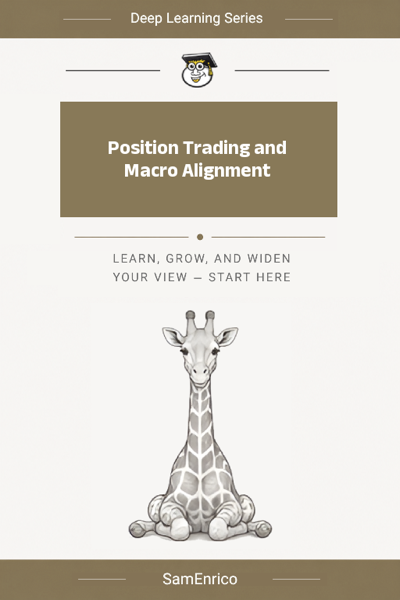
Position Trading and Macro Alignment eBook
A Coursebook on Position Trading and Macro Alignme
A Coursebook on Position Trading and Macro Alignment
Formats
Free sample
Chapter 1: The Patience Paradox--The day I realized I had been trading entirely wrong did not come during a dramatic market crash or a sudden $50,000 loss. It came on a quiet Tuesday afternoon in March, sitting in a coffee shop in Chicago, watching a man who looked like he had nowhere else to be slowly read the Wall Street Journal print edition. He was in his sixties, wearing an old baseball cap and a fleece jacket that had seen better decades. He had no laptop. No phone on the table.
No glowing screens with dancing candlesticks. Just a newspaper, a cup of black coffee, and a calm that I, at twenty-eight years old, had never experienced in my entire trading career.I was three years into day trading at that point. I had seven screens at my desk. Three monitors for charts, one for news, one for my order entry platform, one for Discord chat rooms where other traders yelled about "gamma squeezes" and "liquidity grabs," and one for Netflix because even I couldn't stare at candlesticks for twelve hours straight without something to numb the boredom. I had read every book.
I had bought every course. I knew what a Fibonacci retracement was before I could explain how interest rates worked. I had backtested seventeen different strategies and had the journal entries to prove it. And yet, after three years, my account balance was almost exactly where it had started—down slightly if you counted the money I had spent on better monitors, faster internet, and the three separate "mentorship programs" that promised to teach me the secrets that the "1 percent" didn't want me to know.The man with the newspaper was not in a hurry. He turned pages slowly.
He read the bond section first, then the currency section, then the commodities page, and only at the very end did he glance at the stock tables. I watched him for an hour. In that same hour, I had checked my phone twenty-seven times. I had opened my brokerage app nine times. I had executed two trades—one small winner, one small loser—and felt the familiar cortisol spike and crash that had become my baseline emotional state.
I was exhausted, and it was only two in the afternoon.He finished his coffee, folded the newspaper, and stood up to leave. On his way out, he glanced at my open laptop—covered in charts, indicators, and a dozen open tabs—and smiled. Not a mocking smile. A knowing one."You're working too hard," he said.I laughed, more out of reflex than humor. "That's what they say about trading, right?
The harder you work, the luckier you get."He shook his head. "No. That's what they say about everything else. Trading is the opposite. The harder you work, the worse you do." He pointed at my screen.
"How many trades did you take this month?"I had to think. "Maybe eighty? Ninety?"He nodded as if he had expected exactly that number. "I've taken six trades in the last two years. I've made more money than you'll see in the next decade.
You're fighting the market. I'm just reading it."He walked out. I never saw him again. But that moment—that uncomfortable collision between his calm and my chaos—was the beginning of everything this book will teach you.The Great Misconception: Why Activity Is Not Productivity There is a lie that runs through the entire trading industry, and it is told by everyone who profits from your activity. Your broker tells it when they encourage you to trade more because every click generates commission.
The financial media tells it when they manufacture twenty-four hours of "breaking news" because fear and greed drive ratings. The "trading influencers" on social media tell it when they post screenshots of their hundred-trade months because they need you to believe that intensity equals success so you will buy their courses. Even the software companies tell it when they design platforms with faster execution speeds and more indicators because their business model depends on you believing that the next tool—the next chart, the next scanner, the next alert—will finally unlock consistent profits.The lie is simple: the harder you work at trading, the more you will succeed.Every piece of data we have about retail trading performance proves that this is backward. The academic research is unambiguous. A comprehensive study by Barber and Odean, updated with data through 2024, analyzed over 66,000 retail trading accounts and found that the most active traders—those in the top decile of turnover—underperformed the most passive traders by 6.5 percent annually.
Not because they had worse ideas. Not because they lacked skill. But because activity itself is a tax on returns. Every trade has a cost: the spread, the commission, the slippage, and perhaps most damaging of all, the cognitive load that comes from making dozens of decisions under uncertainty.Proprietary data from a group of professional position traders tells an even starker story. The top-performing traders in that sample—those with Sharpe ratios above 1.5 and annual returns exceeding 25 percent—executed an average of just twelve to twenty trades per year.
Not per month. Not per week. Per year. Their win rates were not extraordinary, typically ranging from 45 to 55 percent. Their average holding periods ranged from three to nine months.
They spent between forty-five and ninety minutes per week analyzing markets, and the rest of their "trading time" was spent doing nothing—waiting, monitoring, and letting time work its slow and invisible magic.The worst-performing traders in that same sample? They executed two hundred to five hundred trades per year. They spent twenty to forty hours per week staring at screens. They had higher win rates—often above 60 percent—but their losses were larger than their wins, and their transaction costs consumed any edge they might have had. They were working extremely hard.
They were also losing money.This is the Patience Paradox: In trading, the relationship between effort and outcome is inverted. Up to a point, more analysis and preparation improves results. But beyond a very low threshold, more activity destroys returns. The best traders are not the ones who work the hardest. They are the ones who think the clearest, wait the longest, and act the least.Defining Position Trading: The Longest Short-Term Game Before we go any further, we need to be precise about what position trading actually is—and what it is not.
This clarity is essential because confusion at the definitional level leads to strategy errors at the execution level.Position trading occupies a specific and often misunderstood place on the trading spectrum. It is not "slower day trading." It is not "faster investing." It is a distinct discipline with its own tools, its own timeframes, and its own psychological demands.Let me put this in the starkest possible terms: Position trading is the practice of holding trades for weeks to months based on a synthesis of macroeconomic direction and technical timing, with position sizes determined by volatility and risk limits, and exits governed by structural breaks in either the macro thesis or the technical trend.That is a dense sentence. Let me unpack it by…
This is the end of the free sample. Get the eBook to keep going. Buy now
About this book
Details
- Author
- Robert Collene
- Publisher
- SamEnrico
- Language
- English
- Genre
- trading, Informative, Educational
- Released
- 2026-06-03
- Pages (approx.)
- 147
- Available as
- eBook, Audiobook

Read better in the ZLOADR app
Your eBooks on your phone or tablet. Sign in with your SamEnrico account and start reading.
More by Robert Collene
 Anger With Addicted PartnerRobert Collene$11.99
 Guilt Trigger ManagementRobert Collene$11.99
 Vitamin D Complete Science PrimerRobert Collene$11.99
 Offshore Wind InvestmentRobert Collene$11.99
 MBSR for ArtistsRobert Collene$11.99
 Sheppard Case Weapon Never FoundRobert Collene$11.99
 Migraine Support Groups GuideRobert Collene$11.99
 Utilization Scripting GuideRobert Collene$11.99
 Bloomberg MikeRobert Collene$11.99
 The Jade Spy: A Dragon’s Gambit in the Celestial CourtRobert Collene$11.99
 Stuart's Arctic Gambit: The Overland Telegraph That Conquered the IceRobert Collene$11.99
 Shadows Over the Kremlin: The Poisoned ChaliceRobert Collene$11.99
You may also like
 Shift Work Shift Trading GuideDuff Cathrine$11.99
 Insider Trading SentimentWurtz Shawnda$11.99
 Gambler's Fallacy TradingGaydos Shu$11.99
 Cryptocurrency Trading AddictionGeorge Kathleen$11.99
 Brokerage Account Margin TradingSegura Hermila$11.99
 Gambling Addiction and Day TradingClanton Hyacinth$11.99
 Beginner Mindfulness for Stock TradersFultz Mary$11.99
 Dividend Capture Strategy GuideWallace Antoinette$11.99
 Unauthorized Trading CasesQuintanilla Ima$11.99
 Insider Trading Heist TheoryTripp Luvenia$11.99
 Trader Distraction Control GuideSummers Gina$11.99
 Loss Aversion Trading GuideBoucher Ellamae$11.99