
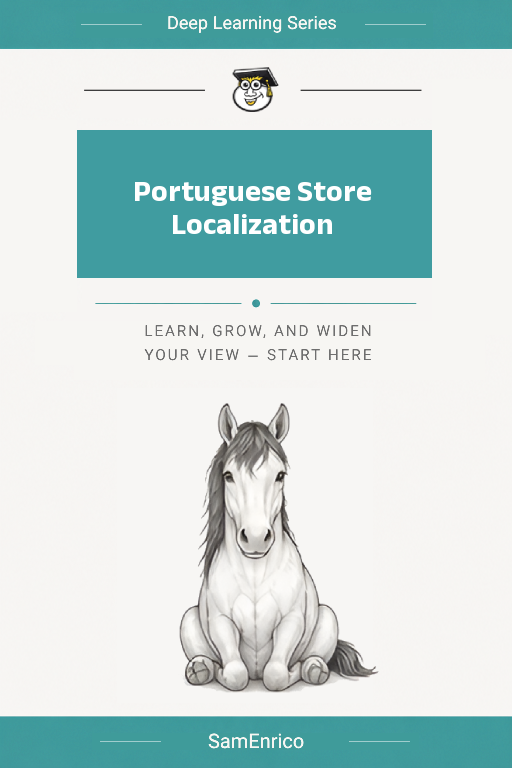
Non-FictionBusiness BriefLocalization Brazil
Portuguese Store Localization eBook
Translate Shopify store to Brazilian Portuguese fo
Translate Shopify store to Brazilian Portuguese for higher conversion in Brazil.
Formats
Free sample
Chapter 1: The Invisible Tax--–- In 2019, a Miami-based skincare brand spent $200,000 on Facebook ads targeting Brazilian consumers. They had done everything right — beautiful creative, precise audience targeting, a compelling offer. Their ads generated over 500,000 clicks to their Shopify store in just sixty days. Their total sales from Brazil during that period? Zero.
Not a single completed transaction.The post-mortem investigation took three weeks. The product was desirable. The pricing was competitive. The shipping costs were clearly displayed. The problem, it turned out, was a single phrase on the checkout page.Under the credit card field, the brand had kept the English instruction: "Enter the 3-digit number on the back of your card." Seventy percent of Brazilian credit cards have the security code on the front of the card, not the back.
Half a million Brazilian shoppers looked at that instruction, looked at their card, found no number on the back, and decided the transaction was untrustworthy or impossible. Then they left.Two hundred thousand dollars in ad spend. Zero dollars in revenue. All because of a twelve-word sentence that a Brazilian proofreader could have fixed in thirty seconds.This story has become legend in cross-border e-commerce circles, known simply as "The $200k Comma" — a metaphor for the thousands of invisible, culturally specific errors that separate success from failure in the Brazilian market. Every day, Shopify merchants make similar mistakes.
They believe their problem is traffic, or pricing, or product-market fit. Almost always, they are wrong.The problem is localization. Not the obvious kind that Google Translate can solve, but the deep, psychological, structurally embedded kind that determines whether a Brazilian shopper trusts you enough to enter their credit card number. This chapter establishes why Brazil demands your attention, why most foreign stores fail there, and why the ones that succeed treat localization not as a translation project but as a complete business transformation.The $8 Trillion Question Let us begin with a question that most e-commerce founders never ask: What is the largest market in the world that you are currently ignoring?For most American and European brands, the answer is Brazil.Brazil has 187 million internet users as of 2024, making it the fifth-largest online market in the world after China, India, the United States, and Indonesia. Of those, approximately 108 million are active e-commerce shoppers.
The Brazilian e-commerce market generated R185billion(approximately185 billion (approximately 185billion(approximately36 billion USD) in revenue in 2023, and it is growing at 14% annually — nearly triple the growth rate of the United States or Western Europe.These numbers are not projections. They are the current reality. And they represent a market that most foreign e-commerce brands have barely touched.Consider the penetration gap. In the United States, 78% of internet users have made an online purchase in the past month. In Brazil, that figure is 52%.
The gap represents not a lack of interest, but a lack of trust in foreign retailers. Brazilian consumers are sophisticated digital shoppers — they use instant payment systems, comparison shop across platforms, expect installment plans on everything from sneakers to refrigerators — but they have been burned by cross-border purchases with hidden fees, failed deliveries, and impossible returns. Every foreign store must overcome this accumulated skepticism.The opportunity is not evenly distributed. The Brazilian e-commerce market is concentrated in the Southeast — São Paulo, Rio de Janeiro, and Minas Gerais account for 60% of all online sales — but the fastest growth is happening in the Northeast and South, where first-time internet users are coming online at rates of 20% year over year. The typical Brazilian e-commerce shopper is younger than their US or European counterpart (median age 34 vs.
45 in the US), more mobile-first (78% of purchases begin on a smartphone), and more socially influenced (57% discover products through Instagram or Tik Tok).But here is the statistic that should stop you cold: according to research from the Brazilian E-commerce Association (ABComm), foreign-language checkout pages convert at an average rate of 1.2%, while fully localized Brazilian Portuguese checkouts convert at 5.7% — nearly five times higher. That is not a marginal improvement. That is the difference between a channel that loses money and a channel that prints it.The Four Filters of Brazilian E-Commerce Understanding why localization works requires understanding what it solves. Brazilian shoppers evaluate foreign stores through four distinct psychological filters. Each filter eliminates a percentage of your potential customers.
Miss any one, and your conversion funnel becomes a sieve.Filter One: Shipping Anxiety Brazilians have a complicated relationship with their postal service, Correios. For decades, the system was slow, unreliable, and prone to theft. It has improved dramatically in recent years — tracking is now standard, and delivery times have fallen — but the reputation persists. Brazilian shoppers assume that anything shipped from outside the country will take weeks to arrive, will not have reliable tracking, and may disappear entirely.This anxiety is compounded by import regulations. Brazilian customs inspects a random percentage of international packages, and items can be held for weeks.
When duties are assessed, the recipient must pay them before delivery — sometimes more than the value of the product itself. A 2022 survey found that 43% of Brazilian consumers had abandoned a cross-border purchase specifically because they were uncertain about total landed cost.Localization addresses shipping anxiety by doing three things: providing clear, prominent shipping timelines in Brazilian Portuguese (not "5-7 business days" but "Chega em até 7 dias úteis" — note the warm, reassuring phrasing), displaying duty estimates at checkout so there are no surprises, and using tracking language that matches Correios terminology so customers can follow their package through a familiar interface.Filter Two: Payment Distrust The second filter is more subtle and more deadly.Brazilians are accustomed to elaborate consumer protections on payments. Their credit cards typically offer zero liability for fraud. Brazil's instant payment system, PIX, allows for immediate transfers that are reversible for certain types of disputes. Boleto Bancário gives shoppers 72 hours to pay, during which time the merchant cannot touch the money.
These protections are not features — they are baseline expectations.When a Brazilian shopper sees a foreign checkout page, they do not know whether these protections apply. The credit card entry form looks different. The company name on the receipt is unfamiliar. The payment processor may be based in Delaware or Dublin. In the absence of certainty, Brazilian shoppers assume the worst: that this transaction is not protected, that their card information could be stolen, that they will have no recourse if the product never arrives.The data on this is striking.
A/B tests conducted by multiple cross-border payment processors show that adding Brazilian trust badges — "Compre e Confie," "Site Seguro," "Protegido por LGPD" — increases checkout completion by 18-25%. Simply translating "Secure Checkout" to "Pagamento Seguro" helps, but the real lift comes from using the specific phrases Brazilians associate with financial safety.The gold standard is integrating PIX. Stores that add PIX see conversion rates increase by 30-40% on average, because PIX signals something profound: this store has done the work to integrate with Brazilian financial infrastructure. It is a trust signal that no badge can replicate.Filter Three: Return Uncertainty The third filter is legal but feels emotional.Brazilian consumer law (the Código de Defesa do Consumidor, or Consumer Defense Code) grants shoppers the "Direito de…
This is the end of the free sample. Get the eBook to keep going. Buy now
About this book
Details
- Author
- Matlock Jenise
- Publisher
- SamEnrico
- Language
- English
- Genre
- Non-Fiction, Business Brief, Localization Brazil
- Released
- 2026-05-28
- Pages (approx.)
- 149
- Available as
- eBook, Audiobook

Read better in the ZLOADR app
Your eBooks on your phone or tablet. Sign in with your SamEnrico account and start reading.
More by Matlock Jenise
 Innovation Culture For EngineersMatlock Jenise$11.99
 Downsizing Disaster AvoidanceMatlock Jenise$11.99
 Compressed Nerve ReliefMatlock Jenise$11.99
 Microfinance Social Business MemoirMatlock Jenise$11.99
 Diplomat Crisis ManagementMatlock Jenise$11.99
 Ghost in the Grid: The AI That Outsmarted Its CreatorsMatlock Jenise$11.99
 The Lost Inca Trail: Unraveling the Psychology of Medieval MountaineersMatlock Jenise$11.99
 Potato HarvestingMatlock Jenise$11.99
 How to Start a Cylinder Liner for Motor Vehicle Business (Beginners Guide)Matlock Jenise$11.99
 Data Presentation Tool Kit for AnalystsMatlock Jenise$12.99
 Understanding Familial Amyloid PolyneuropathyMatlock Jenise$17.99
You may also like
 Hong Kong Handover 1997Dunn Johnnie$11.99
 Zumba For Postnatal Recovery CourseNeal Christian$11.99
 Zumba for BeginnersLadner Nikia$11.99
 YouTube Comment Mining GuideHumes Pandora$12.99
 Worry Box MeditationCarlin Rudy$11.99
 Workplace Stress MeditationNguyen Lynn$11.99
 Workplace Stress and Sleep RepairHawley Ivory$11.99
 Workplace Perfectionism CureDelaney Jeffry$11.99
 Workplace Injustice Anger GuideWallen Isabelle$11.99
 Work Addiction and Burnout LinkGreenwood Ester$11.99
 Women in Yoga and WellnessBeattie Galina$11.99
 Women in Stand Up ComedyChun Evangeline$11.99