
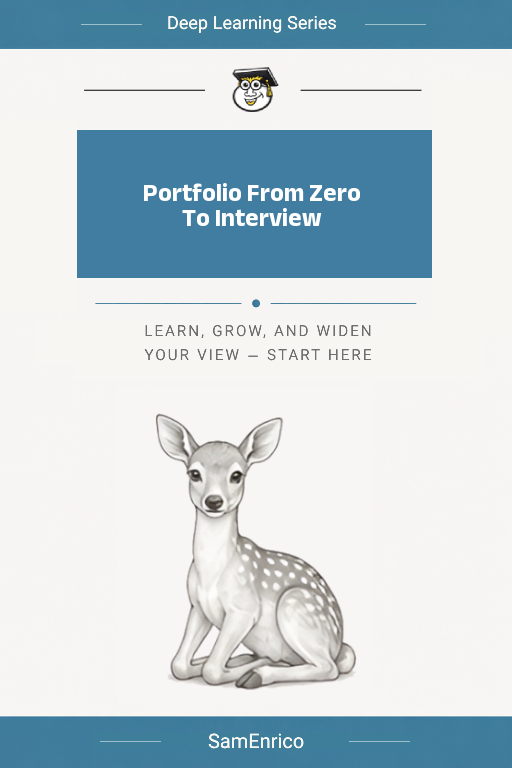
Non-FictionZero-to-One CreatorInterview Prep Guide
Portfolio From Zero To Interview eBook
Bridge the gap between no experience and landing y
Bridge the gap between no experience and landing your first interview. This roadmap sequences projects specifically designed to pass portfolio reviews in competitive fields.
Formats
Free sample
Chapter 1: The Portfolio Graveyard--If you are reading this book, you have probably already built something. Maybe it is a to-do list app with a satisfying checkmark animation. Maybe it is a weather dashboard that pulls from a free API. Maybe it is a data visualization of movie ratings or a Dribbble shot of a coffee shop app that will never be coded. You worked hard on it.
You stayed up late. You felt proud when it finally worked.And then you sent out fifty job applications and heard nothing back.Not a rejection. Not a "we will keep your resume on file." Just silence. The kind of silence that makes you check your spam folder three times a day. The kind that makes you wonder if the application portal even worked.
The kind that slowly transforms pride into confusion, then confusion into doubt, then doubt into a quiet, creeping fear: Maybe I am not good enough.Here is the truth that no one tells you. You are probably good enough. Your skills are likely fine. Your problem is not a lack of talent or effort. Your problem is that you built the wrong thing.You built what everyone else builds.
And because you built what everyone else builds, you have become invisible.The Diagnosis: Portfolio Blindness Let us start with a brutal fact. Recruiters and hiring managers have seen your project before. Not your exact project, of course, but its skeleton. Its shape. Its predictable, unoriginal outline.Consider the numbers for a moment.
In 2024 alone, over 400,000 new repositories were created on Git Hub with the word "todo" in the name. Over 150,000 with "dashboard." Over 80,000 with "weather app." Every single day, hundreds of aspiring developers, data analysts, and designers upload the same projects that were uploaded the day before, and the week before, and the year before.Now put yourself in the hiring manager's chair. You have fifteen minutes to review forty portfolios before your next meeting. You open the first link. To-do list app.
Next. Weather dashboard. Next. Movie recommendation engine. Next.
E-commerce homepage redesign. Next. After the tenth portfolio, everything blurs together. After the twentieth, you stop reading entirely and start scanning for anything—anything at all—that looks different.This phenomenon has a name. Let us call it Portfolio Blindness.
It is the cognitive habituation that occurs when a reviewer sees the same patterns repeated so often that they stop seeing individual projects altogether. Your work is not being rejected. It is being filtered out before it is even seen.And here is the painful irony. The candidates who suffer most from Portfolio Blindness are often the most diligent ones. They searched "portfolio projects for beginners" on You Tube.
They followed along with a tutorial. They customized the colors and added a few extra features. They did everything right by the standards of online learning communities. But those communities are echo chambers. They teach you to build what impresses other learners, not what impresses people who write paychecks.The Kitchen Table Mentality There is a story that circulates in startup circles about a woman named Raegan Moya-Jones.
She was a full-time employee at a publishing company, with no experience in entrepreneurship, no funding, and no permission from anyone. She started a children's book company called Annalivia from her kitchen table at 4 AM before her day job began. She built the website herself. She called suppliers herself. She made mistakes, fixed them, and kept going.
Eventually, she sold that company for tens of millions of dollars.The point of this story is not that you need to start a company. The point is that she did not wait for someone to give her a badge, a title, or a budget. She built something valuable from nothing, in the margins of her life, without asking for permission.This is the Kitchen Table Mentality, and it is the foundation of everything in this book. You do not need a corporate logo on your resume to build portfolio-worthy work. You do not need a client who pays you.
You do not need a professor to assign you a project. The only things you need are a problem worth solving, the courage to solve it badly at first, and the persistence to make it better.The candidates who get interviews are not the ones with the most impressive job histories. They are the ones who can point to something they built and say, "This thing right here? It solves a real problem. Here is the problem.
Here is how I solved it. Here is the evidence that it works."That is the gap this book exists to close. Not the gap between your skills and a job description. The gap between building something and building evidence.The 5-Second Scan: How Your Portfolio Actually Gets Judged Before we go any further, you need to understand how your portfolio is evaluated in the real world. Not how you hope it is evaluated.
Not how your bootcamp instructor told you it would be evaluated. How it is actually evaluated.Here is the sequence.A recruiter or hiring manager opens your portfolio link. They are usually multitasking. They have a calendar notification for their next meeting in ten minutes. They have twenty other tabs open.
They have already looked at twelve portfolios today and have thirteen more to go.They are not going to read your "About Me" section. They are not going to watch your three-minute video introduction. They are not going to click through your carousel of images. They are going to scan. And that scan takes approximately five seconds.In those five seconds, their eyes follow a predictable path.
Eye-tracking studies conducted on hiring professionals reveal a consistent pattern. The eyes land first on the project title—specifically, the first project listed on the page. Then they move to the impact statement or the first sentence of the project description. Then they flick to any visual evidence—a screenshot, a chart, a graph. If those three elements align into a coherent story, they will scroll.
If not, they close the tab and move on.Five seconds. That is all you get.This means that everything below the fold—your detailed write-up, your technical architecture diagram, your thoughtful reflection on lessons learned—is invisible unless the first five seconds earn the scroll. Your portfolio is not a novel. It is a billboard on a highway. Drivers going seventy miles per hour need to understand your message before they have passed you.Most portfolios fail this test immediately.
They lead with a generic project title like "React Dashboard" or "Data Analysis Project." They follow with a vague description like "A web application for tracking tasks." They include a screenshot that shows a login screen with no data. The recruiter sees nothing unique, nothing specific, nothing that suggests this candidate understands their business. Tab closed. Five seconds or less.Show Process Imperfection. Hide Execution Imperfection.Before we go any further, let us establish a rule that will guide every decision you make from this chapter forward.
This rule will resolve confusion, eliminate contradiction, and give you a clear standard for evaluating your own work. Here it is.Show…
This is the end of the free sample. Get the eBook to keep going. Buy now
About this book
Details
- Author
- Harrell Tamela
- Publisher
- SamEnrico
- Language
- English
- Genre
- Non-Fiction, Zero-to-One Creator, Interview Prep Guide
- Released
- 2026-05-27
- Pages (approx.)
- 152
- Available as
- eBook, Audiobook

Read better in the ZLOADR app
Your eBooks on your phone or tablet. Sign in with your SamEnrico account and start reading.
More by Harrell Tamela
 Vitamin B12 Deficiency HandbookHarrell Tamela$11.99
 NVC for Academic SettingsHarrell Tamela$11.99
 Availability ExpectationsHarrell Tamela$11.99
 Alternative Close Proposal GuideHarrell Tamela$11.99
 Toddler Trigger ControlHarrell Tamela$11.99
 Liver Cancer SurvivorHarrell Tamela$11.99
 Food Addiction in TeensHarrell Tamela$11.99
 Posture Power for ConfidenceHarrell Tamela$11.99
 Britney Spears ToxicHarrell Tamela$11.99
 The Last Pharaoh: Cleopatra’s Secret LegacyHarrell Tamela$11.99
 The Great Bitcoin Heist: How a Genius Coder Stole $4.5 Billion and VanishedHarrell Tamela$11.99
 The Last Whisper of the Saturn V: Apollo 11's Forgotten Test FlightHarrell Tamela$11.99
You may also like
 Hong Kong Handover 1997Dunn Johnnie$11.99
 Zumba For Postnatal Recovery CourseNeal Christian$11.99
 Zumba for BeginnersLadner Nikia$11.99
 YouTube Comment Mining GuideHumes Pandora$12.99
 Worry Box MeditationCarlin Rudy$11.99
 Workplace Stress MeditationNguyen Lynn$11.99
 Workplace Stress and Sleep RepairHawley Ivory$11.99
 Workplace Perfectionism CureDelaney Jeffry$11.99
 Workplace Injustice Anger GuideWallen Isabelle$11.99
 Work Addiction and Burnout LinkGreenwood Ester$11.99
 Women in Yoga and WellnessBeattie Galina$11.99
 Women in Stand Up ComedyChun Evangeline$11.99