
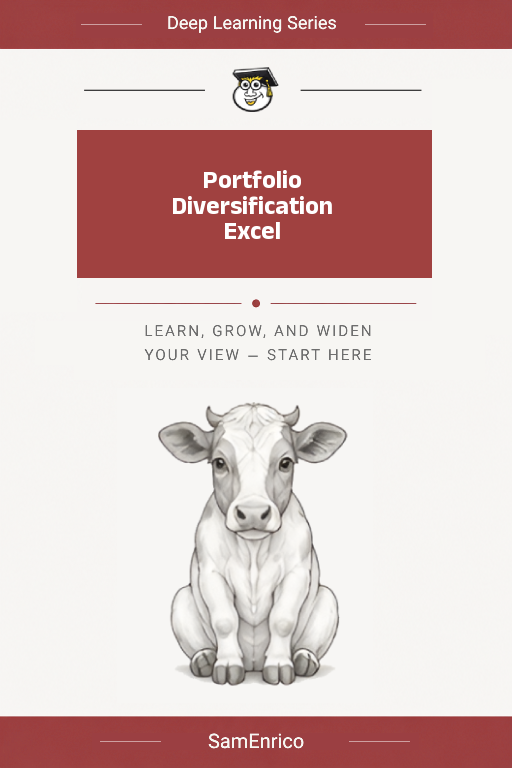
Non-FictionStudent's ShortcutPortfolio
Portfolio Diversification Excel eBook
Calculate portfolio expected return and risk for t
by Roden Edison
Calculate portfolio expected return and risk for two asset portfolios using Excel formulas.
Formats
Free sample
Chapter 1: The 60/40 Lie--–- Sarah had done everything right. At thirty-seven, she had a stable job as a marketing director, a modest house in a decent neighborhood, and a 401(k) that she had been contributing to faithfully for eleven years. Her statement said she was "diversified" across twenty-three different mutual funds. Her financial advisor, a friendly man named Dave who wore bow ties and sent her a calendar every December, assured her she was on track. "You're in our Moderate Growth model," Dave had said during their last quarterly call.
"Very well diversified. You own a little bit of everything."Sarah believed him. Why wouldn't she? Dave had certificates on his wall. His firm managed over a billion dollars.
He used words like "asset allocation" and "rebalancing" with the easy confidence of someone who had said them ten thousand times. Sarah, like most investors, assumed that diversification meant one thing: not putting all her eggs in one basket. She owned large-cap funds and small-cap funds. She owned international funds and emerging market funds. She even owned a real estate fund and a commodities fund.
Twenty-three different baskets. Surely that was diversified.It was not.In March of 2020, when the pandemic panic hit, Sarah watched her account balance drop by twenty-nine percent in seventeen trading days. Every single one of her twenty-three funds went down together. The large-cap funds fell. The small-cap funds fell harder.
The international funds fell. The emerging market funds fell the hardest. Even the real estate fund and the commodities fund—the ones Dave had called "uncorrelated diversifiers"—fell in near-perfect lockstep with everything else.Sarah called Dave. He sounded stressed. "These are unprecedented times," he said.
"Stay the course. You're diversified." But Sarah was no longer sure what that word meant. If diversification meant anything, shouldn't it protect her from losing nearly a third of her life savings in three weeks? Shouldn't her "uncorrelated" assets have done something—anything—other than collapse simultaneously?Dave could not answer these questions. Neither, Sarah would later discover, could most financial advisors.
They used the language of diversification without understanding its mathematical engine. They sold portfolios with many funds but paid no attention to the correlations between those funds. They confused quantity with quality, complexity with safety.This book exists because of Sarah—and because of the millions of investors like her who have been sold a lie. The lie is not that diversification is bad. Proper diversification is the only free lunch in finance, the closest thing to a genuine magic trick that the investment world has ever produced.
The lie is that owning many different things automatically makes you diversified. It does not. Diversification is not about how many eggs you own. It is about how the baskets move relative to one another.By the time you finish this chapter, you will understand the difference. More importantly, you will have built your first Excel spreadsheet that proves the principle with your own eyes.
You will not need to trust me, or Dave, or any financial advisor. You will see the truth in black and white, on your own screen, calculated by your own formulas.Welcome to the real story of portfolio diversification.The Umbrella Factory and the Ice Cream Shop To understand why diversification works—and why most investors do it wrong—let us travel to a small coastal town with two businesses. The first business is an umbrella factory. The second is an ice cream shop. Both businesses cost 100,000toown.Bothgenerateanaverageannualprofitof100,000 to own.
Both generate an average annual profit of 100,000toown.Bothgenerateanaverageannualprofitof10,000. On paper, they are identical investments. Both have an expected return of ten percent.But there is a catch. The umbrella factory does well when it rains. In rainy years, it makes 20,000.Insunnyyears,itmakesnothing.Theicecreamshopdoestheopposite.Insunnyyears,itmakes20,000.
In sunny years, it makes nothing. The ice cream shop does the opposite. In sunny years, it makes 20,000.Insunnyyears,itmakesnothing.Theicecreamshopdoestheopposite.Insunnyyears,itmakes20,000. In rainy years, it makes nothing. The weather in this town is unpredictable but fair: half the years are rainy, half are sunny.If Sarah buys only the umbrella factory, her returns look like this: a good year (20,000)followedbyabadyear(20,000) followed by a bad year (20,000)followedbyabadyear(0) followed by a good year (20,000)followedbyabadyear(20,000) followed by a bad year (20,000)followedbyabadyear(0).
Her average return is 10,000peryear,butherreturnsswingwildly.Sheexperiencesaone−hundredpercentswingbetweenyears.Similarly,ifshebuysonlytheicecreamshop,sheexperiencesthesamevolatility:10,000 per year, but her returns swing wildly. She experiences a one-hundred percent swing between years. Similarly, if she buys only the ice cream shop, she experiences the same volatility: 10,000peryear,butherreturnsswingwildly.Sheexperiencesaone−hundredpercentswingbetweenyears.Similarly,ifshebuysonlytheicecreamshop,sheexperiencesthesamevolatility:20,000 in sunny years, $0 in rainy years.But what if Sarah buys both businesses? She puts 50,000intotheumbrellafactoryand50,000 into the umbrella factory and 50,000intotheumbrellafactoryand50,000 into the ice cream shop. In a rainy year, the umbrella factory makes 10,000(halfof10,000 (half of 10,000(halfof20,000) and the ice cream shop makes 0.Total:0.
Total: 0.Total:10,000. In a sunny year, the umbrella factory makes 0andtheicecreamshopmakes0 and the ice cream shop makes 0andtheicecreamshopmakes10,000 (half of 20,000).Total:20,000). Total: 20,000).Total:10,000. In every year, regardless of weather, Sarah makes exactly $10,000.This is the magic. By combining two volatile businesses whose good years and bad years perfectly offset each other, Sarah created a portfolio with the same average return as either business alone—ten percent—but with zero volatility.
She achieved the impossible: higher risk-adjusted return with no trade-off. She enjoyed a free lunch.In the real world, perfect negative correlation is almost impossible to find. Very few assets move in exact opposition. But imperfect negative correlation—or even low positive correlation—still produces meaningful diversification benefits. The closer the correlation between two assets is to negative one, the greater the risk reduction.
The closer the correlation is to positive one, the smaller the risk reduction. At positive one, there is no risk reduction at all. The two assets become, for practical purposes, the same investment wearing different costumes.This is where Dave and most financial advisors fail. They build portfolios with many different asset classes—stocks, bonds, real estate, commodities, international—without ever calculating the correlations between those assets. In normal times, many of these assets appear to have low correlations.
But in times of crisis, as Sarah discovered in March 2020, correlations tend to move toward positive one. Everything becomes correlated. The diversification benefit vanishes exactly when it is most needed.Why "Owning Everything" Is Not Diversification Let us be precise about a term that is constantly misused. Diversification is not the same as variety. Owning thirty different stocks from thirty different industries is not necessarily diversified if those thirty stocks all tend to rise and fall together.
What matters is not the number of holdings but the covariance structure of those holdings—the pattern of how each asset moves relative to every other asset.Consider a concrete example. Suppose Sarah owns two technology stocks: Apple and Microsoft. Are these diversified? No. Both are large-cap U.S.
technology companies. Their correlation is approximately 0.7. They tend to rise together and fall together. Owning both instead of just one reduces Sarah's risk only modestly. Now suppose Sarah owns Apple and a long-term Treasury bond ETF.
The correlation between Apple and long-term Treasuries is approximately negative 0.3. They tend to move in opposite directions. Owning both…
This is the end of the free sample. Get the eBook to keep going. Buy now
About this book
Details
- Author
- Roden Edison
- Publisher
- SamEnrico
- Language
- English
- Genre
- Non-Fiction, Student's Shortcut, Portfolio
- Released
- 2026-05-30
- Pages (approx.)
- 138
- Available as
- eBook, Audiobook

Read better in the ZLOADR app
Your eBooks on your phone or tablet. Sign in with your SamEnrico account and start reading.
More by Roden Edison
 The Immigrant SaaS PioneerRoden Edison$11.99
 KC 10 ExtenderRoden Edison$11.99
 Weight Loss Meal PrepRoden Edison$11.99
 Overcoming Loneliness for Highly Gifted AdultsRoden Edison$11.99
 OCD Support Groups GuideRoden Edison$11.99
 Mindfulness Based Cognitive TherapyRoden Edison$11.99
 Menopause And Memory LapsesRoden Edison$11.99
 Fear of Failure for ArchitectsRoden Edison$11.99
 The Tiger and the Lion: Tipu Sultan's Defiance of EmpireRoden Edison$11.99
 The Great Wine Swindle: How Counterfeit Vintages Fooled the Elite (1970s-1980s)Roden Edison$11.99
 How to Produce Vehicles and PartsRoden Edison$11.99
 Service Providers Guide to Co-op CouponsRoden Edison$11.99
You may also like
 Hong Kong Handover 1997Dunn Johnnie$11.99
 Zumba For Postnatal Recovery CourseNeal Christian$11.99
 Zumba for BeginnersLadner Nikia$11.99
 YouTube Comment Mining GuideHumes Pandora$12.99
 Worry Box MeditationCarlin Rudy$11.99
 Workplace Stress MeditationNguyen Lynn$11.99
 Workplace Stress and Sleep RepairHawley Ivory$11.99
 Workplace Perfectionism CureDelaney Jeffry$11.99
 Workplace Injustice Anger GuideWallen Isabelle$11.99
 Work Addiction and Burnout LinkGreenwood Ester$11.99
 Women in Yoga and WellnessBeattie Galina$11.99
 Women in Stand Up ComedyChun Evangeline$11.99