
Non-FictionSelf-HelpFocus Techniques
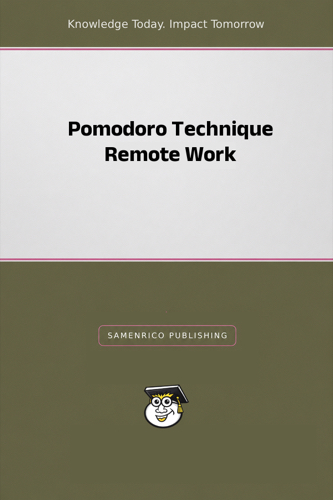
Pomodoro Technique Remote Work eBook
Use timed sprints to maintain focus when working w
Use timed sprints to maintain focus when working without office supervision.
Formats
Free sample
Chapter 1: The Lazy Lie--–- The first time Sarah cried during a workday, she was sitting on her couch in sweatpants, three hours into a task that should have taken forty-five minutes. She had answered fourteen Slack messages, checked Instagram twice, folded a load of laundry, and somehow still felt like she hadn't stopped working. When her manager Slack’d “Quick sync?” she felt her stomach drop—not because she feared the conversation, but because she had nothing to show for the morning. She typed back “👍” and stared at the ceiling. She was not overworked.
She was not underqualified. She was, by every external measure, failing at working from home. And she believed it was because she was lazy.That belief is wrong. And this chapter exists to dismantle it.The Self-Blame Trap Remote workers across the world are trapped in a silent epidemic of shame. They tell themselves stories: “I have no discipline.” “I’m just not a self-starter.” “Everyone else seems to manage, so why can’t I?” These stories feel true because they arrive without counterevidence.
When you procrastinate in an office, someone might see you. When you procrastinate at home, the only witness is your own guilt.The data tells a different story. A 2022 study of 10,000 remote workers found that 73% reported struggling with focus at least three days per week, yet 81% also reported that they genuinely wanted to do good work. The gap between intention and action is not laziness. It is a structural gap.
Your environment has changed, but your brain’s operating system has not received an update.Consider what the office provided without your conscious awareness. When you walked past a manager’s desk, you straightened your posture. When you saw a coworker deep in concentration, you lowered your voice. When everyone around you was typing, you typed. These are not acts of virtue.
They are acts of mimicry, and they are incredibly powerful.The office was a scaffolding that held up your attention. Remote work removes that scaffolding and then blames you for falling.The Three Things the Office Gave You (That Your Home Doesn't)To understand why you struggle, you must first understand what you lost. Not nostalgia—actual neurological and social structures that kept you on task.The Invisible Audience Social psychologists have known for decades that human performance changes in the presence of others. This is called social facilitation theory: the presence of an audience improves performance on well-practiced tasks and degrades performance on novel ones. But for knowledge work—which is neither purely automatic nor purely novel—the effect is more subtle.
The presence of others creates a low-grade accountability pressure. You do not need your boss to tap you on the shoulder. You need the quiet awareness that someone might walk past your desk at any moment.At home, that audience vanishes. No one walks past your desk. No one sees your open tabs.
No one notices that you have been on the same email for twenty minutes. The absence of witness is not freedom. For many people, it is the removal of a critical performance cue.Spatial Boundaries Your brain uses physical space as a context switch. When you walk into a library, you whisper. When you walk into a bedroom, you relax.
When you walk into an office, you work. These are not conscious decisions. They are conditioned responses built over thousands of repetitions.At home, the boundaries collapse. Your desk is three feet from your bed. Your kitchen is ten feet from your laptop.
Your brain receives mixed signals: “Work? Rest? Eat? All of the above?” This is called context confusion, and it is exhausting. Your brain spends energy just trying to figure out which mode to be in, energy that should be going to your actual tasks.Temporal Cues The office provided invisible timekeeping.
The train schedule forced you to arrive by a certain hour. The lunch crowd told you when to eat. The quiet after 5 PM told you when to stop. These temporal markers are powerful because they are external. You do not have to decide when to start working—the commute decides for you.
You do not have to decide when to stop—the emptying office decides for you.Remote work removes these markers. Now every decision is internal. “Should I start now? Should I take a break? Should I stop?” Each decision consumes willpower.
And willpower, as we will see throughout this book, is a finite resource that you are spending before you even begin your first task.The "Lazy Remote Worker" Is a Myth Let us be precise about what laziness actually is. Laziness is not struggling to focus. Laziness is not feeling overwhelmed. Laziness is not failing at a system that was designed against you. Laziness, in the clinical sense, is a voluntary choice to avoid effort despite having the capacity to perform.
It is rare. What is common is what psychologists call learned helplessness: the belief that your actions do not matter because past efforts have failed despite your best intentions.Remote workers are not lazy. They are under-structured. They have been handed a job that requires self-supervision but no training in self-supervision. They have been told to “just stay focused” without being told how.
They have been given a timer and told to “try harder” without understanding the biology of attention.Consider the difference between these two framings:Laziness framing: “I can’t focus because I’m unmotivated. I need to try harder.”Structure framing: “I can’t focus because my environment lacks cues. I need to add structure.”The first framing leads to shame, which leads to avoidance, which leads to more shame. The second framing leads to diagnosis, which leads to intervention, which leads to improvement. One is a dead end.
The other is a path forward.The Pomodoro Timer as a Mirror Throughout this book, you will learn the Pomodoro Technique in depth: how to set a 25-minute timer, how to protect it, how to take breaks, and how to scale it for remote work. But before we get to the mechanics, we must first reframe what the timer is.The Pomodoro timer is not a whip. It is not a punishment for your supposed laziness. It is not a tool to force yourself to work harder. The Pomodoro timer is a personal accountability mirror.
It holds up a neutral reflection of your focus choices without judgment.Here is what that means in practice. When you set a 25-minute timer and commit to one task, the timer does not care whether you succeed or fail. It simply ticks. If you stay focused, the timer gives you no reward except the quiet satisfaction of completion. If you get distracted, the timer gives you no punishment except the honest record of what happened.
The timer is a mirror. It shows you your behavior. What you do with that information is up to you.This is radically different from most productivity advice, which tells you to “stay disciplined” or “build willpower” or “just do it.” Those commands assume that you already know how to focus and simply lack the motivation. The Pomodoro mirror assumes the opposite: that…
This is the end of the free sample. Get the eBook to keep going. Buy now
About this book
Details
- Author
- Gatlin Vannesa
- Publisher
- SamEnrico
- Language
- English
- Genre
- Non-Fiction, Self-Help, Focus Techniques
- Released
- 2026-06-11
- Pages (approx.)
- 139
- Available as
- eBook, Audiobook

Read better in the ZLOADR app
Your eBooks on your phone or tablet. Sign in with your SamEnrico account and start reading.
More by Gatlin Vannesa
 Tone of Voice GuideGatlin Vannesa$11.99
 Protect Deep Work BlocksGatlin Vannesa$11.99
 Climate Risk in Retirement HousingGatlin Vannesa$11.99
 The Resilience GymGatlin Vannesa$11.99
 Remote Work Travel GuideGatlin Vannesa$11.99
 Estate Settlement GriefGatlin Vannesa$11.99
 Personal Branding for VeterinariansGatlin Vannesa$11.99
 The Whispering Fingerprints: The First Forensic Breakthrough in the Victorian EraGatlin Vannesa$11.99
 The Celestial Architects: Designing the Future of HumanityGatlin Vannesa$11.99
 How to Start a Esters of Methacrylic Acid Business (Beginners Guide)Gatlin Vannesa$11.99
 How to Produce Water Filter HousingsGatlin Vannesa$11.99
 How to Produce Linens and BeddingGatlin Vannesa$11.99
You may also like
 Hong Kong Handover 1997Dunn Johnnie$11.99
 Zumba For Postnatal Recovery CourseNeal Christian$11.99
 Zumba for BeginnersLadner Nikia$11.99
 YouTube Comment Mining GuideHumes Pandora$12.99
 Worry Box MeditationCarlin Rudy$11.99
 Workplace Stress MeditationNguyen Lynn$11.99
 Workplace Stress and Sleep RepairHawley Ivory$11.99
 Workplace Perfectionism CureDelaney Jeffry$11.99
 Workplace Injustice Anger GuideWallen Isabelle$11.99
 Work Addiction and Burnout LinkGreenwood Ester$11.99
 Women in Yoga and WellnessBeattie Galina$11.99
 Women in Stand Up ComedyChun Evangeline$11.99