
Non-FictionSelf-HelpYouTube Creation
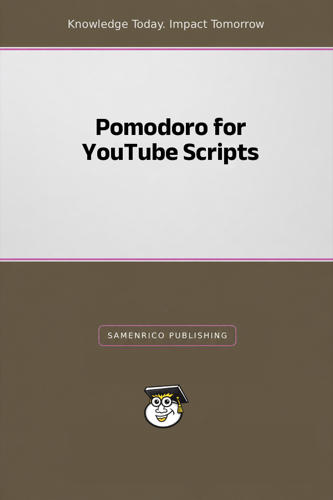
Pomodoro for YouTube Scripts eBook
Write video scripts in timed sessions to meet uplo
by Shay Debi
Write video scripts in timed sessions to meet upload schedules.
Formats
Free sample
Chapter 1: The Four Pillars--–- Before you can tame the timer, you must understand what you are building. Most creators sit down to write a You Tube script with only a vague sense of direction—"I'll make a video about this topic"—and then wonder why they spend eight hours staring at a blinking cursor. The problem is not laziness. The problem is not lack of talent. The problem is that you are trying to build a house without a blueprint, and the Pomodoro Technique cannot save you if you do not know what a finished script actually looks like.This chapter deconstructs the You Tube script into its fundamental architecture.
I call these the Four Pillars: The Hook, The Body, The Payoff, and The Call to Action. Every successful You Tube video, regardless of genre or length, rests on these four pillars. If any pillar is weak, the entire structure collapses. Viewers leave. The algorithm stops recommending your content.
And you find yourself trapped in the cycle of low views, high effort, and creeping burnout.The good news is that once you internalize these four pillars, the Pomodoro Technique becomes almost trivial to apply. You will know exactly how many 25-minute sprints to allocate to each section. You will stop overworking the parts that don't matter and underworking the parts that do. You will write faster not because you are rushing, but because you have a map.Let me start with a confession: I spent my first two years on You Tube writing scripts like essays. I opened with a polite introduction—"Hey everyone, today I want to talk about"—then slowly built my argument, added some background context, and eventually arrived at a conclusion.
My retention graphs looked like a ski slope dropping off a cliff at the 30-second mark. I blamed the algorithm. I blamed my audience's attention span. I blamed everything except my own misunderstanding of what a You Tube script is supposed to be.A You Tube script is not an essay. An essay earns the reader's attention gradually, trusting that someone who picked up a book or magazine will invest a few minutes before deciding to continue.
A You Tube video exists in a firehose of infinite competing content. The viewer's thumb is already hovering over the "back" button before you say your first word. You do not have the luxury of a slow build. You have five to ten seconds to convince a stranger to give you the next thirty seconds, and thirty seconds to convince them to give you the next three minutes.This is the fundamental structural difference that most creators never internalize. An essay is a contract: the reader agrees to invest time in exchange for eventual value.
A You Tube video is a series of micro-commitments: each second must earn the next second. The Four Pillars are the mechanism for earning those micro-commitments.Let me walk you through each pillar in detail.The Hook: Your First and Most Important Sentence The Hook occupies the first fifteen to thirty seconds of your video. Its job is singular: make the viewer forget that they were about to scroll past. The Hook does not summarize what you are going to say. The Hook does not welcome the viewer or introduce yourself.
The Hook seizes attention by violating an expectation, asking a provocative question, or promising a specific, urgent benefit.There are five proven types of hooks that work consistently on You Tube. I will give you each one with an example so you can hear the difference between a hook that works and one that fails.The first is the pattern interrupt. This hook works by saying something that contradicts what the viewer assumes to be true. For example: "Stop using the rule of thirds for your photography composition. It is making your images boring." The viewer who believes in the rule of thirds feels a jolt of cognitive dissonance.
They cannot scroll past because something in their brain says, "Wait, what? That goes against everything I know." They stay to hear your justification. The pattern interrupt works because humans are wired to pay attention to information that contradicts our existing beliefs.The second is the question hook. But not just any question. A weak question is "Have you ever struggled with editing?" The viewer has heard that a thousand times.
A strong question is specific, surprising, and targets a known frustration. For example: "Why does your footage look crisp on your camera screen but turn into a pixelated mess the second you upload it?" This question names a specific pain that the viewer has likely experienced but never heard articulated so precisely. They stay because you have proven that you understand their exact problem.The third is the story hook. This is not a full story but the opening line of a story that creates curiosity. For example: "Last Tuesday, I deleted a video that had 200,000 views.
Here is why." The viewer now wants to know why anyone would delete a successful video. The unfinished story creates an open loop in their mind, and humans have a strong drive to close open loops. They stay to find out what happens next.The fourth is the data hook. Numbers grab attention because they promise specificity and evidence. For example: "Ninety-one percent of You Tube creators will never see their channel grow past 1,000 subscribers.
But the nine percent who do share one habit." The specific number (91%) feels factual and authoritative. The contrast between 91% and 9% creates tension. The viewer wants to be in the 9%, so they stay.The fifth is the direct address hook. This hook speaks to the viewer's identity or situation. For example: "If you are a filmmaker who has spent more money on camera gear than on learning lighting, this video is for you." The viewer who recognizes themselves feels personally called out.
They stay because you have signaled that this content is specifically for people like them.Notice what none of these hooks do. None of them say "Hey guys, welcome back to the channel." None of them say "In this video, we're going to talk about." None of them thank the viewer for watching. Those phrases are not hooks. They are noise that tells the viewer's brain, "Nothing interesting is happening yet, feel free to leave."The Hook is the only pillar that cannot be delegated or diluted. You can have a mediocre Body and still keep viewers if your Hook is excellent.
You cannot have a weak Hook and recover, no matter how good the rest of your video is. The retention graph at the thirty-second mark is the single most important metric on You Tube. The Hook determines that metric.The Body: Delivering on Your Promise Once the Hook has secured the viewer's attention for the first thirty seconds, the Body must deliver the value that the Hook promised. If your Hook said, "Here are three lighting fixes that cost zero dollars," the Body had better provide three specific, actionable lighting fixes. If your Hook said, "Let me tell you why I deleted a 200,000-view video," the Body had better tell that story with rising tension and a…
This is the end of the free sample. Get the eBook to keep going. Buy now
About this book
Details
- Author
- Shay Debi
- Publisher
- SamEnrico
- Language
- English
- Genre
- Non-Fiction, Self-Help, YouTube Creation
- Released
- 2026-06-08
- Pages (approx.)
- 141
- Available as
- eBook, Audiobook

Read better in the ZLOADR app
Your eBooks on your phone or tablet. Sign in with your SamEnrico account and start reading.
More by Shay Debi
 Cluster Set Training GuideShay Debi$11.99
 The TM Breath TechniqueShay Debi$11.99
 Gut Health for Keto DietShay Debi$11.99
 The Nun Who Chanted for PeaceShay Debi$11.99
 The School of Hard KnocksShay Debi$11.99
 Step Five Confession GuideShay Debi$11.99
 Return Shame Overcoming GuideShay Debi$11.99
 Living Loss Grief WorkbookShay Debi$11.99
 The Southern Skies: James Dunlop and the Charting of the CosmosShay Debi$11.99
 The Last Whisper of the Deep: The Mystery of the Titanic’s Lost WhistleShay Debi$11.99
 The Healing Hands of the Nubian Physicians: Pioneers of Ancient MedicineShay Debi$11.99
 Toptal Client Acquisition SystemsShay Debi$11.99
You may also like
 Hong Kong Handover 1997Dunn Johnnie$11.99
 Zumba For Postnatal Recovery CourseNeal Christian$11.99
 Zumba for BeginnersLadner Nikia$11.99
 YouTube Comment Mining GuideHumes Pandora$12.99
 Worry Box MeditationCarlin Rudy$11.99
 Workplace Stress MeditationNguyen Lynn$11.99
 Workplace Stress and Sleep RepairHawley Ivory$11.99
 Workplace Perfectionism CureDelaney Jeffry$11.99
 Workplace Injustice Anger GuideWallen Isabelle$11.99
 Work Addiction and Burnout LinkGreenwood Ester$11.99
 Women in Yoga and WellnessBeattie Galina$11.99
 Women in Stand Up ComedyChun Evangeline$11.99