
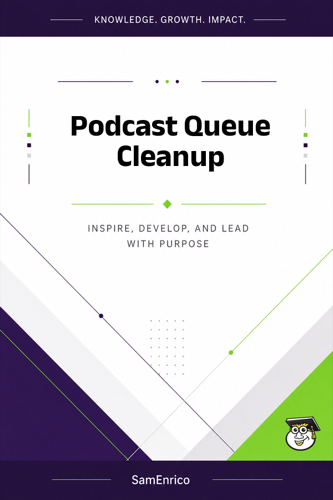
Podcast Queue Cleanup eBook
Unsubscribe from shows you never listen to anymore
Unsubscribe from shows you never listen to anymore.
Formats
Free sample
Chapter 1: The 47-Tab Mind--–- The average podcast listener subscribes to more than twenty shows but actively listens to fewer than five. This gap between subscription and consumption is not a moral failing. It is not a lack of discipline. It is not evidence that you are lazy, disorganized, or somehow broken. It is, instead, a perfectly predictable outcome of how the human brain responds to abundance—and how the attention economy has learned to exploit that response.Let me say that again, because it matters: you are not broken.The fact that you have three hundred and forty-seven unplayed episodes spread across seventeen different shows does not mean you have a character flaw.
It means you are a normal human being living in an era of unprecedented content abundance, and no one ever taught you how to manage it. The apps certainly did not teach you. The creators did not teach you. The algorithms actively worked against you learning. You have been set up to fail, and then made to feel guilty about failing, and then offered more content to distract yourself from the guilt.This chapter is where that cycle ends.We are going to name the enemy.
We are going to map the psychological traps that keep you subscribed to shows you never hear. We are going to understand why the "Mark as Played" button feels like a confession of failure rather than a tool for liberation. And we are going to begin the process of separating who you actually are from who you wish you were—because that separation is the secret door out of the backlog.But first, a confession of my own.The Backlog That Broke Me I was not always the person who writes books about cleaning up podcast queues. Once upon a time, I was the person who needed this book. My podcast app was a graveyard of good intentions.At my worst, I had forty-three active subscriptions.
The unplayed count hovered around six hundred episodes. That number is not a typo. Six hundred. I had episodes from 2017 still sitting in my feed, untouched, silently accumulating digital dust. I had paid for three separate Patreon tiers for shows I had not listened to in over a year.
I had downloaded episodes "for a flight" that I had taken eighteen months earlier.The worst part was not the number. The worst part was the feeling every time I opened the app.You know the feeling. That small spike of anxiety when the logo appears. The slight heaviness in your chest as you scroll past the same ten episodes you have been scrolling past for weeks. The guilty swipe to the next screen, as if looking at the backlog directly might force you to actually do something about it.
The quiet voice that says, "You really should listen to that episode about blockchain. You saved it for a reason."I never listened to the blockchain episode. I do not even remember what the reason was. But that episode sat in my feed for eleven months, judging me every single time I opened the app.The breaking point came on a Tuesday. I was sitting on a train, scrolling through my feed, trying to find something—anything—that I actually wanted to hear.
There were six hundred episodes, and none of them appealed to me. Not one. I had curated a library of content that theoretically interested me, and yet I felt no interest at all. I felt only obligation.That was the moment I realized: the backlog was not a library. It was a liability.The Average Listener's Dirty Secret Let me share some numbers that the podcast industry does not want you to see.According to listener data aggregated from multiple platforms, the average podcast subscriber follows between twenty and thirty shows.
The average active listener—meaning someone who opens their app at least once a week—will actually play episodes from only four to seven of those subscriptions in any given month. The rest sit untouched.Industry research on listener retention shows that churn is high, but here is the part they do not emphasize: most listeners do not actively unsubscribe. They just stop listening. Their subscriptions become digital ghosts, lingering in the feed long after the relationship has ended. This is not a failure of the listener.
It is a feature of the system.Think about what happens when you subscribe to a new show. You click a button. Maybe you hear a pleasant chime. The app congratulates you. The show's logo appears in your library.
You have taken an action, and the app has given you a small dopamine hit in return. You feel, for a moment, like you have accomplished something. You have added knowledge to your life. You have made a good choice.But nothing has actually changed. You have not listened to an episode.
You have not learned anything. You have simply added another obligation to a list that was already too long. The app does not care whether you listen. It cares whether you subscribe. Because subscriptions are the metric that sells advertising.
Subscriptions are the metric that attracts investors. Subscriptions are the metric that makes the platform look successful.Your unplayed episodes are not a problem to be solved. They are inventory to be monetized.I want you to sit with that for a moment. Your backlog is not your fault. It is the intended outcome of a system designed to prioritize accumulation over attention.
You have been playing a game where the rules were written by people who profit from your guilt.The Three Psychological Traps Now that we have established the context—the system, the incentives, the quiet conspiracy of platforms and creators—let us examine the specific psychological mechanisms that keep you trapped. I have identified three primary traps. They work together, reinforcing each other, creating a cage that feels like a choice.Trap One: FOMO (The Dopamine Subscription)The Fear of Missing Out is not just a cute acronym. It is a well-documented cognitive bias with measurable neurological effects. When you hear about a popular podcast—when a friend recommends it, when an influencer mentions it, when it appears at the top of the Apple Podcasts charts—your brain releases a small amount of dopamine in anticipation of a future reward.
The act of subscribing delivers that dopamine. The act of listening would require effort, time, and attention.So you subscribe. You get the hit. And then you never listen, because the dopamine is gone and the next recommendation is already waiting.This is sometimes called "digital hoarding," and it follows the same psychological pattern as physical hoarding. The accumulation of objects—or episodes—provides a sense of security and potential.
The object itself is not the point. The possession of the object is the point. You are not subscribing because you want to hear the episodes. You are subscribing because you want to have the episodes. They represent a version of you that is informed, cultured, intellectually curious—even if the actual you never presses play.I have seen this pattern in dozens of listeners.
They subscribe to shows about topics they genuinely care about. History, science, philosophy, current events. The shows are excellent. The…
This is the end of the free sample. Get the eBook to keep going. Buy now
About this book
Details
- Author
- Hammons Errol
- Publisher
- SamEnrico
- Language
- English
- Genre
- Non-Fiction, Self-Help, Audio
- Released
- 2026-06-11
- Pages (approx.)
- 135
- Available as
- eBook, Audiobook

Read better in the ZLOADR app
Your eBooks on your phone or tablet. Sign in with your SamEnrico account and start reading.
More by Hammons Errol
 The First Responder RegulationHammons Errol$11.99
 Teen Self Talk RewireHammons Errol$11.99
 Habit Formation for Real EstateHammons Errol$11.99
 Sacheen Littlefeather Oscar ProtestHammons Errol$11.99
 Music for Calm DrivingHammons Errol$11.99
 Data Presentation ClarityHammons Errol$11.99
 The Harmonic Code: The Mathematical Genius of Bakare GbolahanHammons Errol$11.99
 The Wind in Their Sails: How the Dutch Ruled the WavesHammons Errol$11.99
 A Collector's Handbook to the Invicta Black PrinceHammons Errol$11.99
 Visa Interview Document ChecklistHammons Errol$12.99
 Mobile Money Freemium GuideHammons Errol$12.99
 Service Providers Guide to Weight Loss ProgramsHammons Errol$11.99
You may also like
 Podcast Breath MeditationReeves Paul$11.99
 Voice Recording Dream LogVerdin Tiesha$11.99
 Music For Study GuideCartwright Salena$11.99
 Morning Routine Audio GuideKruger Norberto$11.99
 The Beginner's Audio GuideMyrick Hilaria$11.99
 Sleep Meditation Audio CollectionBethel Monnie$11.99
 Improv Audio Game CollectionCloud Elli$11.99
 Audio Memoir GuideMixon Danuta$11.99
 The Guided Body Scan AudioDavis Angelina$11.99
 Healing Affirmation AudioStill Christa$11.99
 Affirmation Recording GuideBurkett Mariella$11.99
 The Alcohol Sobriety PodcastsSwenson Halina$11.99