
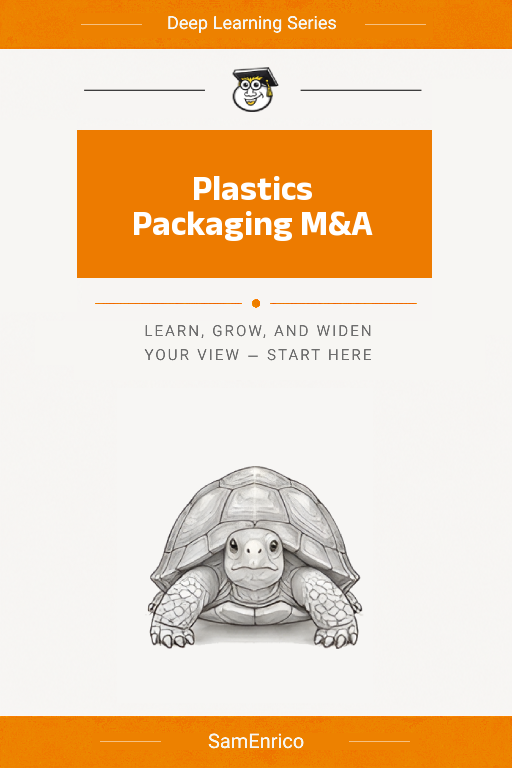
Non-FictionStrategic AtlasPackaging M&A
Plastics Packaging M&A eBook
Identify rigid and flexible packaging targets for
Identify rigid and flexible packaging targets for Amcor, Berry Global, Sealed Air, and Sonoco.
Formats
Free sample
Chapter 1: The Great Unwrapping...--The conference room on the 34th floor of One South Wacker Drive in Chicago smelled of stale coffee and desperation. It was November 2022, and the senior leadership team of a $2.8 billion rigid plastics packaging company—let us call it “Midwest Containers”—had just finished a nine-hour strategy offsite. The flip charts were covered with SWOT analyses and five-year forecasts. The consultant from Mc Kinsey had flown back to New York. And the CEO, a third-generation packaging veteran named Frank, was staring at a single number on a single page: the company’s EV/EBITDA multiple over the past five years.It had gone from 8.2x in 2018 to 6.1x in 2022.Over the same period, Amcor’s multiple had expanded from 9.5x to 11.3x.
Sealed Air’s had held steady around 10x. Even Sonoco, a company Frank had always dismissed as “too boring to matter,” had seen its multiple rise from 7.8x to 9.4x.“What are we doing wrong?” Frank asked the room.No one had a good answer. But the answer was sitting in plain sight, buried in the appendix of the consultant’s deck. Midwest Containers operated 19 manufacturing plants across eight product categories: beverage bottles, food containers, industrial pails, automotive parts, medical device housings, caps and closures, thermoformed trays, and a small custom molding business that made parts for lawnmowers. Nineteen plants.
Eight categories. One confused stock price.The conglomerate era of plastic packaging was over. Frank’s company just did not know it yet.The Conglomerate Discount: Why More Is Less The story of Midwest Containers is not an outlier. It is a parable for an entire industry that spent three decades believing that diversification was a virtue. From the 1980s through the early 2010s, the largest packaging companies in the world operated as mini-conglomerates.
They believed that owning a beverage bottle plant in Ohio, a medical tubing facility in Ireland, a flexible film converter in Thailand, and a metal can factory in Brazil spread risk and smoothed earnings. A downturn in beverages would be offset by strength in healthcare. A resin price spike would hurt rigid containers but leave flexible films relatively unscathed.There was only one problem. Public markets stopped believing in that logic around 2015.The evidence is overwhelming. Between 2015 and 2025, packaging conglomerates—defined as companies operating in four or more distinct end-markets with no single product category exceeding 40% of revenue—traded at an average discount of 22% to their sum-of-the-parts valuation.
In plain English, investors were saying: “We do not trust your internal capital allocation. Sell the pieces, and we will value each piece more highly on its own.”This phenomenon, known in finance as the conglomerate discount, has been studied across industries from automotive to aerospace. But it is unusually pronounced in plastic packaging for three specific reasons that this chapter will explore in depth.First, packaging end-markets have diverged dramatically in their growth trajectories. Healthcare packaging grows at 5-7% annually. Beverage rigid packaging has declined 1-2% per year since 2019.
A conglomerate that owns both is not diversified—it is a tug-of-war between growth and decline, with the declining segment pulling down the entire valuation.Second, resin procurement synergies (which we will model in detail in Chapter 7) only accrue when a buyer has massive, concentrated volume in a single resin type. A conglomerate that buys 50 million pounds each of PE, PP, PET, and PS across 19 plants has less negotiating power than a focused player that buys 150 million pounds of a single resin. The conglomerate is paying more for resin while earning less from investors—a double penalty.Third, and most importantly, the rise of ESG investing has changed the calculus of public market valuation. Environmental, social, and governance funds—which now control approximately $30 trillion globally—prefer simple, transparent stories. A company that “makes sustainable packaging for the healthcare industry” is an easy narrative.
A company that “makes plastic bottles for soda, medical devices for hospitals, and industrial pails for paint manufacturers” is a muddle. And muddles trade at discounts.The Sonoco Blueprint: From 20 Businesses to 2 Core Segments To understand how a packaging company escapes the conglomerate trap, there is no better case study than Sonoco. And because this case study will be referenced multiple times throughout this book—in our discussions of divestiture strategy (Chapter 9) and disciplined capital allocation (Chapter 6)—we will examine it in detail here.In 2018, Sonoco was a mess by almost any financial metric. Not a failing mess, but a drifting mess. The company reported $5.4 billion in revenue spread across twenty distinct business units.
It made rigid paper cans for nuts and pretzels. It made thermoformed plastic trays for fresh berries. It made metal ends for steel drums. It made temperature-assured packaging for pharmaceutical shipments (a division called Thermo Safe). It made protective packaging for industrial components.
It made custom blow-molded bottles for household cleaners. It made reels and spools for wire and cable. The list went on.Wall Street’s verdict was clear: no one could understand this company. Analyst reports from 2018 show that sell-side coverage of Sonoco was dominated by the phrase “sum-of-the-parts” —the polite way of saying “we think you are worth more dead than alive.” Sonoco’s EV/EBITDA multiple in 2018 was 7.8x, a full 1.5 turns below the packaging industry average.Then came the transformation.Between 2019 and 2024, Sonoco executed one of the most methodical portfolio simplifications in packaging history. The company sold or closed thirteen of its twenty business units.
The divestitures were not random. They followed a clear, repeatable framework that any M&A professional can apply, and which we will return to in Chapter 9’s Divestiture Scorecard.Signal One: The asset is growing slower than the parent company’s core. Thermo Safe was growing at 2% annually while Sonoco’s core consumer packaging business was growing at 4%. The gap was small, but it was persistent. In a conglomerate, the slower-growing asset drags down the multiple of the faster-growing parent.Signal Two: The parent recently made a large acquisition and needs debt paydown.
Sonoco acquired Eviosys, a European metal food can manufacturer, for 1.4billionin2022.Theacquisitiondoubleddownonthecompany’scoremetalpackagingexpertisebutrequiredsignificantleverage.Selling Thermo Safe—agoodbusiness,butanon−coreone—raised1.4 billion in 2022. The acquisition doubled down on the company’s core metal packaging expertise but required significant leverage. Selling Thermo Safe—a good business, but a non-core one—raised 1.4billionin2022.Theacquisitiondoubleddownonthecompany’scoremetalpackagingexpertisebutrequiredsignificantleverage.Selling Thermo Safe—agoodbusiness,butanon−coreone—raised950 million that retired the acquisition debt within 18 months.Signal Three: The asset has “strategic misfit.” Thermo Safe served the pharmaceutical cold chain. Sonoco’s core was consumer and industrial packaging. There were no cross-selling opportunities, no resin purchasing synergies, no shared customers.
Thermo Safe’s salesforce never talked to the metal can salesforce. The two businesses might as well have been in different industries.When Sonoco sold Thermo Safe to a private equity buyer in 2023 for $950 million (9.2x EBITDA), the market reacted immediately. Sonoco’s stock rose 8% in the week following the announcement. By 2024, after completing the full simplification to just two core segments (Consumer and Industrial), Sonoco’s EV/EBITDA multiple had expanded from 7.8x to 9.4x—a 20% increase in valuation without any improvement in underlying operational performance. The company was worth more because it was simpler.This is the central lesson of Chapter…
This is the end of the free sample. Get the eBook to keep going. Buy now
About this book
Details
- Author
- Fairbanks Ferne
- Publisher
- SamEnrico
- Language
- English
- Genre
- Non-Fiction, Strategic Atlas, Packaging M&A
- Released
- 2026-06-01
- Pages (approx.)
- 156
- Available as
- eBook, Audiobook

Read better in the ZLOADR app
Your eBooks on your phone or tablet. Sign in with your SamEnrico account and start reading.
More by Fairbanks Ferne
 Weekly Interruption Audit WorkbookFairbanks Ferne$11.99
 Indian Agent Remote ManagementFairbanks Ferne$11.99
 The Samson Raphael Hirsch Neo OrthodoxyFairbanks Ferne$11.99
 Anthropology Essay AI GuideFairbanks Ferne$11.99
 Workplace Microaggression Anger ResponseFairbanks Ferne$11.99
 The Healers of Nubia: Medicine and Majesty in the Land of the NileFairbanks Ferne$11.99
 Understanding PneumothoraxFairbanks Ferne$17.99
 QuickBooks for Contractors GuideFairbanks Ferne$12.99
 BakingFairbanks Ferne$11.99
 How to Start a Optical and Precision Goods (retail) Business (Beginners Guide)Fairbanks Ferne$11.99
You may also like
 Hong Kong Handover 1997Dunn Johnnie$11.99
 Zumba For Postnatal Recovery CourseNeal Christian$11.99
 Zumba for BeginnersLadner Nikia$11.99
 YouTube Comment Mining GuideHumes Pandora$12.99
 Worry Box MeditationCarlin Rudy$11.99
 Workplace Stress MeditationNguyen Lynn$11.99
 Workplace Stress and Sleep RepairHawley Ivory$11.99
 Workplace Perfectionism CureDelaney Jeffry$11.99
 Workplace Injustice Anger GuideWallen Isabelle$11.99
 Work Addiction and Burnout LinkGreenwood Ester$11.99
 Women in Yoga and WellnessBeattie Galina$11.99
 Women in Stand Up ComedyChun Evangeline$11.99