
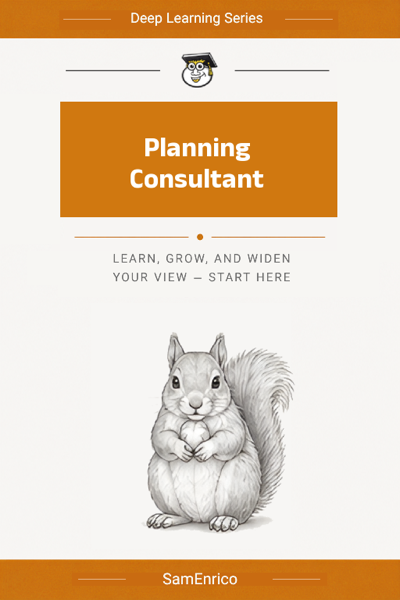
Non-FictionInformativeEducational
Planning Consultant eBook
A Coursebook on Planning Consultant
by Tam Naida
A Coursebook on Planning Consultant
Formats
Free sample
Chapter 1: The Strategic Physician...--–- The first time Maria lost a million dollars, she didn't even know it. She was too busy celebrating.The conference room in Portland's tallest high-rise smelled of fresh paint and expensive coffee. Maria Vasquez, a senior planner with twelve years of experience at a respected regional firm, had just delivered what she believed was the finest presentation of her career. For ninety minutes, she had walked the city council through two hundred pages of meticulous analysis—traffic projections, environmental impact studies, zoning recommendations, phasing schedules, and a beautifully rendered vision of the downtown riverfront transformed into a mixed-use paradise of housing, retail, and public space.The council members nodded. The mayor smiled.
The community stakeholders in the back row actually applauded."Outstanding work, Maria," the mayor said. "This is exactly what we needed."She drove home that evening with the windows down, replaying the moment like a highlight reel. Eighteen months of work. Thousands of hours. A team of seven brilliant planners and engineers.
And now, finally, the plan would move to implementation. She would be remembered as the consultant who saved the Riverfront District.Eight months later, the Riverfront District was a crater.Not a literal crater, though it might as well have been. The city had broken ground on the first phase—a new parking garage and a relocated transit stop—when a coalition of neighborhood groups filed a lawsuit. The suit alleged that the environmental impact statement had inadequately addressed displacement of low-income renters who, it turned out, lived in three apartment buildings that Maria's team had marked on a map but never entered. Then a newly elected council member, who had campaigned against "elite consultant fantasies," froze the project's budget allocation.
Then the federal grant that Maria's plan had assumed as guaranteed was delayed by twelve months due to an administrative review no one had predicted.Then the contractor walked. Then the local newspaper ran a front-page story with the headline "Riverfront Boondoggle."By the time Maria was called to testify before a special committee, the project was $4 million over its original budget with nothing to show but a half-built garage and a transit shelter that homeless residents had already claimed as their own."How did this happen?" the committee chair asked. "You were the expert. Your firm was the best in the region. We paid you half a million dollars for a plan.
What went wrong?"Maria opened her mouth to answer. And realized she had no idea.She had done everything right. Every tool in the planning consultant's standard playbook—the community workshops (six of them), the stakeholder interviews (forty-two of them), the traffic models, the fiscal impact analysis, the phasing plan, the implementation matrix. She had followed the methodology taught in graduate school, practiced at her previous firm, and refined over a decade of successful projects.But success, she was beginning to understand, had been an illusion. Her previous projects hadn't succeeded because her methods were sound.
They had succeeded because the political stars had aligned—the right champions, the right funding environment, the right combination of luck. And when the stars misaligned on Riverfront, her methods were exposed as what they really were: a collection of techniques for producing documents, not a system for producing change.She testified for three hours. She apologized. She offered to reduce her final invoice. She went home and stared at her ceiling until 3 AM.That night, Maria made a decision.
She would figure out what she had missed. She would learn the difference between a consultant who delivers plans and a consultant who delivers results. And she would never, ever let a million dollars of public money evaporate on her watch again.This book is for Maria. And for every planner, strategist, and consultant who has ever watched their brilliant plan die on a shelf—or worse, watched it get built and fail anyway.The Order-Taker Trap Maria's story is not unusual. It is, in fact, the norm.Every year, tens of thousands of planning consultants deliver hundreds of thousands of strategic plans, master plans, transportation plans, economic development plans, and community visions.
The vast majority of these plans are never fully implemented. A significant minority are not implemented at all. And a heartbreaking few are implemented exactly as designed—and still fail to achieve their intended outcomes.Why?The answer begins with a fundamental misunderstanding of what a planning consultant actually does. Ask ten people to define the role, and you will hear something like this: "A planning consultant helps organizations figure out what to do and how to do it." Or, more cynically: "A planning consultant is an expert who tells you what you already know in fancier language."Both definitions are wrong. Or, more precisely, both definitions describe a model of consulting that is catastrophically incomplete.Let me introduce you to the three models of consulting that dominate the planning profession.
You have likely practiced all three at various points. Only one of them reliably produces results.The Expert Model In the Expert Model, the client hires you because you know something they don't. You possess specialized knowledge—traffic engineering, zoning law, environmental impact analysis, financial modeling for public-private partnerships—and the client pays you to apply that knowledge to their problem.This model is seductive. It feels good to be the smartest person in the room. It feels even better to command high hourly rates for your specialized expertise.
And for certain narrowly defined problems, the Expert Model works beautifully. If a client needs a traffic study to satisfy a regulatory requirement, you can deliver that study, collect your fee, and move on with a clear conscience.But the Expert Model carries a hidden risk that most consultants never acknowledge. When you operate as an expert, you are making an implicit promise: that the problem the client has defined is the right problem to solve.This is almost never true.Clients are notoriously bad at defining their own problems. Not because they are stupid—most planning clients are intelligent, experienced professionals—but because they are trapped inside the system they are trying to change. They see symptoms, not causes.
They name technical problems when the real issues are political or cultural. They ask for a traffic study when what they actually need is a community engagement strategy. They request a zoning rewrite when the deeper problem is a planning department that has lost the trust of the very communities it serves.When you accept a client's problem definition uncritically, you become an accomplice to their misdiagnosis. You apply your expert tools to the wrong problem with impressive precision, producing a solution that is technically flawless and strategically useless. This is the "narrow trap" that Maria fell into.
The city asked for a riverfront plan. What they needed was a political process for reconciling competing interests, a communication strategy for building trust with displaced residents, and a risk management framework for navigating funding uncertainty. Maria gave them the plan they asked for. She did not give them what they needed.The Pair-of-Hands Model The Pair-of-Hands Model is even more dangerous, precisely because it feels so efficient. In this…
This is the end of the free sample. Get the eBook to keep going. Buy now
About this book
Details
- Author
- Tam Naida
- Publisher
- SamEnrico
- Language
- English
- Genre
- Non-Fiction, Informative, Educational
- Released
- 2026-05-11
- Pages (approx.)
- 152
- Available as
- eBook, Audiobook

Read better in the ZLOADR app
Your eBooks on your phone or tablet. Sign in with your SamEnrico account and start reading.
More by Tam Naida
 The Reward FundTam Naida$11.99
 Collector Addiction RecoveryTam Naida$11.99
 The Emotion Wheel WorkbookTam Naida$11.99
 Legacy Of Adventure GuideTam Naida$11.99
 Scott Peterson Forensic PodcastsTam Naida$11.99
 Fort Duquesne Falls: The British Gambit That Won the WestTam Naida$11.99
 UAE Virtual Work Visa GuideTam Naida$12.99
 Factoring vs Bank OverdraftTam Naida$12.99
 Understanding Viscero-atrial HeterotaxiaTam Naida$17.99
 How to Start a Newspapers (retail) Business (Beginners Guide)Tam Naida$11.99
You may also like
 Hong Kong Handover 1997Dunn Johnnie$11.99
 Zumba For Postnatal Recovery CourseNeal Christian$11.99
 Zumba for BeginnersLadner Nikia$11.99
 YouTube Comment Mining GuideHumes Pandora$12.99
 Worry Box MeditationCarlin Rudy$11.99
 Workplace Stress MeditationNguyen Lynn$11.99
 Workplace Stress and Sleep RepairHawley Ivory$11.99
 Workplace Perfectionism CureDelaney Jeffry$11.99
 Workplace Injustice Anger GuideWallen Isabelle$11.99
 Work Addiction and Burnout LinkGreenwood Ester$11.99
 Women in Yoga and WellnessBeattie Galina$11.99
 Women in Stand Up ComedyChun Evangeline$11.99