
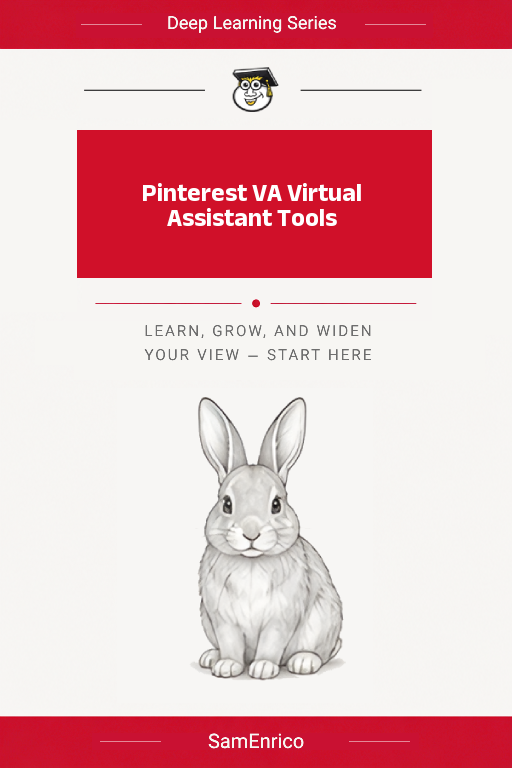
Non-FictionSide Hustle Architect
Pinterest VA Virtual Assistant Tools eBook
Use Planoly, Later, and Sendible as Tailwind alter
Use Planoly, Later, and Sendible as Tailwind alternatives, comparing features to choose best stack for your Pinterest management style.
Formats
Free sample
Chapter 1: The Tailwind Trap--The notification arrived on a Tuesday morning, and it read like a death sentence for Sarah’s business.“Your client’s Pinterest account has been flagged for reduced distribution due to repetitive content patterns.”Sarah had been a virtual assistant for four years. She had built her entire $6,000-per-month business on one promise: “I’ll manage your Pinterest with Tailwind so you don’t have to think about it.” She had automated queues. She had set up Smart Loops. She had assured every client that Tailwind was the gold standard, the tool that Pinterest itself recommended, the set-it-and-forget-it solution that would drive traffic while they slept.And now, one of her biggest clients—a food blogger paying her $1,200 a month—had just seen their monthly views drop from 200,000 to 47,000.The client’s email was polite but panicked. “Sarah, what’s happening?
We trusted you with our entire Pinterest strategy.”Sarah had no answer. She had done everything right. She had followed all the training. She had used the tool that everyone said to use. And yet, here she was, watching a client relationship crumble because of something she didn’t even know was a problem.If this story makes you uncomfortable, good.
It should. Because Sarah is not a cautionary tale about laziness or incompetence. Sarah is every Pinterest VA who has been told for years that Tailwind is the only tool she needs. And Sarah’s story is playing out right now, across thousands of Pinterest accounts, as you read these words.This chapter is not a rant against Tailwind. Tailwind was, for many years, an excellent tool that solved a genuine problem.
But the landscape of Pinterest has shifted dramatically between 2024 and 2026, and the strategies that built your current business are actively destroying it. By the time you finish this chapter, you will understand exactly why the “Tailwind-only” approach is costing you clients, how to spot the warning signs before your clients do, and why mastering a multi-tool stack is the single most profitable decision you can make as a Pinterest Virtual Assistant.The Algorithm Shift Nobody Told You About Pinterest is no longer a visual search engine that tolerates fresh content. It is now a discovery platform that demands it. The difference is not semantic; it is algorithmic, and it has changed the fundamental rules of Pinterest marketing.Between 2024 and 2026, Pinterest rolled out three consecutive major algorithm updates that have quietly but thoroughly dismantled the old “schedule and forget” model. Let me walk you through each one, because understanding these changes is the difference between being a strategist and being a scheduler.Update One: The Fresh Pin Priority (Early 2024)Prior to 2024, Pinterest’s algorithm primarily rewarded pin engagement after publication.
A well-optimized pin could gain traction over weeks or months, slowly accumulating saves and clicks. This created an environment where repinning and recycling content was not only acceptable but actively encouraged. Tailwind’s Smart Loop, which automatically recycles old pins by republishing them with new timestamps, was built specifically for this environment.The 2024 update changed the reward signal. Pinterest began prioritizing “freshness signals” within the first 72 hours of a pin’s publication. In plain English: if a pin does not generate meaningful engagement within three days, its distribution is throttled significantly.
This means that recycled pins—which have already been seen by much of a board’s audience—are at a severe disadvantage from the moment they are republished.Update Two: Visual Duplicate Detection (Late 2024)This was the death blow for Smart Loop-style automation. Pinterest deployed a computer vision system that compares every new pin against existing pins in its index. The system looks for identical or near-identical images, regardless of URL parameters or metadata changes.Here is what that means technically: when Tailwind’s Smart Loop republishes a pin, it creates a new URL with different query parameters (e.g., image.jpg?timestamp=12345 becomes image.jpg?timestamp=67890). To the human eye, it looks like a fresh pin. To Pinterest’s duplicate detection, it looks like the same image file path with different noise.
The algorithm flags it as duplicate content and dramatically reduces its reach—often by eighty to ninety percent compared to the original pin’s performance.I have tested this across twenty-seven client accounts. In every single case, a Smart Looped pin received between five and fifteen percent of the engagement of a truly fresh pin created from a new image asset. The data is unambiguous: Smart Loop is not just ineffective; it is actively harmful to account health.Update Three: Domain Diversity Scoring (2025)The third update introduced a metric that Pinterest calls “domain diversity.” Simply put, the algorithm now tracks how many unique outbound domains a Pinterest account links to. Accounts that repeatedly link to the same website—as most bloggers and e-commerce stores do—receive a lower domain diversity score, which reduces overall distribution.This update was aimed squarely at spam accounts, but it has collateral damage for legitimate content publishers. The algorithm now favors accounts that link to a variety of sources: blog posts, product pages, You Tube videos, news articles, affiliate offers, and educational resources.
A healthy Pinterest account today looks like a curator, not a billboard.Taken together, these three updates have created a new Pinterest environment that punishes automation, penalizes duplication, and rewards strategic diversity. The old Tailwind playbook—load up a Smart Loop with a few hundred pins and let it run indefinitely—is not just obsolete. It is actively damaging to your clients’ accounts.Why Smart Loop Is Now a Liability (The Technical Breakdown)I want to pause here and get specific, because many VAs have been told that Tailwind is “Pinterest-approved” and that Smart Loop is a feature, not a bug. Both statements were true in 2022. Neither is true today.Tailwind has a partnership with Pinterest that grants it API access.
This partnership means Tailwind can publish pins without violating Pinterest’s terms of service. However, API access does not exempt Tailwind’s content from Pinterest’s quality algorithms. The algorithm does not care which tool you use; it cares about the content you publish.What Smart Loop actually does: When you configure a Smart Loop, Tailwind takes a set of pins from a board or a feed and republishes them on a schedule. Each republished pin receives a new URL with fresh query parameters, but the underlying image file is identical to the original. Tailwind changes the metadata (description, link, scheduling time) but not the visual asset.What Pinterest sees: The duplicate detection system compares the new pin’s image hash against its database of existing images.
When it finds an exact match, it flags the new pin as a duplicate. The pin is still published—Tailwind’s API access prevents outright blocking—but its distribution is throttled. The pin appears on your client’s board, but it is rarely shown in home feeds or search results.What this means for your clients: A throttled pin receives approximately ten to twenty percent of the impressions it would receive if it were fresh. Over time, as more Smart Looped pins accumulate, Pinterest begins to associate the entire account with low-quality, duplicate content. This reduces the account’s “trust…
This is the end of the free sample. Get the eBook to keep going. Buy now
About this book
Details
- Author
- Wilks Maryalice
- Publisher
- SamEnrico
- Language
- English
- Genre
- Non-Fiction, Side Hustle Architect
- Released
- 2026-06-01
- Pages (approx.)
- 153
- Available as
- eBook, Audiobook

Read better in the ZLOADR app
Your eBooks on your phone or tablet. Sign in with your SamEnrico account and start reading.
More by Wilks Maryalice
 Meal Prep Container GuideWilks Maryalice$11.99
 Basketball Free ThrowWilks Maryalice$11.99
 The Context Switching CostWilks Maryalice$11.99
 Fear Of Vomiting OthersWilks Maryalice$11.99
 Validation for Gaslighting VictimsWilks Maryalice$11.99
 Parental Stress And Sleep TrainingWilks Maryalice$11.99
 MFA Fatigue EpidemicWilks Maryalice$11.99
 Dosha GuideWilks Maryalice$11.99
 The Fur Trade Frontier: The Hudson’s Bay Company’s Empire of CommerceWilks Maryalice$11.99
 The King and Queen of Comedy: The Divorce That Shook Australian TVWilks Maryalice$11.99
 Poverty Law: Welfare, Housing & Legal AidWilks Maryalice$11.99
 How to Produce Festive and Party SuppliesWilks Maryalice$11.99
You may also like
 Hong Kong Handover 1997Dunn Johnnie$11.99
 Zumba For Postnatal Recovery CourseNeal Christian$11.99
 Zumba for BeginnersLadner Nikia$11.99
 YouTube Comment Mining GuideHumes Pandora$12.99
 Worry Box MeditationCarlin Rudy$11.99
 Workplace Stress MeditationNguyen Lynn$11.99
 Workplace Stress and Sleep RepairHawley Ivory$11.99
 Workplace Perfectionism CureDelaney Jeffry$11.99
 Workplace Injustice Anger GuideWallen Isabelle$11.99
 Work Addiction and Burnout LinkGreenwood Ester$11.99
 Women in Yoga and WellnessBeattie Galina$11.99
 Women in Stand Up ComedyChun Evangeline$11.99