
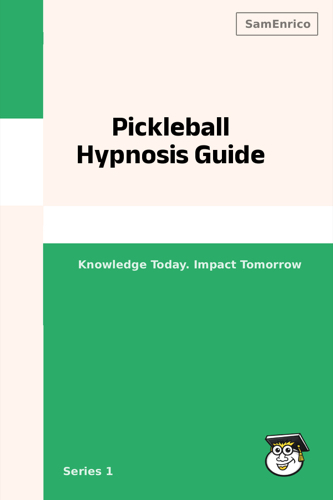
Non-FictionSelf-HelpPickleball
Pickleball Hypnosis Guide eBook
Sharpens dinking and court positioning for older a
Sharpens dinking and court positioning for older athletes.
Formats
Free sample
Chapter 1: The Knowing-Doing Gap--–- The ball leaves your opponent’s paddle at roughly thirty miles per hour. It will cross the net in less than half a second. It will bounce once, maybe twice, and then it will be gone. In that sliver of time, your brain must perform a series of calculations that would stump a supercomputer: trajectory, spin, velocity, depth, angle, wind, your position, your partner’s position, the opponent’s position, the kitchen line, the score, the game situation, and the optimal shot selection.And yet, somehow, you do it. Not every time, but often enough to keep playing.
Often enough to love the game.But here is the question that haunts every senior pickleball player who has ever muttered “I know what I should have done” after a missed shot: If you know what to do, why did you do something else?This is the knowing-doing gap. It is the distance between understanding a skill and executing it under pressure. It is the reason drill champions often become game disappointments. It is the most frustrating, humiliating, and widespread problem in all of amateur sports.And it has nothing to do with your age.The Anatomy of a Missed Shot Let us set the scene. You are at the kitchen line.
The rally has been going for twelve shots—a good, long dink battle. Your knees are bent. Your paddle is up. Your eyes are tracking the ball. Your opponent, a player you have beaten before but who always makes you work, reaches for a low ball and sends it floating toward your backhand side.In that instant, your conscious mind fires off a rapid sequence of thoughts.
Some of them are useful. Most of them are not.“Backhand. Step in. Paddle face open. No, wait, closed?
Soft hands. Don’t pop it up. You popped it up last time. His partner is cheating to the middle. Maybe go cross-court?
No, he’s fast. Down the line? That’s risky. Just get it over. Don’t mess up.
Everyone is watching. The guy on the next court is definitely watching. Your partner is going to be so annoyed if you—”The ball hits your paddle. You don’t even feel the contact. The ball sails into the net, or floats long, or pops up like a offering to the pickleball gods.
Your partner sighs. You walk to the back of the court, replaying the error in your mind, trying to figure out what went wrong.Here is what went wrong: you were thinking.Not the kind of thinking that helps—strategic thinking, reading the opponent, anticipating the next shot. You were thinking about how to perform the shot. You were analyzing your own mechanics in real time. You were coaching yourself while the ball was in the air.This is the knowing-doing gap made visible.
The knowledge was there. You know how to hit a backhand dink. You have done it thousands of times. But the knowledge could not translate into action because your conscious mind was clogging the pipeline.The Two Brains Revisited In Chapter 1 of this book, you were introduced to the concept of two processing systems in your brain. System 1 is fast, automatic, and subconscious.
System 2 is slow, analytical, and conscious. You learned that overthinking forces System 2 to take over, slowing your reactions and introducing tension into your body.Now we need to go deeper. Because the relationship between these two systems is not simply “System 1 good, System 2 bad.” Both systems are essential. The problem is timing.During a pickleball rally, System 2 is like a backseat driver. It has opinions.
It has advice. It has a running commentary on every turn you take and every brake you apply. But it is not holding the steering wheel. It cannot react quickly enough to avoid an accident. Its job is to navigate—to look at the map, to plan the route, to make strategic decisions when the car is parked.When the car is moving, the backseat driver needs to be quiet.The challenge for senior athletes is that System 2 becomes more talkative with age.
You have more knowledge, so you have more to say. You have more memories of mistakes, so you have more warnings to issue. You have more awareness of your physical limitations, so you have more concerns to raise.All of this internal chatter is well-intentioned. But it is disastrous for performance.Why Drill Champions Struggle in Matches If you have been playing pickleball for any length of time, you have encountered this phenomenon. There is a player at your courts—maybe it is you, maybe it is someone you know—who looks like a professional during drills.
Their dinks are soft and low. Their drops land perfectly in the kitchen. Their volleys are crisp and controlled.Then the game starts.Suddenly, that same player cannot keep the ball in bounds. Their dinks float. Their drops catch the net.
Their volleys sail long. They look like a different person.What happened?During drills, there is no pressure. There is no score. There is no opponent trying to exploit your weaknesses. There is no partner relying on you.
There is no audience. Your System 2 is relaxed because there is nothing to fear.During a game, all of those elements are present. Your System 2 detects the pressure and activates your sympathetic nervous system—the fight-or-flight response. Your heart rate increases. Your muscles tense.
Your breathing becomes shallow. And your internal monologue shifts from “Let’s practice this shot” to “Don’t mess this up.”That shift is the killer.The drill champion has the same skills during a game that they have during practice. But their ability to access those skills is compromised by their mental state. The knowing-doing gap widens under pressure.Hypnosis closes that gap by teaching you to maintain a relaxed, focused state regardless of the situation. It trains your System 2 to step aside when the ball is in play.
It gives you tools to quiet the internal monologue and trust your System 1.The Cost of the Gap Let us be specific about what the knowing-doing gap costs you.Lost Points. This is the most obvious cost. Every time you miss a shot you know how to make, you lose a point. Over the course of a game, those lost points add up. A single unforced error can shift momentum.
Three unforced errors in a row can lose a game entirely.Lost Confidence. The knowing-doing gap is a confidence killer. When you repeatedly fail to execute shots you know you can make, you start to doubt yourself. That doubt becomes another voice in your internal monologue: “You can’t make this shot. You always miss this shot.” The gap widens further.Lost Enjoyment.
Pickleball is supposed to be fun. But when you are trapped in your own head, analyzing every mistake, coaching yourself through every shot, the game becomes a chore. The joy of movement, the pleasure of competition, the camaraderie of the court—all of it fades when you are stuck in the knowing-doing gap.Physical Strain. As you learned in Chapter 1, overthinking creates physical tension. That tension is not…
This is the end of the free sample. Get the eBook to keep going. Buy now
About this book
Details
- Author
- Mcclain Porsche
- Publisher
- SamEnrico
- Language
- English
- Genre
- Non-Fiction, Self-Help, Pickleball
- Released
- 2026-06-10
- Pages (approx.)
- 135
- Available as
- eBook, Audiobook

Read better in the ZLOADR app
Your eBooks on your phone or tablet. Sign in with your SamEnrico account and start reading.
More by Mcclain Porsche
 Desert Night StargazingMcclain Porsche$11.99
 Digital Communication for ExtrovertsMcclain Porsche$11.99
 Moonlit Beach VisualizationMcclain Porsche$11.99
 The Writer Focus GuideMcclain Porsche$11.99
 Self Talk for ParentingMcclain Porsche$11.99
 Boxer's Self Hypnosis GuideMcclain Porsche$11.99
 The Senior Hope GuideMcclain Porsche$11.99
 The Last Oracle of Delphi: Secrets of the Ancient PriestessesMcclain Porsche$11.99
 The Shadow of the White Queen: The Assassination That Sparked a Cartel WarMcclain Porsche$11.99
 How to Produce Pizza PansMcclain Porsche$11.99
 How to Produce Diaper Rash TreatmentMcclain Porsche$11.99
 A Collector's Handbook to the Wolseley 60 Series IiiMcclain Porsche$11.99
You may also like
 Hong Kong Handover 1997Dunn Johnnie$11.99
 Zumba For Postnatal Recovery CourseNeal Christian$11.99
 Zumba for BeginnersLadner Nikia$11.99
 YouTube Comment Mining GuideHumes Pandora$12.99
 Worry Box MeditationCarlin Rudy$11.99
 Workplace Stress MeditationNguyen Lynn$11.99
 Workplace Stress and Sleep RepairHawley Ivory$11.99
 Workplace Perfectionism CureDelaney Jeffry$11.99
 Workplace Injustice Anger GuideWallen Isabelle$11.99
 Work Addiction and Burnout LinkGreenwood Ester$11.99
 Women in Yoga and WellnessBeattie Galina$11.99
 Women in Stand Up ComedyChun Evangeline$11.99