
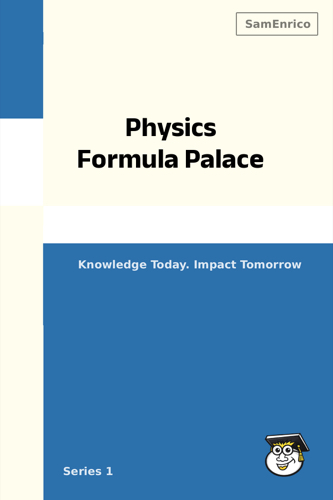
Physics Formula Palace eBook
Memorize laws and equations using spatial memory t
Memorize laws and equations using spatial memory techniques.
Formats
Free sample
Chapter 1: The Coat Rack Conspiracy--– You have already memorized physics. You just don’t know it yet.Let me prove it to you in the next ten seconds. Close your eyes—or don’t, but imagine this. Picture the front door of the place where you slept last night. See the color.
Feel the handle. Now walk inside. Look to your left. What object is there? A shoe rack?
An umbrella stand? A pile of mail? Now look to your right. A mirror? A coat rack?
A table with keys on it?You just recalled a half-dozen spatial locations without effort. You didn’t cram them. You didn’t use a flashcard app. You walked through that space once, maybe a thousand times, and your brain said: “This matters. Keep it.”Now answer this: What is the first equation in most physics textbooks?
If you said v=u+atv = u + atv=u+at, you’re either a physics teacher or you’ve been traumatized by one. But here’s the strange thing. That equation is not harder to remember than the position of your coat rack. It just feels harder because your brain doesn’t know where to put it.This book is going to give you a place to put it. A real place.
A room in a mental mansion that you will build, decorate, and walk through until every law of motion, every conservation principle, and every maddening Greek letter lives exactly where you left it.Welcome to the Newtonian Foyer. Your first room. And the conspiracy is this: someone convinced you that physics equations belong on paper. They don’t. They belong on coat racks, staircases, and paintings.
Let me show you how.The Problem with Paper Memory Before we build anything, we need to understand why traditional physics study fails so spectacularly for so many people. You have likely experienced the following cycle:Read an equation in a textbook.Write it down three times.Recite it five times.Feel confident.See the same equation on a test one week later.Draw a complete blank. Or worse, confuse it with a different equation that looks similar.This is not a character flaw. This is not a sign that you “aren’t a physics person.” This is the Ebbinghaus forgetting curve in action. In the 1880s, German psychologist Hermann Ebbinghaus discovered that without reinforcement, humans forget approximately 50% of new information within one hour, 70% within 24 hours, and nearly 90% within one week.
Your brain is not being lazy. It is being efficient. It prioritizes information that appears relevant to survival and spatial navigation—where the waterhole is, which path is safe, where the couch is—and discards abstract symbols that float in a vacuum.Equations are abstract symbols. They have no color, no smell, no location, no emotional weight. When you memorize an equation by repeating it like a mantra, you are asking your prefrontal cortex to do the job of your ancient spatial memory system.
That is like asking a poet to perform open-heart surgery. It can be done, but it is exhausting, error-prone, and completely unnecessary.The solution is not to memorize harder. The solution is to memorize differently. To translate the abstract into the spatial. To turn vf=vi+atv_f = v_i + atvf=vi+at into a coat rack.What Is a Memory Palace?You have likely heard of the Method of Loci—the memory technique used by ancient Greek and Roman orators to deliver hours-long speeches without notes.
The name comes from the Latin word for “places.” Here is how it works in one sentence: you take a familiar physical space, assign one piece of information to each location in that space, and then mentally walk through the space to retrieve the information.That is it. That is the entire secret. No magic. No genetic gift. Just geography.In this book, we are not building a generic memory palace.
We are building a Physics Formula Palace—a specialized mental mansion where every room corresponds to a branch of physics, every object encodes a specific equation, and every walkway connects related concepts. By the time you finish this book, you will have built:A Newtonian Foyer (kinematics and vectors)A Force and Motion Living Room (Newton’s laws and momentum)An Energy Conservatory (work, power, and conservation)A Rotational Roundabout (angular kinematics and torque)A Gravitational Observatory (universal gravity and orbits)An Electromagnetic Corridor (Coulomb and Gauss)A Circuit Cellar (Ohm, Kirchhoff, and power)A Magnetic Gallery (Ampère, Faraday, and induction)A Wave and Sound Alcove (harmonic motion and standing waves)A Thermodynamic Kitchen (gas laws and entropy)A Modern Physics Attic (quantum and relativity)A Review Dome (retrieval drills and expansion)And before all of that, a Constants Closet that you will build in Chapter 0.5 (yes, we start there—turn back one chapter if you skipped it). That closet holds every universal constant you will need, so you never again wonder whether GGG is 6.67×10−116.67 \times 10^{-11}6.67×10⁻¹¹ or 9.819.819.81.But first, the foyer. The entrance to your palace. The room that sets the rules for everything that follows.The Architecture of the Newtonian Foyer Close your eyes.
(Or keep them open. I am not your supervisor.) Picture a grand entrance hall. Not a cramped apartment hallway—this is a foyer. High ceiling. Good lighting.
A floor you could polish to a mirror shine. This is the first room anyone sees when they enter your mental mansion, so make it impressive.Now, place the following objects in this room. They will not move. They will not change color. They will be here when you return tomorrow, next week, or next year.Object 1: The Coat Rack Against the left wall, place a sturdy wooden coat rack.
It has four hooks at different heights. On the highest hook, hang a black umbrella. On the middle hook, hang a clock. The clock ticks audibly. On the lowest hook, hang nothing—leave it empty for now.This coat rack encodes the first equation of kinematics: vf=vi+atv_f = v_i + atvf=vi+at.Here is the translation:The rack itself is the final velocity vfv_fvf.
Racks hold things; final velocity holds the result of the equation.The umbrella is the initial velocity viv_ivi. An umbrella starts closed, then opens—just as initial velocity is where motion begins.The clock is acceleration times time atatat. The clock ticks seconds (time), and the act of hanging it on the rack with the umbrella represents multiplication.The empty hook? That is for you to add a second acceleration term if you ever study jerk (the derivative of acceleration). Most students will never need it, but the space is there.Now, anchor this image with a tiny action.
Every time you walk into your foyer, imagine taking the umbrella and the clock off the rack, then putting them back. The motion of your hand reinforces the equation. Do this three times today, once tomorrow, and once next week. You will never forget vf=vi+atv_f = v_i + atvf=vi+at again.Object 2: The Main Staircase Directly ahead of you, a staircase ascends to the second floor. This is not the spiral staircase you will build…
This is the end of the free sample. Get the eBook to keep going. Buy now
About this book
Details
- Author
- Nesmith Merle
- Publisher
- SamEnrico
- Language
- English
- Genre
- Non-Fiction, Self-Help, Physics
- Released
- 2026-06-11
- Pages (approx.)
- 150
- Available as
- eBook, Audiobook

Read better in the ZLOADR app
Your eBooks on your phone or tablet. Sign in with your SamEnrico account and start reading.
More by Nesmith Merle
 Wholesaling Pre ForeclosuresNesmith Merle$11.99
 ED and Smoking CessationNesmith Merle$11.99
 Pet Loss Therapist GuideNesmith Merle$11.99
 Assertiveness for GriefNesmith Merle$11.99
 The Generic ED Medication GuideNesmith Merle$11.99
 Separation Anxiety NightmaresNesmith Merle$11.99
 Freelance During Layoff FearsNesmith Merle$11.99
 Soul of the Underground: The Lost Tapes of Detroit’s Hidden MotownNesmith Merle$11.99
 The Great Colonial Ledger Heist: Australia's First Financial FraudNesmith Merle$11.99
 Class Action Litigation: Mass Torts & CertificationNesmith Merle$11.99
 English Taught Programs HandbookNesmith Merle$12.99
 Pinterest VA Monthly Reporting SystemNesmith Merle$12.99
You may also like
 Hong Kong Handover 1997Dunn Johnnie$11.99
 Zumba For Postnatal Recovery CourseNeal Christian$11.99
 Zumba for BeginnersLadner Nikia$11.99
 YouTube Comment Mining GuideHumes Pandora$12.99
 Worry Box MeditationCarlin Rudy$11.99
 Workplace Stress MeditationNguyen Lynn$11.99
 Workplace Stress and Sleep RepairHawley Ivory$11.99
 Workplace Perfectionism CureDelaney Jeffry$11.99
 Workplace Injustice Anger GuideWallen Isabelle$11.99
 Work Addiction and Burnout LinkGreenwood Ester$11.99
 Women in Yoga and WellnessBeattie Galina$11.99
 Women in Stand Up ComedyChun Evangeline$11.99