
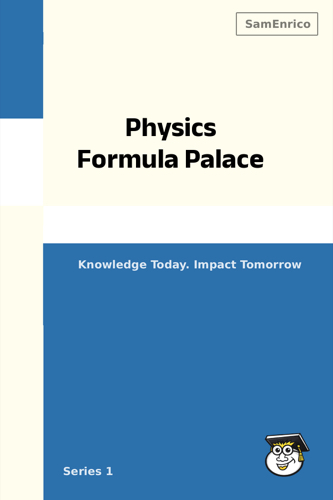
Physics Formula Palace Audiobook
Memorize laws and equations using spatial memory t
Memorize laws and equations using spatial memory techniques.
Formats
Free sample
Chapter 1: The Coat Rack Conspiracy--– You have already memorized physics. You just don’t know it yet.Let me prove it to you in the next ten seconds. Close your eyes—or don’t, but imagine this. Picture the front door of the place where you slept last night. See the color.
Feel the handle. Now walk inside. Look to your left. What object is there? A shoe rack?
An umbrella stand? A pile of mail? Now look to your right. A mirror? A coat rack?
A table with keys on it?You just recalled a half-dozen spatial locations without effort. You didn’t cram them. You didn’t use a flashcard app. You walked through that space once, maybe a thousand times, and your brain said: “This matters. Keep it.”Now answer this: What is the first equation in most physics textbooks?
If you said v=u+atv = u + atv=u+at, you’re either a physics teacher or you’ve been traumatized by one. But here’s the strange thing. That equation is not harder to remember than the position of your coat rack. It just feels harder because your brain doesn’t know where to put it.This book is going to give you a place to put it. A real place.
A room in a mental mansion that you will build, decorate, and walk through until every law of motion, every conservation principle, and every maddening Greek letter lives exactly where you left it.Welcome to the Newtonian Foyer. Your first room. And the conspiracy is this: someone convinced you that physics equations belong on paper. They don’t. They belong on coat racks, staircases, and paintings.
Let me show you how.The Problem with Paper Memory Before we build anything, we need to understand why traditional physics study fails so spectacularly for so many people. You have likely experienced the following cycle:Read an equation in a textbook.Write it down three times.Recite it five times.Feel confident.See the same equation on a test one week later.Draw a complete blank. Or worse, confuse it with a different equation that looks similar.This is not a character flaw. This is not a sign that you “aren’t a physics person.” This is the Ebbinghaus forgetting curve in action. In the 1880s, German psychologist Hermann Ebbinghaus discovered that without reinforcement, humans forget approximately 50% of new information within one hour, 70% within 24…
This is the end of the free sample. Get the Audiobook to keep going. Buy now
About this book
Details
- Author
- Nesmith Merle
- Publisher
- SamEnrico
- Language
- English
- Genre
- Non-Fiction, Self-Help, Physics
- Released
- 2026-06-11
- Pages (approx.)
- 150
- Available as
- eBook, Audiobook

Listen in the VoxFlicks app
Audiobooks and audio dramas wherever you go. Sign in with your SamEnrico account and press play.
More by Nesmith Merle
 Wholesaling Pre ForeclosuresNesmith Merle$11.99
 ED and Smoking CessationNesmith Merle$11.99
 Pet Loss Therapist GuideNesmith Merle$11.99
 Assertiveness for GriefNesmith Merle$11.99
 The Generic ED Medication GuideNesmith Merle$11.99
 Separation Anxiety NightmaresNesmith Merle$11.99
 Freelance During Layoff FearsNesmith Merle$11.99
 Soul of the Underground: The Lost Tapes of Detroit’s Hidden MotownNesmith Merle$11.99
 The Great Colonial Ledger Heist: Australia's First Financial FraudNesmith Merle$11.99
 Class Action Litigation: Mass Torts & CertificationNesmith Merle$11.99
 English Taught Programs HandbookNesmith Merle$12.99
 Pinterest VA Monthly Reporting SystemNesmith Merle$12.99
You may also like
 Hong Kong Handover 1997Dunn Johnnie$11.99
 Zumba For Postnatal Recovery CourseNeal Christian$11.99
 Zumba for BeginnersLadner Nikia$11.99
 YouTube Comment Mining GuideHumes Pandora$12.99
 Worry Box MeditationCarlin Rudy$11.99
 Workplace Stress MeditationNguyen Lynn$11.99
 Workplace Stress and Sleep RepairHawley Ivory$11.99
 Workplace Perfectionism CureDelaney Jeffry$11.99
 Workplace Injustice Anger GuideWallen Isabelle$11.99
 Work Addiction and Burnout LinkGreenwood Ester$11.99
 Women in Yoga and WellnessBeattie Galina$11.99
 Women in Stand Up ComedyChun Evangeline$11.99