
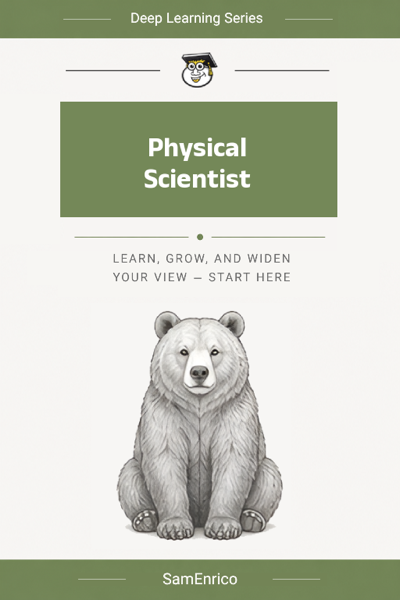
Non-FictionInformativeEducational
Physical Scientist eBook
A Coursebook on Physical Scientist
by Hinds Luanne
A Coursebook on Physical Scientist
Formats
Free sample
Chapter 1: The Curiosity Engine--The moment you asked “why” as a child, you became a scientist. The moment you demanded evidence, you became a physical scientist. This book is not a collection of formulas to memorize or procedures to robotically follow. It is an invitation to join a lineage that includes Galileo dropping spheres from the Leaning Tower of Pisa, Marie Curie extracting radium from tons of pitchblende, and the engineers who landed a nuclear-powered rover on Mars using nothing but mathematics and courage. Physical science is the most successful truth-finding enterprise humanity has ever devised.
But success does not come from genius alone. It comes from a disciplined, repeatable, and teachable way of thinking about the material world.This chapter establishes the philosophical, methodological, and epistemological foundations unique to physical science. Unlike biological systems, which evolve, reproduce, and adapt, physical systems—in physics, chemistry, earth science, and astronomy—are governed by universal laws that are typically deterministic, time-reversible at microscopic scales, and amenable to mathematical formulation. This distinction matters because it shapes how you design experiments, interpret data, and trust your conclusions. A physicist measuring the charge of an electron expects the same result tomorrow in Tokyo as today in Toronto.
A chemist synthesizing a crystal expects the same lattice structure regardless of who performs the synthesis. This reproducibility is not a happy accident. It is the direct consequence of a rigorous framework that this chapter will unpack.What Is Physical Science, Exactly?Physical science is the systematic study of non-living systems through observation, experimentation, and mathematical modeling. The term encompasses physics (matter, energy, space, time), chemistry (substances, reactions, bonding), earth science (geology, meteorology, oceanography), and astronomy (celestial bodies, cosmology). Despite their surface differences, these fields share a common core: they seek universal laws that describe how physical entities behave under specified conditions.The power of physical science lies in its ability to predict.
Newton's laws of motion predict where a cannonball will land. The ideal gas law predicts how pressure changes when you heat a sealed container. Quantum mechanics predicts the spectrum of light emitted by a hydrogen atom with twelve decimal places of accuracy. These predictions are not guesses. They are logical consequences of mathematical models that have survived thousands of experimental tests.
When a prediction fails, the scientist does not despair. She celebrates, because a failed prediction reveals a flaw in the model, and a flaw is an invitation to deeper understanding.The Three Modes of Inquiry Physical scientists approach problems from three complementary angles, and understanding the distinction will help you identify your own strengths and preferences.Theoretical Physical Science derives predictions from first principles using mathematics. The theorist asks: “Given these fundamental laws, what should happen?” James Clerk Maxwell, in the 1860s, wrote down four equations describing electricity and magnetism. From those equations, he predicted the existence of electromagnetic waves traveling at the speed of light, which led directly to radio, television, and mobile phones. The theorist works with symbols, symmetries, and abstract reasoning.
She may never touch a piece of lab equipment, yet her contributions are indispensable.Applied Physical Science uses known principles to design technologies and solve practical problems. The applied scientist asks: “How can I use this law to build something useful?” When engineers at Bell Labs used quantum mechanics to invent the transistor in 1947, they were doing applied physical science. When geophysicists use seismic wave propagation to locate oil deposits, they are doing applied physical science. This mode bridges pure research and engineering.Experimental Physical Science designs controlled manipulations to test hypotheses. The experimentalist asks: “What does nature actually do when I poke it?” Experimentalists build apparatus, collect data, and subject theories to empirical scrutiny.
When LIGO detected gravitational waves in 2015, it was the culmination of decades of experimental work by thousands of people. Most physical scientists work in all three modes at different stages of their careers. A theorist may run a simulation (experimental). An experimentalist may derive a new equation from her data (theoretical). Applied scientists routinely develop new theory when existing models prove inadequate.
The boundaries are porous, and you should resist the temptation to pigeonhole yourself.The Three Pillars of Rigorous Physical Science Over centuries of trial and error, the scientific community has distilled three non-negotiable requirements for any claim to be considered valid physical science. These pillars are not arbitrary rules invented by academics. They are practical safeguards against self-deception, fraud, and error.Pillar One: Measurability Every concept in physical science must be operationally defined via a measurement procedure. An operational definition specifies exactly how to measure a quantity, not merely what the quantity means in the abstract. Consider temperature.
You might think of temperature as “how hot something feels.” But that feeling is subjective and varies from person to person. The operational definition of temperature is: the height of a column of mercury in a glass tube under specified conditions. Or: the electrical resistance of a platinum wire. Or: the wavelength of peak thermal radiation. Each definition produces a number that different observers can reproduce.
Without operational definitions, science degenerates into word games. If you cannot tell me how to measure it, you have not defined it.This pillar has profound consequences. It means that concepts like “dark energy” are provisional. Dark energy is a term cosmologists use to explain the accelerating expansion of the universe. But until someone devises a direct measurement of dark energy—not merely inference from galactic redshifts—the concept remains a placeholder.
This is not a weakness of science. It is an honest admission of ignorance, which is the first step toward knowledge.Pillar Two: Reproducibility Independent researchers must be able to replicate your results using the methods you describe. Reproducibility serves two functions. First, it guards against fraud. If you fabricated your data, others will fail to reproduce your results.
Second, it guards against hidden variables. You may have unknowingly measured something irrelevant. For example, suppose you discover that a certain chemical reaction works only on Tuesdays. A skeptical chemist repeats your experiment on Wednesday and finds no reaction. You then realize that on Tuesdays, a cleaning crew uses a particular solvent that leaves a catalytic residue on your glassware.
The real cause was not the day of the week but the residue. Reproducibility across different conditions exposes these hidden confounders.In practice, full reproducibility is not always possible. Astronomers cannot rerun the birth of a galaxy. Geologists cannot re-erupt a volcano. In such cases, scientists rely on multiple lines of independent evidence and statistical reasoning.
The pillar remains the ideal, even when the ideal is not fully attainable.Pillar Three: Falsifiability This is the most subtle and most misunderstood pillar. Proposed by philosopher Karl Popper in the 1930s, falsifiability is the requirement that a scientific hypothesis must be structured so that a conceivable empirical result could disprove it. Note the phrasing: could disprove it, not must be disproven. A hypothesis is falsifiable if there exists some observation that, if it occurred, would force you to abandon the hypothesis.Consider the statement “All swans are white.” This is falsifiable because observing a single black swan would disprove it. Now consider the statement “There exists an invisible, intangible, undetectable dragon in my…
This is the end of the free sample. Get the eBook to keep going. Buy now
About this book
Details
- Author
- Hinds Luanne
- Publisher
- SamEnrico
- Language
- English
- Genre
- Non-Fiction, Informative, Educational
- Released
- 2026-05-18
- Pages (approx.)
- 154
- Available as
- eBook, Audiobook

Read better in the ZLOADR app
Your eBooks on your phone or tablet. Sign in with your SamEnrico account and start reading.
More by Hinds Luanne
 Logistics ESG ComparisonsHinds Luanne$11.99
 Cremation Burial Memorial Planning CourseHinds Luanne$11.99
 Stress And Witness AccuracyHinds Luanne$11.99
 Metta for Family ConflictHinds Luanne$11.99
 The Letting Go of Anger GuideHinds Luanne$11.99
 The Terracotta Warriors: How King Zheng Forged an EmpireHinds Luanne$11.99
 Business Email Credit ImpactHinds Luanne$12.99
 Connection Requests That Get AcceptedHinds Luanne$12.99
 Understanding Say–Meyer SyndromeHinds Luanne$17.99
 How to Become a Drying-unit-felting-machine OperatorHinds Luanne$11.99
You may also like
 Hong Kong Handover 1997Dunn Johnnie$11.99
 Zumba For Postnatal Recovery CourseNeal Christian$11.99
 Zumba for BeginnersLadner Nikia$11.99
 YouTube Comment Mining GuideHumes Pandora$12.99
 Worry Box MeditationCarlin Rudy$11.99
 Workplace Stress MeditationNguyen Lynn$11.99
 Workplace Stress and Sleep RepairHawley Ivory$11.99
 Workplace Perfectionism CureDelaney Jeffry$11.99
 Workplace Injustice Anger GuideWallen Isabelle$11.99
 Work Addiction and Burnout LinkGreenwood Ester$11.99
 Women in Yoga and WellnessBeattie Galina$11.99
 Women in Stand Up ComedyChun Evangeline$11.99