
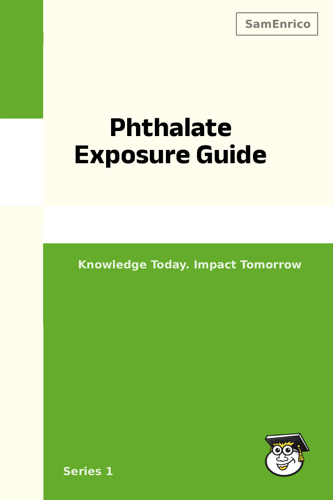
Non-FictionHealth & Wellness / Phthalates
Phthalate Exposure Guide eBook
Avoids plasticizers in personal care, food packagi
Avoids plasticizers in personal care, food packaging, and vinyl products.
Formats
Free sample
Chapter 1: The Invisible Invaders...--We begin with an experiment you can perform in your own home, though I do not recommend it. Take a new vinyl shower curtain out of its packaging, unfold it in a small bathroom, close the door, and leave it there for twenty-four hours. When you return, open the door and take a single deep breath. That sweet, plasticky smell—the one that manufacturers have trained us to associate with “newness” and “clean”—is, in fact, a cloud of volatile plasticizers. Among them are phthalates, a family of industrial chemicals that are now so ubiquitous in the human body that scientists have stopped trying to find people who are phthalate-free.
They have given up because such people almost certainly do not exist.In 2025, a biomonitoring study conducted jointly by researchers at the University of California, San Francisco, and the German Federal Environment Agency tested 2,500 individuals across five continents. The results were so uniform that the lead author described them as “monotonous” in the scientific sense. Phthalate metabolites were detected in 99.3% of urine samples. The 0.7% who tested negative were later found to have levels below the limit of detection, not zero exposure. The study concluded that phthalate exposure is functionally universal.
You are reading this book, and somewhere in your body—your blood, your adipose tissue, your urine, your breast milk if you are lactating—there are molecules of diethyl phthalate, dibutyl phthalate, or DEHP that entered you within the last forty-eight hours.This is not a scare tactic. It is a statement of fact, and it is the foundation upon which this entire book is built. You cannot escape phthalates entirely. The goal is not zero. The goal is less.
The goal is to understand where these chemicals come from, how they enter your body, and which sources you can realistically eliminate without moving to a yurt in the wilderness and weaving your own clothing from nettle fibers. This chapter will give you the working knowledge you need to read the rest of this book with clarity: what phthalates are, why they are used, how they hide in plain sight, and why the regulatory system has done so little to protect you from them.The Chemistry of Flexibility Phthalates (pronounced THAL-ates) are a class of synthetic chemical compounds derived from phthalic acid. The name sounds clinical because it is. The first phthalates were synthesized in the late nineteenth century, but their industrial use did not explode until the 1920s, when chemists discovered that adding them to polyvinyl chloride—PVC, the world’s third-most-common plastic—transformed a rigid, brittle material into something soft, pliable, and endlessly useful. Without phthalates, PVC is hard and unyielding, like a drainpipe or a window frame.
With phthalates, it becomes the material of shower curtains, inflatable pool toys, cling wrap, flexible garden hoses, and the soft dashboard of your car.Chemically, phthalates are what scientists call plasticizers. Their molecules insert themselves between the long polymer chains of PVC, pushing them apart and allowing them to slide past one another. This is not a permanent bond; it is a marriage of convenience. Over time, with heat, abrasion, or simply the passage of time, phthalates migrate out of the plastic and into whatever the plastic touches—your food, your skin, the dust on your floor, the air in your bathroom. That migration is the entire problem.There are dozens of phthalates, but three dominate the consumer landscape.
DEHP (di-2-ethylhexyl phthalate) is the heavy lifter, used in industrial and medical applications, food processing equipment, and vinyl flooring. DBP (dibutyl phthalate) is common in nail polish, adhesives, and printing inks. DEP (diethyl phthalate) is the fragrance carrier, found in lotions, shampoos, soaps, laundry detergents, and anything else that smells like something. A fourth, BBP (butyl benzyl phthalate), is used in vinyl flooring, sealants, and some automotive products. These four account for the vast majority of human exposure, and you will encounter their names repeatedly throughout this book.The Fragrance Loophole: How They Hide If phthalates are so common, why do you not see them on ingredient labels?
The answer lies in one of the most successful regulatory evasions in modern consumer history. Under both United States law (the Fair Packaging and Labeling Act) and European Union regulations (the Cosmetics Regulation, which is otherwise stricter than American law), companies are not required to disclose the individual components of “fragrance” or “parfum.” These terms are considered trade secrets, proprietary mixtures that give a product its signature scent. A company can list “fragrance” as a single ingredient even if that fragrance is a cocktail of fifty different chemicals, including phthalates.This is not a hypothetical concern. When the Environmental Working Group analyzed the ingredient disclosures of top-selling personal care products, they found that phthalates were present in more than seventy percent of products that listed “fragrance” on the label, but in fewer than ten percent of products that did not. The difference was not due to formulation; it was due to disclosure.
Companies using phthalates simply hid them behind the word “fragrance,” and they did so legally.The most common phthalate in this context is DEP. It has no scent of its own, but it serves as a solvent and fixative, helping fragrance molecules dissolve evenly and linger on the skin. DEP is less toxic than DEHP or DBP, but its ubiquity makes it a significant contributor to total exposure. A woman who uses a scented lotion, a scented shampoo, a scented deodorant, and a scented laundry detergent can absorb DEP through her skin and inhale it from the air in her bathroom. By noon, she has a measurable body burden, and she has no way of knowing from the labels alone.The Recycling Code That Betrays You If personal care products hide phthalates behind language, plastics hide them behind numbers.
The recycling code system—those little triangles with a number from 1 to 7—was designed to help recycling facilities sort materials. It was not designed to warn consumers about chemical hazards. But once you know what to look for, the codes become a roadmap of risk.Code 3 is PVC. It is the only plastic that requires phthalates to become flexible. If you see a recycling triangle with a 3 inside it, you are holding a product that almost certainly contains phthalates.
That includes some water bottles (the cloudy, flexible ones, not the clear, rigid ones made of PET), all vinyl shower curtains, most inflatable pool toys and bath toys, many sex toys (a topic we will address frankly in Chapter 6), cling wrap that feels soft and stretchy, and the soft, gummy plastic of some children’s teethers and bath books.But here is the catch: many products do not have recycling codes. Clothing, upholstery, and soft vinyl accessories often lack any marking. In those cases, you must use other clues. If a material smells like a new shower curtain, it is likely PVC. If it is soft and flexible and cannot be creased without whitening at the fold line, it is likely PVC.
If it is labeled “vegan leather” or “pleather” without further specification, it is almost certainly PVC. Real leather, canvas, cotton, wool, hemp, and linen contain no…
This is the end of the free sample. Get the eBook to keep going. Buy now
About this book
Details
- Author
- Labbe Rosalyn
- Publisher
- SamEnrico
- Language
- English
- Genre
- Non-Fiction, Health & Wellness / Phthalates
- Released
- 2026-06-08
- Pages (approx.)
- 135
- Available as
- eBook, Audiobook

Read better in the ZLOADR app
Your eBooks on your phone or tablet. Sign in with your SamEnrico account and start reading.
More by Labbe Rosalyn
 Therapeutic Horticulture BenefitsLabbe Rosalyn$11.99
 Anchor Triggers for HabitsLabbe Rosalyn$11.99
 Sports Injury Master GuideLabbe Rosalyn$11.99
 The Aum Shinrikyo Connection: Russian Mafia and the Tokyo Gas AttackLabbe Rosalyn$11.99
 Export Financing for Small ProducersLabbe Rosalyn$12.99
 How to Produce Circuit Boards and ComponentsLabbe Rosalyn$11.99
 Sanitation SpecialistLabbe Rosalyn$11.99
 A Beginners Guide to 221B Baker Street (Volume 1)Labbe Rosalyn$11.99
You may also like
 Hong Kong Handover 1997Dunn Johnnie$11.99
 Zumba For Postnatal Recovery CourseNeal Christian$11.99
 Zumba for BeginnersLadner Nikia$11.99
 YouTube Comment Mining GuideHumes Pandora$12.99
 Worry Box MeditationCarlin Rudy$11.99
 Workplace Stress MeditationNguyen Lynn$11.99
 Workplace Stress and Sleep RepairHawley Ivory$11.99
 Workplace Perfectionism CureDelaney Jeffry$11.99
 Workplace Injustice Anger GuideWallen Isabelle$11.99
 Work Addiction and Burnout LinkGreenwood Ester$11.99
 Women in Yoga and WellnessBeattie Galina$11.99
 Women in Stand Up ComedyChun Evangeline$11.99