
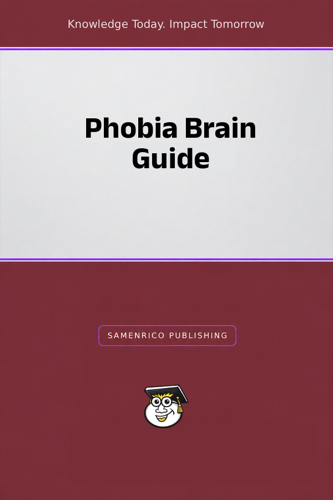
Phobia Brain Guide eBook
Explore amygdala and prefrontal cortex roles in fe
by Smalley Reta
Explore amygdala and prefrontal cortex roles in fear response.
Formats
Free sample
Chapter 1: The Sentinel and The Executive--Your feet leave the ground before your eyes know what they are seeing.This is not an exaggeration or a poetic flourish. It is a measured, replicable fact of human neurobiology. When your peripheral vision detects a long, curved shape on a forest path, your body initiates a jump backwards approximately two hundred milliseconds before your visual cortex finishes processing whether that shape is a snake or a curved stick. Your heart rate spikes. Your muscles tense.
Your palms begin to sweat. And only after your body has already reacted does your conscious brain catch up, whispering: Oh. It was just a rope.This delay between bodily reaction and conscious recognition is the single most important fact about phobias. If you understand nothing else from this book, understand this: your fear response is not controlled by your thinking brain. It is controlled by an ancient, primitive, hyper-efficient alarm system that operates below the level of conscious awareness.
And that alarm system, for reasons we will explore throughout this chapter, is both your greatest protector and your most frustrating saboteur.Every person who has ever suffered from a phobia knows the peculiar humiliation of being afraid of something they know, rationally, is not dangerous. The person with a spider phobia knows intellectually that the tiny creature on the wall cannot hurt them. The person with a flying phobia can recite the statistics showing that commercial aviation is safer than driving to the airport. The person with a social phobia understands that a room full of strangers is not actually a predator. And yet, knowing all of this, the fear remains.
The body reacts. The panic rises.That gap between what you know and what you feel is not a character flaw. It is not a sign of weakness, cowardice, or insufficient willpower. It is a feature of your brain’s architecture. And once you understand that architecture, you can begin to rewire it.This chapter introduces the two main characters of this book: the amygdala (pronounced ah-MIG-dah-lah) and the prefrontal cortex (PFC).
These two structures are the primary actors in every phobic reaction you have ever experienced. The amygdala is the alarm system. The prefrontal cortex is the executive override. Their relationship—how quickly they communicate, who wins the argument, and under what conditions—determines whether you live in fear or live freely.We will map the precise neural pathways of fear, from the moment a stimulus hits your retina to the moment your body decides to fight, flee, or freeze. You will learn why your feet jump before your brain knows why, why logic fails during a panic attack, and why your phobia feels so automatic.
By the end of this chapter, you will have a complete map of your own fear response—and you will understand, perhaps for the first time, that your phobia is not a mystery. It is a machine. And machines can be reprogrammed.The Two Brains Inside Your Skull Neuroanatomists have known for decades that the human brain is not a single, unified organ but rather a collection of evolved structures stacked atop one another like geological layers. The deepest layers—sometimes called the "reptilian brain"—control basic survival functions like breathing, heart rate, and threat detection. The middle layers, shared with most mammals, handle emotion and memory.
The outermost layers, the neocortex, are uniquely developed in humans and handle abstract reasoning, language, and long-term planning.Your phobia lives in the deep layers. Your rational understanding that the phobia is irrational lives in the outer layers. These two layers do not always communicate effectively.The Amygdala: The Sentinel The amygdala is a small, almond-shaped cluster of nuclei located deep within the temporal lobe, approximately level with your ears and about two inches inward from your temples. You have two of them—one on the left, one on the right—though they function largely as a unified system. Despite its small size (roughly the volume of a sugar cube), the amygdala is the most important structure in your brain for detecting threats.Here is what the amygdala does, second by second:It scans constantly.
Unlike your prefrontal cortex, which requires effortful attention to engage, the amygdala operates automatically, twenty-four hours a day, seven days a week. Even during sleep, the amygdala remains active, which is why loud noises can startle you awake before you consciously identify the sound.It reacts fast. When the amygdala detects a potential threat, it can initiate a full-body fear response in approximately two hundred milliseconds. That is one-fifth of a second. By comparison, conscious visual recognition takes approximately four hundred milliseconds—twice as long.
This speed differential is the reason your feet jump before your brain knows why.It prioritizes speed over accuracy. The amygdala does not wait for confirmation. If a stimulus might be dangerous—if it resembles a predator, shares features with a past threat, or appears in a context where danger has occurred before—the amygdala errs on the side of caution and triggers the alarm. From an evolutionary perspective, this makes excellent sense. Mistaking a stick for a snake costs you a few seconds of unnecessary fear.
Mistaking a snake for a stick can cost you your life. The amygdala is designed to produce false positives because false negatives are far more expensive.It learns through experience. The amygdala is not born knowing which stimuli are dangerous. It learns through direct experience (you touch a hot stove and feel pain) and through associative learning (you see someone else recoil from a snake and your amygdala encodes the snake as dangerous). This learning happens quickly—often after a single trial—and the memories it forms are remarkably persistent.It does not process language.
This last point is critical. The amygdala receives input from your senses (vision, hearing, touch, smell) and from your body (heart rate, breathing, muscle tension). It does NOT receive direct input from your language centers. You cannot talk to your amygdala. You cannot reason with it.
You cannot explain that the spider is harmless and expect your amygdala to understand the words. This is why, as we will explore throughout this book, you cannot think your way out of a phobia during a panic attack. The part of your brain that does the thinking is not connected to the part that is sounding the alarm.The Prefrontal Cortex: The Executive The prefrontal cortex occupies the front third of your brain, directly behind your forehead. It is the most recently evolved part of the human brain—the "newest model" in evolutionary terms—and it is responsible for the cognitive abilities that distinguish humans from other animals: abstract reasoning, long-term planning, impulse
This is the end of the free sample. Get the eBook to keep going. Buy now
About this book
Details
- Author
- Smalley Reta
- Publisher
- SamEnrico
- Language
- English
- Genre
- Non-Fiction, Health & Wellness
- Released
- 2026-06-07
- Pages (approx.)
- 149
- Available as
- eBook, Audiobook

Read better in the ZLOADR app
Your eBooks on your phone or tablet. Sign in with your SamEnrico account and start reading.
More by Smalley Reta
 Weekly Action Planning WorkbookSmalley Reta$11.99
 Power Nap Meditation GuideSmalley Reta$11.99
 Shuffll Video Automation GuideSmalley Reta$11.99
 Sober Vacation and Travel Planning GuideSmalley Reta$11.99
 The Silk and the Sea: How Venice's Merchant Princes Ruled the WavesSmalley Reta$11.99
 Understanding Inflammatory Breast CancerSmalley Reta$17.99
 How to Become a Mud-mill TenderSmalley Reta$11.99
 Green Sustainable Spending GuideSmalley Reta$12.99
 First Gen Imposter Syndrome GuideSmalley Reta$12.99
 Chemical Experiments (or Kitchen Chemistry)Smalley Reta$11.99
You may also like
 Hong Kong Handover 1997Dunn Johnnie$11.99
 Zumba For Postnatal Recovery CourseNeal Christian$11.99
 Zumba for BeginnersLadner Nikia$11.99
 YouTube Comment Mining GuideHumes Pandora$12.99
 Worry Box MeditationCarlin Rudy$11.99
 Workplace Stress MeditationNguyen Lynn$11.99
 Workplace Stress and Sleep RepairHawley Ivory$11.99
 Workplace Perfectionism CureDelaney Jeffry$11.99
 Workplace Injustice Anger GuideWallen Isabelle$11.99
 Work Addiction and Burnout LinkGreenwood Ester$11.99
 Women in Yoga and WellnessBeattie Galina$11.99
 Women in Stand Up ComedyChun Evangeline$11.99