
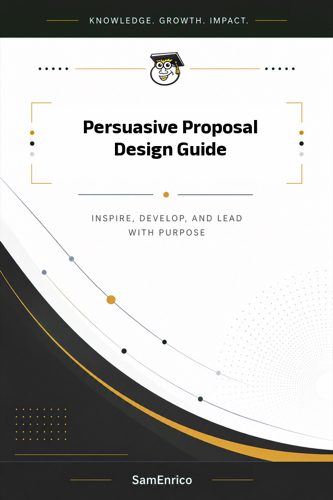
Non-FictionBusiness BriefDocument Design
Persuasive Proposal Design Guide eBook
Use typography, white space, and visual hierarchy
by Epps Collin
Use typography, white space, and visual hierarchy to guide reader attention to key arguments.
Formats
Free sample
Chapter 1: The Skimming Epidemic--–- The proposal landed on the evaluator’s desk at 4:47 PM on a Friday. Seventy-three pages. Eleven sections. Fourteen million dollars on the line. The evaluator had ninety minutes to score it before his weekend began.
He poured a second cup of coffee, flipped to page one, and started reading.Six minutes later, he turned to page two.Not because page one was difficult. Because page one was dense. A wall of text. Justified margins creating rivers of white space that pulled his eye sideways. No call-outs.
No visual breaks. No single sentence that shouted, “Here is why you should give us points.”By page three, he was skimming. By page five, he was hunting for keywords from the RFP. By page ten, he had stopped reading entire paragraphs.The proposal had brilliant content. A truly innovative technical approach.
A past performance record that exceeded every requirement. A price that undercut the incumbent by 12 percent. None of it mattered.The evaluator never saw the innovation. The past performance was buried in a dense table on page forty-one. The price advantage appeared in a paragraph of small print on page fifty-two.The proposal lost.
The competitor—with inferior content but superior visual organization—won.This happens every day. In federal procurement. In commercial bids. In nonprofit grants. In internal funding requests.
The best content almost never wins. The best seen content always wins.This chapter will prove why. More importantly, it will show you the single most important design rule that separates winning proposals from losing ones: The 3-Second Rule.The Uncomfortable Truth About Evaluators Let us begin with a confession that no evaluator will ever tell you directly: they do not read proposals. They scan them. They hunt through them.
They survive them.This is not laziness. This is not incompetence. This is the unavoidable reality of procurement.Consider the typical federal source selection. A single Request for Proposals might receive ten to twenty responses. Each response might be fifty to two hundred pages.
The evaluation team—usually three to seven people—has perhaps two weeks to score everything. That is hundreds of pages per evaluator. Thousands of pages per team.And those evaluators have other jobs. They are not professional readers. They are program managers, engineers, contracting officers, and subject matter experts who have been pulled away from their regular work to serve on a source selection board.
They still have meetings to attend. Emails to answer. Reports to file. The proposal evaluation is an additional duty.Now add the psychological reality.The Science of Limited Attention In 1956, cognitive psychologist George Miller published a landmark paper titled “The Magical Number Seven, Plus or Minus Two.” His discovery: human working memory can hold only five to nine discrete chunks of information at once. Later research refined this estimate downward.
Most cognitive scientists now agree that working memory holds two to six chunks—and that number shrinks under stress, fatigue, or time pressure.John Sweller’s Cognitive Load Theory, developed in the 1980s, built on Miller’s work. Sweller distinguished between three types of cognitive load:Intrinsic load – The inherent difficulty of the material itself. A proposal for a nuclear reactor has higher intrinsic load than a proposal for office cleaning services.Germane load – The mental effort devoted to understanding and learning. This is the good load—the work of comprehension.Extraneous load – The mental effort wasted on poor presentation, confusing layout, or unnecessary complexity. This is the bad load—the work of decoding rather than understanding.Here is the critical insight for proposal design: dense, unbroken text dramatically increases extraneous cognitive load.
When an evaluator faces a wall of text, their brain must first decode the visual information—find the line breaks, track across the page, locate the next sentence—before it can even begin comprehending the content.By the time they finish decoding a dense paragraph, they have no working memory left for the meaning.This is why the best-written proposal loses to the best-designed proposal. Writing quality affects germane load (understanding). Visual design affects extraneous load (decoding). If you fail at design, no amount of writing quality can compensate. The evaluator’s brain has already exhausted its limited working memory before encountering your brilliant argument.The Scanning Behavior Nobody Admits Eye-tracking studies of document reading reveal a consistent pattern.
When readers are relaxed and engaged, they read in a Z-pattern: top-left to top-right, then diagonally down-left, then right again. This pattern allows for deep comprehension.But when readers are stressed, tired, or time-pressured—exactly the condition of most proposal evaluators—they switch to an F-pattern. They scan down the left margin, then move rightward in short horizontal sweeps, then down again. They rarely read entire lines. They rarely reach the right margin on long paragraphs.
They hunt for keywords, numbers, and familiar phrases.A 2006 study by Jakob Nielsen of the Nielsen Norman Group analyzed the eye movements of 232 users reading digital documents. The findings: users read only 20 to 28 percent of the words on a typical page. In a time-pressured condition, that number dropped to 11 percent.Let that sink in. An evaluator under real-world proposal pressure will read approximately one in every ten words on your page.Your proposal is not being read. It is being raided for points.This changes everything about how you should design.The 3-Second Rule Every page of your proposal has a score line—the single sentence, statistic, or claim that answers the RFP question and earns points.
Sometimes the score line is explicit: “Our solution reduces downtime by 40 percent.” Sometimes it is implicit: a past performance narrative that proves you have done this before.The 3-Second Rule states: An evaluator must be able to locate the score line on any given page within three seconds. If they cannot, you have lost a scoring opportunity.Three seconds is not arbitrary. It is the average time an evaluator spends scanning a page before deciding whether to read it closely or move on. In Nielsen’s eye-tracking studies, the first three to five seconds of a page visit determined whether users would engage deeply or abandon the page entirely.Proposals are no different. The evaluator lands on a page.
In three seconds, their brain makes a rapid, subconscious judgment: “This page has something I need” or “This page is just filler.” If they cannot find the score line in that window, they will scan past it—even if the score line appears in the fourth or fifth second.The three seconds count down from the moment the page is visible, not from when the evaluator “starts reading.” This means page layout is more important than paragraph placement. A score line buried in the middle of a dense paragraph is invisible. A score line isolated in a call-out box is visible instantly.Case Study: The $50 Million Margin In 2019, a large defense contractor prepared two versions of a proposal for a $50 million IT infrastructure contract. Both versions contained identical content: the same technical approach, the same past performance narratives, the same pricing tables. The only difference was visual design.Version A used the contractor’s standard proposal template: 0.5-inch margins, fully justified text, single-column layout, no…
This is the end of the free sample. Get the eBook to keep going. Buy now
About this book
Details
- Author
- Epps Collin
- Publisher
- SamEnrico
- Language
- English
- Genre
- Non-Fiction, Business Brief, Document Design
- Released
- 2026-06-08
- Pages (approx.)
- 151
- Available as
- eBook, Audiobook

Read better in the ZLOADR app
Your eBooks on your phone or tablet. Sign in with your SamEnrico account and start reading.
More by Epps Collin
 Analogous Thinking Team GuideEpps Collin$11.99
 Letterboxd Film BuffEpps Collin$11.99
 NVC for MenEpps Collin$11.99
 Team Interruption TrainingEpps Collin$11.99
 The Posture Stress ConnectionEpps Collin$11.99
 The Medical EmergencyEpps Collin$11.99
 Metabolic Health NappingEpps Collin$11.99
 Blue Zone Resilience FactorsEpps Collin$11.99
 The Lost Sculptors of Ife: Masters of the Bronze RenaissanceEpps Collin$11.99
 The Siege of Chaco Canyon: Ancient Warriors of the SouthwestEpps Collin$11.99
 The Last Dance of the Blue Angels: A Legacy of Precision and PerilEpps Collin$11.99
 How to Start a Manometers (non-electronic) Business (Beginners Guide)Epps Collin$11.99
You may also like
 Hong Kong Handover 1997Dunn Johnnie$11.99
 Zumba For Postnatal Recovery CourseNeal Christian$11.99
 Zumba for BeginnersLadner Nikia$11.99
 YouTube Comment Mining GuideHumes Pandora$12.99
 Worry Box MeditationCarlin Rudy$11.99
 Workplace Stress MeditationNguyen Lynn$11.99
 Workplace Stress and Sleep RepairHawley Ivory$11.99
 Workplace Perfectionism CureDelaney Jeffry$11.99
 Workplace Injustice Anger GuideWallen Isabelle$11.99
 Work Addiction and Burnout LinkGreenwood Ester$11.99
 Women in Yoga and WellnessBeattie Galina$11.99
 Women in Stand Up ComedyChun Evangeline$11.99