
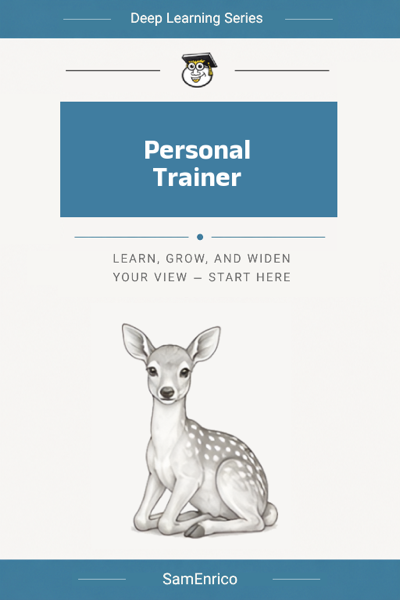
Non-FictionInformativeEducational
Personal Trainer eBook
A Coursebook on Personal Trainer
by Harman Kieth
A Coursebook on Personal Trainer
Formats
Free sample
Chapter 1: The Unspoken Reality--–- You passed the exam. You have the certificate on your wall, the CPR card in your wallet, and the liability insurance policy saved in your email. You can name every muscle in the human body, recite the three energy systems in your sleep, and explain the difference between concentric and eccentric contractions to anyone who will listen. You are, by every objective measure, a certified personal trainer.–- And you are completely unprepared for what comes next.–- Because no certification exam tests you on the things that will actually determine your success or failure. No multiple-choice question asks how you respond when a client bursts into tears during a workout.
No practical assessment evaluates how you handle the moment a forty-five-year-old executive looks you in the eye and says, "I've tried everything. Nothing works. Why should this be any different?" No textbook case study prepares you for the client who lies to your face about what they ate, the gym manager who steals your commission, or the moment you realize you cannot pay your rent this month with the three clients you currently have.–- This chapter is about that gap. The space between what the certification teaches you and what the profession actually demands. The unspoken reality that every successful trainer learns the hard way—often after months or years of frustration, burnout, and financial struggle.
Consider this chapter the warning label that no one puts on the packaging. Read it carefully. It might save your career before it even begins.The Three Certifications You Didn't Get–- When you completed your accredited certification program—whether through the National Strength and Conditioning Association (NSCA), the American College of Sports Medicine (ACSM), the National Academy of Sports Medicine (NASM), or the American Council on Exercise (ACE)—you received a document that certifies your knowledge of exercise science. That document is valuable. It is necessary.
It is not sufficient.–- What you did not receive is equally important. Let us name these missing certifications explicitly, because acknowledging their absence is the first step toward acquiring them.–- The Certification in Human Psychology. No exam tests your ability to recognize the subtle difference between a client who is physically tired and one who is emotionally exhausted. No written question assesses your skill at discerning when a client's resistance to exercise is rooted in fear rather than laziness. The certification boards assume that you will figure this out on your own, through trial and error, through the slow accumulation of awkward silences and misunderstood cues.
Some trainers never figure it out. They spend years wondering why their perfectly designed programs produce mediocre results, why their clients quit after six weeks, why the industry has a ninety percent attrition rate within the first two years.–- The Certification in Financial Literacy. No one teaches you how to price your services. No one explains the difference between charging by the session versus the month, the economics of package sales versus recurring revenue, or the brutal mathematics of running a business where you only get paid when you work. The certification assumes that you will work for a gym, and that the gym will handle the money.
But the gym will take sixty to seventy percent of what your client pays. The gym will classify you as an independent contractor while treating you like an employee. The gym will provide you with clients only until you prove you can retain them, at which point they will stop providing leads and expect you to generate your own. No exam prepares you for this.–- The Certification in Professional Boundaries. What do you say when a client asks for your personal phone number?
How do you respond when a client confesses an eating disorder, or an abusive relationship, or a history of trauma that makes certain touch intolerable? What do you do when a client sends you a message at eleven o'clock at night? The certification assumes clear lines exist. The reality is that those lines are drawn in sand, shift with every client and every context, and must be navigated without a map.–- This book exists because those three missing certifications are not optional. They are not advanced electives.
They are the core curriculum of survival. The exercise science is the admission ticket. The rest is the actual show.The Historical Lie: From Muscle Beach to Allied Health–- To understand why the gap exists, you need to understand where personal training came from. The profession has a origin problem. It was not born in a hospital or a university.
It was born on Muscle Beach in Santa Monica, California, in the 1940s and 1950s, where men in posing trunks lifted heavy things and flexed for crowds. The first personal trainers were not allied health professionals. They were bodybuilders, former athletes, and charismatic entrepreneurs who discovered that wealthy people would pay them to yell encouragement while they lifted weights.–- For decades, that was the model. Personal training was unregulated, unstandardized, and largely unprofessional. Anyone with a gym membership and a confident demeanor could call themselves a trainer.
The results were predictable: injuries, unrealistic expectations, and a reputation for being one step above used car salesmanship.–- The transformation began in the 1980s and accelerated through the 1990s, as organizations like the NSCA, ACSM, NASM, and ACE developed certification exams that required demonstrated knowledge of anatomy, physiology, and program design. By the early 2000s, the major certifying bodies had established themselves as gatekeepers of basic competence. Hospitals began hiring certified trainers for cardiac rehabilitation programs. Physical therapy clinics started integrating trainers into their discharge planning. The profession was moving, slowly and unevenly, from the beach to the clinic.–- But the certification exams remain rooted in the medical model.
They test what you know about the body. They do not test what you know about the person inhabiting that body. The result is a profession that talks about itself as allied health while operating, for most practitioners, as unregulated small business. You are expected to function like a healthcare provider while being paid like a fitness enthusiast. You are required to maintain continuing education credits while struggling to afford them.
You are told to refer clients to psychologists and dietitians while being positioned as the first line of defense for their emotional and nutritional struggles.–- This is the unspoken reality. You are being asked to bridge a gap that the profession itself has not yet closed. The successful trainer does not complain about this gap. The successful trainer learns to stand in it, one foot in the science and one foot in the messy, unpredictable, beautiful chaos of human behavior.The Four Conversations You Will Have (And No Exam Prepared You For)–- Let us move from the abstract to the concrete. Here are four conversations that every personal trainer will have within their first year of practice.
Each one is a test. Each one will shape your career.–- Conversation One: The Tearful Confession. You are fifteen minutes into a session. The client is moving through a warm-up set of goblet squats. Her form is fine.
Her breathing is normal. Then her shoulders begin to shake. Her chin drops to her chest. She is crying—not sobbing…
This is the end of the free sample. Get the eBook to keep going. Buy now
About this book
Details
- Author
- Harman Kieth
- Publisher
- SamEnrico
- Language
- English
- Genre
- Non-Fiction, Informative, Educational
- Released
- 2026-06-03
- Pages (approx.)
- 153
- Available as
- eBook, Audiobook

Read better in the ZLOADR app
Your eBooks on your phone or tablet. Sign in with your SamEnrico account and start reading.
More by Harman Kieth
 Polish False Pregnancy PloyHarman Kieth$11.99
 Team Priority Alignment GuideHarman Kieth$11.99
 Korean Immigrant Grocery EmpireHarman Kieth$11.99
 Vocabulary Lesson AI BuilderHarman Kieth$11.99
 Anansi's Web of Hearts: The Spider's Forbidden LoveHarman Kieth$11.99
 Understanding Mayer–rokitanski–kuster SyndromeHarman Kieth$17.99
 How to Become a District AttorneyHarman Kieth$11.99
 India Raise Evidence ApproachHarman Kieth$12.99
 Executive Travel Blocking GuideHarman Kieth$12.99
You may also like
 Hong Kong Handover 1997Dunn Johnnie$11.99
 Zumba For Postnatal Recovery CourseNeal Christian$11.99
 Zumba for BeginnersLadner Nikia$11.99
 YouTube Comment Mining GuideHumes Pandora$12.99
 Worry Box MeditationCarlin Rudy$11.99
 Workplace Stress MeditationNguyen Lynn$11.99
 Workplace Stress and Sleep RepairHawley Ivory$11.99
 Workplace Perfectionism CureDelaney Jeffry$11.99
 Workplace Injustice Anger GuideWallen Isabelle$11.99
 Work Addiction and Burnout LinkGreenwood Ester$11.99
 Women in Yoga and WellnessBeattie Galina$11.99
 Women in Stand Up ComedyChun Evangeline$11.99