
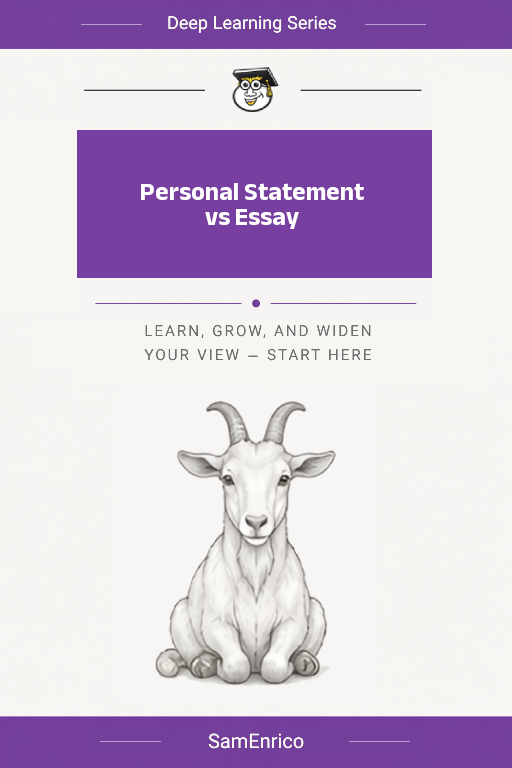
essaysStudent's ShortcutWriting
Personal Statement vs Essay eBook
Compare UK personal statement (academic focus) vs
Compare UK personal statement (academic focus) vs US college essay (personal story) approach.
Formats
Free sample
Chapter 1: Two Doors, One Student...--–- You are standing in a hallway. To your left is a solid oak door with a brass plaque that reads “UK Admissions Tutor – Subject Expert.” To your right is a frosted glass door with a handwritten sign that says “US Admissions Officer – Holistic Reviewer.” Both doors are labeled “Your Future.” Both will open if you knock correctly. But here is the secret no counselor has told you: the person behind each door speaks a different language, reads a different genre, and has a different definition of the word “impressive.” If you knock on the oak door with a story meant for the glass door, you will hear nothing but silence. If you knock on the glass door with an essay meant for the oak door, you will be politely shown out.This book exists because most students – and most counselors – do not understand that the UK personal statement and the US college essay are not different flavors of the same thing. They are not vanilla versus chocolate.
They are a lab report versus a short story. A legal brief versus a memoir. A handshake versus a hug. One is an evidence-based argument for your academic readiness. The other is a character-driven narrative about who you are when no one is grading you.
Confusing the two is the single most expensive mistake a dual applicant can make. It costs time, sanity, and – most painfully – acceptances.I have watched brilliant students with perfect grades and compelling life stories get rejected from both Oxford and Stanford because they tried to write one “master” essay and tweak it for both systems. They wrote about their love for history in the UK statement with a personal anecdote about a grandparent. They wrote about their struggle with anxiety in the US essay with a footnote about their research paper. They thought they were being efficient.
They were actually being rejected in two languages at once.This chapter is your psychological reset. Before you write a single word, before you open a Google Doc, before you even brainstorm a topic, you need to understand the fundamental architecture of the two systems. You need to know who is reading your words, what they are looking for, and why they will reject you for reasons that have nothing to do with your intelligence or character. By the end of this chapter, you will have a diagnostic map of your own natural writing tendencies, a clear understanding of the density versus depth trade-off, and a concrete plan for which system you should write for first.Let us begin with the people behind the doors.The Two Readers: A Study in Contrasts Behind the oak door sits the UK Admissions Tutor. This person is almost always a subject expert.
If you are applying for history, a historian reads your statement. If you are applying for chemistry, a chemist reads it. They have a Ph D. They have taught tutorials for twenty years. They have read five hundred personal statements this month alone, and they have seventeen more waiting in their inbox before dinner.
They are not looking for a new friend. They are not looking for a future roommate. They are looking for evidence that you can survive – and thrive – in their department.The UK tutor’s scanning pattern is vertical. They read for depth of engagement with a single subject. They want to see that you have pursued your academic interest outside the classroom, that you have encountered a genuine intellectual problem, and that you have thought critically about it.
They do not care, even slightly, that you captained the debate team unless you debated something directly related to your course. They do not care that you volunteered at a hospital unless you are applying for medicine and can connect that experience to clinical reasoning. They are not being cruel. They are being efficient. They have a job to do: admit students who will not fail out of their rigorous, specialized, lecture-and-tutorial system.Behind the frosted glass door sits the US Admissions Officer.
This person is almost always a generalist. They might have a degree in English, or sociology, or business. They read applications across all disciplines – the English major, the physics prodigy, the undeclared sophomore, all in the same hour. They are not a subject expert in your field. They are an expert in you.
They have read thousands of essays. They have a finely tuned BS detector. They are looking for character, contribution, and distinctiveness.The US officer’s scanning pattern is horizontal. They read for breadth of experience and the thread that connects your disparate interests. They want to know how you will contribute to campus life – not just in the classroom, but in the dining hall, the intramural soccer field, the student government, the a cappella group.
They ask two unofficial questions of every application: the Roommate Test (“Would I want to live with this person?”) and the Contributor Test (“Will this student start something, help someone, or make a seminar discussion better?”). They are not looking for a future academic. They are building a class – a messy, vibrant, diverse community of humans who will teach each other as much as the professors do.These two readers live in different countries, work for different institutions, and operate under different incentives. But they share one thing in common: they can spot a misfired essay from the first sentence. If you write a UK personal statement that opens with a dramatic childhood story, the tutor will think you are unfocused.
If you write a US college essay that opens with a list of books you have read, the officer will think you are a robot. The tragedy is that both students are probably brilliant. They just knocked on the wrong door.The Core Question: “Can You Do the Work?” vs. “Who Are You Beyond the Grade?”Every admissions document, every personal statement, every supplemental essay, every activity list – they are all answers to a single implicit question. That question changes depending on the system.The UK asks: Can you do the work?This is a question of evidence.
It demands proof of academic readiness. Have you read beyond the syllabus? Have you encountered a genuine intellectual problem? Have you disagreed with an author, designed a small experiment, attended a lecture and asked a question afterward? The UK system assumes that your grades tell the reader that you are smart.
The personal statement tells the reader that you are curious – and that your curiosity produces tangible, analyzable results.The US asks: Who are you beyond the grade?This is a question of character. It demands revelation. What do you do when no one is watching? What keeps you up at night? What have you failed at, and what did that failure teach you?
The US system assumes that your grades and test scores tell the reader that you are academically capable. The personal essay tells the reader that you are interesting – and that your interestingness will enrich the campus community.Let me give you an example of how the same raw material becomes completely different documents in each system.Imagine a student who…
This is the end of the free sample. Get the eBook to keep going. Buy now
About this book
Details
- Author
- Houghton Karry
- Publisher
- SamEnrico
- Language
- English
- Genre
- essays, Student's Shortcut, Writing
- Released
- 2026-05-30
- Pages (approx.)
- 142
- Available as
- eBook, Audiobook

Read better in the ZLOADR app
Your eBooks on your phone or tablet. Sign in with your SamEnrico account and start reading.
More by Houghton Karry
 Design Thinking for MeetingsHoughton Karry$11.99
 Detox for Intellectual DisabilitiesHoughton Karry$11.99
 College Student Sleep GuideHoughton Karry$11.99
 DBT for DissociationHoughton Karry$11.99
 Empathy Role Play GuideHoughton Karry$11.99
 Workplace NVC HandbookHoughton Karry$11.99
 Cleopatra Naval StrategyHoughton Karry$11.99
 Remote Work for CoachesHoughton Karry$11.99
 The Ghost Guns of the Seven Years' War: How Artillery Shaped EmpiresHoughton Karry$11.99
 Leaping Through Royal Courts: The Grace and Power of Black Ballet PioneersHoughton Karry$11.99
 Service Providers Guide to Grief CounselingHoughton Karry$11.99
 How to Produce Tool BoxesHoughton Karry$11.99
You may also like
 YouTube Video Essay DepthLeon Lala$11.99
 TOEFL Independent Essay GuideMintz Alex$11.99
 Music Theory Essay GuideWilkinson Maisha$11.99
 Expository Essay AI PromptsApplegate Dalia$11.99
 Exam Essay MemorizationMcgovern Johna$11.99
 Compare Contrast Essay PromptsOntiveros Marx$11.99
 College Application Essay GuideSisson Aimee$11.99College Application Essay GuideSisson Aimee$11.99
 The 100 Word Essay ChallengeAli Luciana$11.99
 Journalism Essay PromptsThatcher Williemae$11.99
 Finance Essay PromptsShrader Lamont$11.99
 Cause Effect Essay GPT GuideBland Jacelyn$11.99