
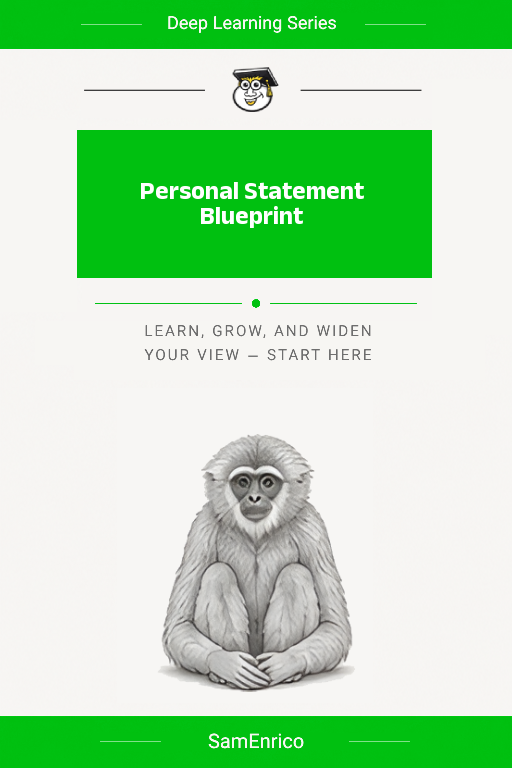
Non-FictionBlueprint GuideAdmissions Strategy
Personal Statement Blueprint eBook
Structure your main college essay for maximum impa
Structure your main college essay for maximum impact. Covers hooks, storytelling arcs, and memorable conclusions.
Formats
Free sample
Chapter 1: The Smallest Story Wins--–- Every year, over one million students sit down to write their personal statement. Nearly all of them make the same mistake before they type a single word. They ask themselves the wrong question.The question most students ask is: "What is the most impressive thing I've ever done?"This question is poison. It sends you hunting for a tragedy you haven't survived, an award you haven't won, a nonprofit you haven't founded, or a trip you haven't taken. It convinces you that your life—your actual, ordinary, perfectly fine life—is not enough.
And then it leaves you staring at a blank screen, convinced that you have nothing to say.I have read thousands of college essays. I have seen students cry over this process. I have watched brilliant, kind, interesting young people convince themselves they are boring because they climbed the wrong mountain or didn't climb any mountain at all.Here is what I need you to understand before we go any further: The students who write the most memorable essays are almost never the ones with the most spectacular stories. They are the ones who learned to look at their ordinary lives differently. They stopped searching for a topic and started searching for a lens.This chapter will teach you how to do the same.The Terror of the Blank Screen Let's name the enemy.
The blank page is not actually your enemy. The real enemy is the voice in your head that says, "Nothing I've done is good enough."This voice has a name. Let's call it the Imposter Editor. The Imposter Editor shows up the moment you open a document. It whispers things like:"Everyone else has a better story than you.""That thing you're thinking about writing?
It's too small. Too boring. Too ordinary.""Admissions officers want to be impressed, not entertained.""If you don't have a tragedy, you don't have an essay."Every single one of these statements is false. But they feel true, don't they? That's because the college admissions industry has spent decades convincing students that they need to be exceptional in every possible way.
The word "essay" gets attached to "unique" and "memorable" and "standout" so often that students start to believe their actual lives cannot possibly measure up.Here is the truth that the Imposter Editor does not want you to know: Admissions officers are not looking for the most extraordinary event. They are looking for the most self-aware student.Let me prove this to you.The Kilimanjaro Trap Imagine two students. Both write about climbing Mount Kilimanjaro.Student A writes a play-by-play of the climb. They describe the gear, the altitude, the physical exhaustion, the moment they reached the summit. They conclude that they learned "perseverance" and "the importance of setting goals." The essay is fine.
It is competent. It is also completely forgettable. The admissions officer has read twenty versions of this exact essay this year alone.Student B also climbs Kilimanjaro. But their essay does not begin at the base of the mountain. It begins at the back of the group, where a slower climber is struggling.
Student B writes about the moment they made a choice: push ahead to reach the summit faster, or stay behind and help. They write about the frustration of moving slowly, the guilt of wanting to abandon someone, and the unexpected lesson they learned about leadership not being about speed but about who you bring with you.Same mountain. Same climb. Same event. Radically different essays.The difference is not the topic.
The difference is the lens.Student A used Kilimanjaro as a gimmick—a unique event that went nowhere. The essay could have been about any mountain climb, any race, any physical challenge. There was nothing in it that revealed who Student A actually is when no one is watching.Student B used Kilimanjaro as a lens—a specific moment that magnified their values. The essay revealed that Student B values community over individual achievement, that they struggle with competing desires, that they are willing to sacrifice personal glory for collective success. You learned something about their character that you could not have learned from their transcript or activity list.The gimmick impresses no one.
The lens reveals everything.Small Stories, Big Truths Here is where most students get stuck. They hear "use a lens, not a gimmick" and immediately think, "Okay, so I need to find a different impressive event that I can use as a lens."No. That is not the move.The move is to stop looking for impressive events entirely. The move is to look for small moments that contain big truths.Consider these real essay topics from students who were admitted to highly selective colleges. None of these topics would make anyone say "wow" at a dinner party:A student who wrote about learning to cook eggs with their grandmother, and how the imperfect, burned, over-salted eggs taught them more about love than any perfect meal ever could.A student who wrote about being the worst player on their soccer team for three years, and how they learned to measure success not by goals scored but by how many teammates they helped improve.A student who wrote about a single argument with their father over a broken lawnmower, and how that ten-minute fight revealed the entire emotional architecture of their relationship.A student who wrote about the summer they worked at a grocery store and discovered that they were better at talking to elderly customers than anyone else, and what that said about their patience and curiosity.A student who wrote about failing their driver's license test three times, and how the embarrassment of being the last kid in their grade to drive taught them to stop defining themselves by other people's timelines.These are not "spectacular" topics.
They are not tragedies or triumphs. They are ordinary, mundane, everyday moments. And they worked because the students who wrote them asked a different question.They did not ask: "What is the best thing I've ever done?"They asked: "What small thing shows how I work, love, or think?"The Microcosm Principle Let me give you a name for this idea. I call it the Microcosm Principle.A microcosm is a small system that reflects a larger one. In essay writing, the Microcosm Principle says this: Your essay should be a sample, not a résumé.Think about it this way.
If I wanted to understand what your house looks like, I could ask you to describe every room, every hallway, every piece of furniture, every scuff mark on the floor. That would take hours. It would be exhausting. And by the end, I would probably be confused and bored.Or, I could ask you to show me one room. One well-lit, carefully chosen room.
The kitchen where your family argues and laughs. The basement where you go to be alone. The bedroom that still has the same posters from eighth grade. And in that one room, I would understand more about who you are than any exhaustive tour could ever provide.One well-lit room is better than a dim view of…
This is the end of the free sample. Get the eBook to keep going. Buy now
About this book
Details
- Author
- Slater Conception
- Publisher
- SamEnrico
- Language
- English
- Genre
- Non-Fiction, Blueprint Guide, Admissions Strategy
- Released
- 2026-05-30
- Pages (approx.)
- 144
- Available as
- eBook, Audiobook

Read better in the ZLOADR app
Your eBooks on your phone or tablet. Sign in with your SamEnrico account and start reading.
More by Slater Conception
 Attempt Survivor Firefighter StorySlater Conception$11.99
 Mindful Walking For Pain ManagementSlater Conception$11.99
 The Letting Go Ritual GuideSlater Conception$11.99
 Playdate Hosting Time MinimizationSlater Conception$11.99
 Whole Food Plant Based GuideSlater Conception$11.99
 Athens vs. Sparta: The Peloponnesian War That Shaped Western CivilizationSlater Conception$11.99
 Understanding Nevi Flammei, Familial MultipleSlater Conception$17.99
 How to Start a Calcined Dolomite Business (Beginners Guide)Slater Conception$11.99
 Small Business AI Profitability AnalysisSlater Conception$12.99
 Photojournalism PhotographySlater Conception$11.99
You may also like
 Hong Kong Handover 1997Dunn Johnnie$11.99
 Zumba For Postnatal Recovery CourseNeal Christian$11.99
 Zumba for BeginnersLadner Nikia$11.99
 YouTube Comment Mining GuideHumes Pandora$12.99
 Worry Box MeditationCarlin Rudy$11.99
 Workplace Stress MeditationNguyen Lynn$11.99
 Workplace Stress and Sleep RepairHawley Ivory$11.99
 Workplace Perfectionism CureDelaney Jeffry$11.99
 Workplace Injustice Anger GuideWallen Isabelle$11.99
 Work Addiction and Burnout LinkGreenwood Ester$11.99
 Women in Yoga and WellnessBeattie Galina$11.99
 Women in Stand Up ComedyChun Evangeline$11.99