
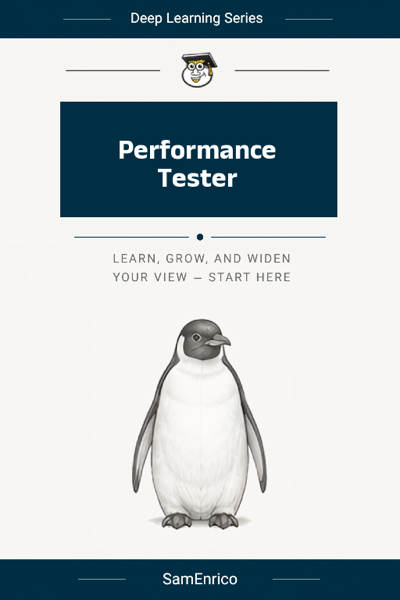
Non-FictionInformativeEducational
Performance Tester eBook
A Coursebook on Performance Tester
A Coursebook on Performance Tester
Formats
Free sample
Chapter 1: The Million-Dollar Second--The first time a production system failed on my watch, I was holding a coffee in one hand and a pager in the other. The pager vibrated so violently that hot coffee splashed across my keyboard. On the screen, a dashboard was turning from amber to deep, alarming red. Forty-seven thousand users were staring at a spinning cursor. The company was losing $12,000 per minute.
And I had no idea why.That was the moment I stopped being a person who ran load tests and started being a performance engineer. The difference between those two things is the difference between owning a stethoscope and being a cardiologist. Both can hear the heartbeat. Only one knows what to do when it stops.This book exists to make you the cardiologist.The Great Misunderstanding Let me start with a confession that might upset some of my former colleagues. For the first three years of my career, I was a fraud.
I had a title that said "Performance Test Engineer." I could click buttons in Load Runner and JMeter. I could generate reports with pretty green bars and red bars. I could say things like "the 95th percentile response time exceeded the SLA" with a straight face.But I did not understand performance. I understood button-clicking.Here is what I wish someone had told me on day one: performance testing is not about running tools. Performance engineering is about asking the right questions before you run any tool at all.
The tools are the easy part. Anyone can learn JMeter in a week. The hard part is learning to think like someone who can look at a system architecture, predict where it will fail, design a test that proves the prediction correct or incorrect, analyze the results, and then tell developers exactly what to fix and why.That hard part is what this book teaches.The Cost of Ignorance Before we talk about how to do performance work correctly, we need to talk about what happens when you do it poorly. This is not an academic exercise. The numbers I am about to share come from real incidents that real companies survived—or did not survive.Case Study One: The Banking App That Went Dark A regional bank in the northeastern United States launched a mobile app update on a Thursday morning.
The performance testing before launch consisted of one person running a script from his laptop connected to the company Wi-Fi. The script passed. The app launched.At 9:47 AM, the app stopped responding. At 10:12 AM, the bank's call center received 1,400 calls in fifteen minutes—twice their average daily volume. At 11:03 AM, the bank's CEO received a call from a reporter asking why customers could not access their paychecks on a Thursday.The root cause?
A single database query that worked fine when one user ran the app but created a lock contention storm when 4,000 concurrent users hit the same table. The performance test never simulated concurrency because the tester did not understand the difference between sequential script execution and real user concurrency.The cost: $847,000 in regulatory fines, $2.1 million in customer goodwill payments, and a CEO who publicly announced that the bank's technology leadership would be "evaluated."Case Study Two: The Retailer Who Lost Black Friday An online retailer had been running the same load test for three years. Every quarter, they spun up the same script, ran it against their staging environment, and declared the system ready. The test simulated 5,000 users. The system handled 5,000 users.
Everyone was happy.Black Friday arrived. At 6:00 AM, traffic hit 5,000 users. The system was fine. At 6:15 AM, traffic hit 7,000 users. Response times doubled.
At 6:22 AM, traffic hit 9,000 users. The website started returning HTTP 500 errors. At 6:31 AM, the site went completely offline.The problem was not that the system could not handle more than 5,000 users. The problem was that the load test had never simulated the behavior of real users. The script sent requests with five seconds of think time between each click.
Real users on Black Friday clicked every two seconds. The script requested only product pages and the cart. Real users also hit the search endpoint, which was ten times slower. The test was a fantasy, and the fantasy collapsed the instant reality arrived.The cost: $4.7 million in lost sales on the single most profitable day of the year, plus the long-term cost of customers who switched to Amazon permanently.Case Study Three: The Streaming Service That Became a Meme A streaming service announced a major sporting event would be available exclusively on their platform. The performance team ran stress tests that showed the system could handle 8 million concurrent streams.
The engineering leadership was confident.On game day, 8.2 million people tried to watch. The system survived—barely. But something strange happened. Users reported that the stream would play for exactly 47 minutes and then buffer endlessly. Restarting the stream fixed the problem for another 47 minutes.The performance tests had all been thirty minutes long.
No one had ever run a soak test. The memory leak in the video player's buffer management code only became visible after forty minutes of continuous streaming. The team had built a system that passed every test they wrote and failed the moment real users behaved differently.The cost: The company's stock dropped 7% the following Monday. The sporting event became a viral joke. The head of engineering resigned within six months.What These Stories Reveal If you take nothing else from this chapter, take this: every single one of these failures was preventable.
Not with better tools. Not with more expensive software. Not with longer testing cycles. With better thinking.The banking app failed because the tester did not understand the difference between sequential and concurrent execution. The retailer failed because the tester did not understand user behavior modeling.
The streaming service failed because the tester did not understand system behavior over time.These are not tool problems. These are thinking problems.And the good news is that thinking can be taught.The Performance Engineer vs. The Test Runner Let me draw a sharp distinction that will run through every chapter of this book.A test runner knows how to use JMeter, Load Runner, or Gatling. They can record a script, add assertions, and run a load test. They can generate a report that shows response times and error rates.
They are valuable. They are also replaceable.A performance engineer knows how to do all of that, plus: analyze an architecture to predict failure modes, design experiments that isolate specific variables, read monitoring data to understand what a system is doing under load, use profiling tools to find the exact line of code causing a bottleneck, and communicate findings in a way that developers actually want to fix.The test runner asks "how do I run a load test?" The performance engineer asks "what question am I trying to answer?"This book is written for people who want to become performance engineers. If you are already a test runner, you will find the first few chapters familiar. Do not skip them. The concepts matter more than the syntax.Non-Functional Requirements Before you write a single line of test script, before you configure a single thread…
This is the end of the free sample. Get the eBook to keep going. Buy now
About this book
Details
- Author
- Baines Holley
- Publisher
- SamEnrico
- Language
- English
- Genre
- Non-Fiction, Informative, Educational
- Released
- 2026-06-03
- Pages (approx.)
- 146
- Available as
- eBook, Audiobook

Read better in the ZLOADR app
Your eBooks on your phone or tablet. Sign in with your SamEnrico account and start reading.
More by Baines Holley
 Presentation Script SecurityBaines Holley$11.99
 Tabata Method HandbookBaines Holley$11.99
 Broken Bond Repair GuideBaines Holley$11.99
 Venture Debt Exit FeeBaines Holley$11.99
 Thunder Over the Yalu: The Forgotten Dogfight That Saved the Korean WarBaines Holley$11.99
 How to Start a Paper Cut To Size (not Packaging Products) Business (Beginners Guide)Baines Holley$11.99
 How to Produce CentrifugesBaines Holley$11.99
 Recourse vs Non Recourse Factoring GuideBaines Holley$12.99
You may also like
 Hong Kong Handover 1997Dunn Johnnie$11.99
 Zumba For Postnatal Recovery CourseNeal Christian$11.99
 Zumba for BeginnersLadner Nikia$11.99
 YouTube Comment Mining GuideHumes Pandora$12.99
 Worry Box MeditationCarlin Rudy$11.99
 Workplace Stress MeditationNguyen Lynn$11.99
 Workplace Stress and Sleep RepairHawley Ivory$11.99
 Workplace Perfectionism CureDelaney Jeffry$11.99
 Workplace Injustice Anger GuideWallen Isabelle$11.99
 Work Addiction and Burnout LinkGreenwood Ester$11.99
 Women in Yoga and WellnessBeattie Galina$11.99
 Women in Stand Up ComedyChun Evangeline$11.99