
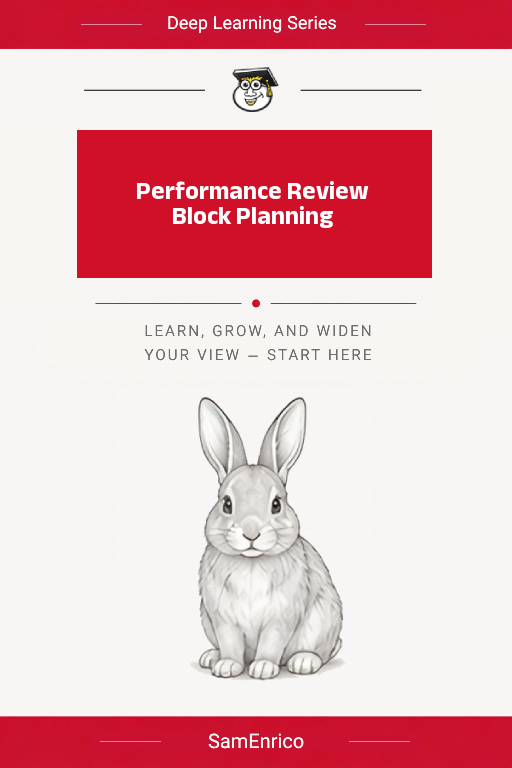
Non-FictionProfessional's Cheat SheetReviews
Performance Review Block Planning eBook
Schedule 45-minute blocks for each direct report's
by Tyson Danika
Schedule 45-minute blocks for each direct report's quarterly and annual performance reviews.
Formats
Free sample
Chapter 1: The 60-Hour Lie--–- The first time Maria canceled a quarterly performance review, she told herself it was because the client deadline moved. The second time, she blamed a company-wide reorg. By the third cancellation, she didn't bother with an excuse. She just let the meeting invite expire in her calendar like a forgotten grocery list.Maria was not a bad manager. She was a director of product at a mid-sized Saa S company, responsible for eleven direct reports, a $4 million P&L, and the mental health of a team that had started calling her quarterly reviews "the haunted hour." She was smart, well-liked, and genuinely invested in her people's growth.
But she had a secret that she had never admitted to anyone, not even her own boss: she was terrified of performance reviews.Not terrified of the conversation itself. She could give feedback. She could handle tears, defensiveness, even the occasional outburst. What terrified her was the math. Eleven direct reports.
Four quarters. Forty-four reviews per year. At sixty minutes each (because who can do a proper review in less?), that was forty-four hours of meetings. Add thirty minutes of prep per review—hunting for emails, digging through Slack threads, trying to remember what happened six months ago—and she was looking at sixty-six hours per year. Sixty-six hours of her life, gone, to produce outcomes she couldn't measure, documents no one read, and conversations that left both parties feeling worse than when they started.So she canceled.
Rescheduled. "Let's circle back next month." And next month became next quarter, and next quarter became the annual review death march, where she locked herself in a conference room for three days, wrote eleven reviews from scratch, and emerged with a pounding headache and the vague sense that she had failed everyone, including herself.Maria's story is not unusual. It is not even remarkable. According to a 2023 survey by the Society for Human Resource Management, 67% of managers admit to canceling or rescheduling at least one performance review per quarter. The same survey found that the average manager spends 58 hours per year on performance reviews—and rates their own effectiveness at 4.2 out of 10.
That is not a process. That is a confession.This book exists because Maria's story ends differently. Three years ago, after her annual review death march left her in tears in a parking garage, she stumbled onto an idea that would change everything. What if, she wondered, performance reviews took exactly forty-five minutes? What if they happened every quarter, like clockwork, and what if the preparation took fifteen minutes or less?
What if the annual review was not a three-day ordeal but a fifteen-minute copy-paste job from the previous four quarters?She tried it. It worked. Then she taught her team. Then her peer managers asked for the template. Then her VP demanded she train the whole department.
Today, Maria's team has the highest retention rate in the company, the shortest time-to-promotion, and the lowest number of "surprise resignations" (zero in two years). She did not achieve this by working harder. She achieved it by working differently.This chapter is about the lie Maria believed: that performance reviews require massive, unfocused blocks of time to be meaningful. That lie costs managers like you sixty hours a year. It costs your employees their trust.
And it costs your organization the very thing performance reviews are supposed to create: alignment, growth, and accountability.The sixty-hour lie has three parts. Let me name them now, because once you see them, you cannot unsee them. First, the lie that longer reviews are better reviews. Second, the lie that frequent check-ins can replace structured reviews. Third, the lie that you can "find time" for reviews instead of scheduling them.
This chapter dismantles all three.The First Lie: Longer Is Better The traditional annual review, as practiced in most organizations, is a sixty-to-ninety-minute conversation that attempts to summarize twelve months of work. This is absurd on its face. Human memory is not designed to recall twelve months of specific, nuanced behavior. In fact, cognitive psychology research has demonstrated that memory for routine performance decays exponentially after approximately ninety days. A study published in the Journal of Applied Psychology found that managers rating employees on annual cycles could accurately recall only 22% of critical incidents from the first half of the year.
The other 78%? Lost, forgotten, or unconsciously replaced by more recent events.This is not a failure of managerial competence. It is a feature of how brains work. The recency effect—the tendency to overweight the most recent information—means that an employee who stumbled in January but excelled in December will receive a higher rating than an employee who excelled for eleven months and stumbled in December. The halo effect—the tendency to let one outstanding trait or achievement color everything else—means that an employee who led one successful project in February will be remembered as "strong" even if they underperformed for the remaining ten months.These biases are not corrected by longer meetings.
They are amplified by them. When a manager sits down for a ninety-minute annual review, they do not suddenly remember the forgotten eight months. Instead, they fill the time with whatever comes to mind first: the most recent project, the most memorable interaction, the most emotional moment. The result is a conversation that feels substantive but is actually a Rorschach test of the manager's imperfect memory.Parkinson's Law—work expands to fill the time available for its completion—applies ruthlessly to performance reviews. A ninety-minute review will take ninety minutes.
A sixty-minute review will take sixty minutes. A forty-five-minute review will take forty-five minutes. The difference is not in what gets covered. The difference is in what gets cut. And what gets cut in longer reviews is usually the most important thing: specificity.Consider two reviews of the same employee.
In the ninety-minute version, the manager spends twenty minutes on small talk, fifteen minutes searching for an example they can't quite remember, ten minutes repeating themselves, and forty-five minutes on actual content. In the forty-five-minute version, the manager has no time for small talk, no time to search for lost examples, no time to repeat themselves. They have forty-five minutes to be specific, or they have nothing. This constraint is not a bug. It is the entire point.Maria discovered this the hard way.
During her annual review death march, she found herself writing things like "needs to improve communication" for an employee whose communication was actually fine. She was filling space. When she switched to forty-five-minute quarterly reviews, she could no longer afford vague feedback. She had to say, "On the March client call, you interrupted the stakeholder three times. Here's what I noticed.
Here's what I'd like to see instead." Specific. Actionable. Forty-five seconds, not forty-five minutes.The research backs her up. A meta-analysis of performance feedback studies found that specific, behavioral feedback delivered within ninety days of the observed behavior improves subsequent performance by 34%. General feedback delivered annually improves subsequent performance by 6%.
The difference is not in the words. The difference is in the timing and the specificity. Forty-five-minute quarterly reviews force both.The Second Lie: Frequent…
This is the end of the free sample. Get the eBook to keep going. Buy now
About this book
Details
- Author
- Tyson Danika
- Publisher
- SamEnrico
- Language
- English
- Genre
- Non-Fiction, Professional's Cheat Sheet, Reviews
- Released
- 2026-05-30
- Pages (approx.)
- 152
- Available as
- eBook, Audiobook

Read better in the ZLOADR app
Your eBooks on your phone or tablet. Sign in with your SamEnrico account and start reading.
More by Tyson Danika
 The Emotion Name GuideTyson Danika$11.99
 Polysubstance Dependency HelpTyson Danika$11.99
 De escalating Heated ArgumentsTyson Danika$11.99
 Alcohol Withdrawal Seizure PreventionTyson Danika$11.99
 IBS And Dairy Sensitivity GuideTyson Danika$11.99
 Francis and the Simple BrothersTyson Danika$11.99
 Online Cessation Communities GuideTyson Danika$11.99
 Parent of Child with DepressionTyson Danika$11.99
 The Ballad of General Giáp: How a Peasant Commander Defied EmpiresTyson Danika$11.99
 The Alchemists of the Enlightenment: Lavoisier and the Birth of Modern ChemistryTyson Danika$11.99
 Service Providers Guide to Spine & Neck OrthopedicsTyson Danika$11.99
 How to Become a Powder-mill OperatorTyson Danika$11.99
You may also like
 Hong Kong Handover 1997Dunn Johnnie$11.99
 Zumba For Postnatal Recovery CourseNeal Christian$11.99
 Zumba for BeginnersLadner Nikia$11.99
 YouTube Comment Mining GuideHumes Pandora$12.99
 Worry Box MeditationCarlin Rudy$11.99
 Workplace Stress MeditationNguyen Lynn$11.99
 Workplace Stress and Sleep RepairHawley Ivory$11.99
 Workplace Perfectionism CureDelaney Jeffry$11.99
 Workplace Injustice Anger GuideWallen Isabelle$11.99
 Work Addiction and Burnout LinkGreenwood Ester$11.99
 Women in Yoga and WellnessBeattie Galina$11.99
 Women in Stand Up ComedyChun Evangeline$11.99