
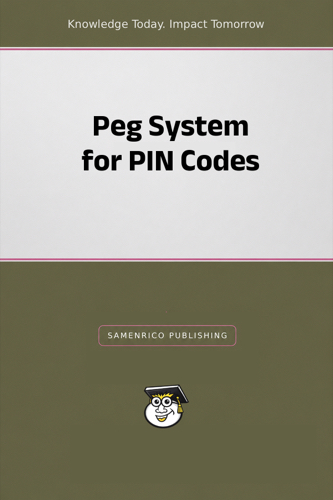
Peg System for PIN Codes eBook
Store multiple PIN numbers securely using visual n
Store multiple PIN numbers securely using visual number pegs.
Formats
Free sample
Chapter 1: The $47 Embarrassment--I stood at the register, three bags of groceries sweating through their paper sacks, a pint of ice cream already softening into a puddle of vanilla goo. There were ten people behind me. I could feel their collective impatience pressing against my back like a physical weight. The cashier, a teenager named Brandon according to his tag, had already scanned everything. The total was $47.32.
He looked at me with the hollow stare of someone who had watched this exact scene play out a thousand times."Your PIN, sir?"I reached for the keypad. And then nothing.Four numbers. Four simple, familiar numbers that I had typed thousands of times over three years. They were gone. Not fuzzy, not slow to arrive—simply gone, as if someone had reached into my brain and erased a single, critical file.
I pressed my palm against my forehead, hoping the pressure would somehow dislodge the memory. It did not. I tried typing a sequence I thought might be correct. The machine beeped angrily at me. Transaction declined."I'm sorry," I said to Brandon, to the ten people behind me, to the universe in general.
"I just—I know this. Give me a second."I stepped out of line. The woman behind me, holding a case of bottled water and a look of profound judgment, slid forward without making eye contact. I stood by the gum rack, phone in hand, pretending to check for a text message that did not exist. Then I walked out of the store, abandoned groceries and all, and drove home in silence.That night, I sat at my kitchen table and asked myself a question that had been lurking for years: Why does this keep happening?This book is the answer to that question.
And more importantly, this book is the solution—a solution that has nothing to do with willpower, brain training apps, or the false promise of "just concentrate harder." What I am about to teach you took me six months of frustrated research, dozens of dead-end methods, and one accidental discovery in a used bookstore to uncover. You will learn it in the next fifteen minutes.The Secret You Already Possess Before we talk about PINs, let us talk about something you never forget. Think about the house where you grew up. Do not try to remember it—just let it appear. You can probably see the front door.
The color of the carpet in the hallway. The spot on the kitchen counter where your family kept the fruit bowl. You can remember the smell of rain on the driveway, the sound of the garage door opening, the way the light came through the kitchen windows on a Saturday morning.You did not try to memorize any of this. You never sat down with flashcards labeled "Front Door Color" or drilled "Carpet Texture" for thirty minutes a day. You simply lived there, and your brain absorbed everything—the layout, the sensory details, the emotional associations—without conscious effort.Now consider your debit card PIN.
You probably have tried to memorize it. You have typed it thousands of times. You have repeated it to yourself like a mantra. And yet, as we both know, it can vanish in an instant under the slightest pressure.Why? Why can your brain effortlessly remember the layout of a house you have not lived in for twenty years, but struggle to retain four numbers you use every single week?The answer is not that you have a bad memory.
The answer is that you have been asking your brain to do something it was never designed to do.The Baker/Baker Paradox In the early 2000s, a cognitive psychologist named Dr. Jennifer Baker (a real person with an inconveniently perfect name for this story) conducted a simple but profound experiment. She showed participants a photograph of a man's face and told half of them, "This man's last name is Baker." She told the other half, "This man is a baker." Later, she asked all the participants to recall the word associated with the face.The results were dramatic. The participants who were told the man was a baker—meaning, he baked bread for a living—remembered the word "baker" with significantly higher accuracy than the participants who were told the man's last name was Baker. Same word.
Same face. Different meaning. Different outcome.This became known as the "Baker/baker paradox," and it reveals something fundamental about how your brain works. When you hear that someone is a baker (the profession), your brain automatically generates a rich web of associations: flour-dusted aprons, warm ovens, early mornings, the smell of sourdough, the weight of a bread peel. These sensory and contextual details act as hooks, holding the word "baker" firmly in place.When you hear that someone's last name is Baker, there is nothing.
No associations. No sensory hooks. Just an arbitrary label attached to a face. The word floats away because there is nothing to anchor it.Now consider your PIN. A four-digit number like 4489 is the surname "Baker." It is an arbitrary label with no inherent meaning, no sensory details, no emotional hooks.
Your brain, which evolved over millions of years to remember where the fruit trees are and which animals are dangerous, has absolutely no interest in 4489. It will delete that number at the first opportunity to make room for something useful, like the face of a person who might share their food with you or the location of a water source.This is not a design flaw. It is a design feature. Your brain is a survival machine, not a spreadsheet. Forgetting your PIN is not evidence of cognitive decline—it is evidence that your brain is working exactly as evolution intended.The problem is that we now live in a world that demands we remember hundreds of arbitrary numbers: PINs, passwords, account numbers, confirmation codes, locker combinations, safe codes, extension numbers, two-factor authentication tokens.
Your brain never signed up for this job. But that does not mean you are helpless. It means you need to stop fighting your brain's natural design and start working with it.Why Rote Repetition Is a Trap The most common strategy for remembering a PIN is also the worst: typing it over and over again until your fingers "know" it. This strategy fails for two reasons, both rooted in how memory actually works.First, rote repetition creates what cognitive psychologists call "shallow encoding." When you type a number repeatedly, you are engaging only the most superficial levels of processing—motor memory and visual recognition. You are not attaching meaning, emotion, or context to the number.
You are teaching your fingers a pattern, not your brain a fact. And finger patterns are fragile. They collapse under stress, fatigue, distraction, or the simple passage of time.Second, rote repetition creates a false sense of security. You type your PIN correctly 999 times, and on the 1,000th time, you blank. This feels like a betrayal—I know this, why can't I access it?
—but it is actually predictable. Your brain does not store memories as single files. It stores them as networks of associations, and…
This is the end of the free sample. Get the eBook to keep going. Buy now
About this book
Details
- Author
- Collazo Connie
- Publisher
- SamEnrico
- Language
- English
- Genre
- Non-Fiction, Self-Help
- Released
- 2026-06-08
- Pages (approx.)
- 117
- Available as
- eBook, Audiobook

Read better in the ZLOADR app
Your eBooks on your phone or tablet. Sign in with your SamEnrico account and start reading.
More by Collazo Connie
 Laci Peterson Victim Family JourneyCollazo Connie$11.99
 Anxiety Reading Body Language GuideCollazo Connie$11.99
 Remote Review Neurodivergent GuideCollazo Connie$11.99
 The Retirement Financial Planning GuideCollazo Connie$11.99
 The Phantom of the Grand Guignol: Paris' Theater of Terror and TriumphCollazo Connie$11.99
 Infection ControlCollazo Connie$11.99
 Tax Transparency Performance GuideCollazo Connie$12.99
 Dot Eu Domain Registration GuideCollazo Connie$12.99
 Understanding Partial Deletion of YCollazo Connie$17.99
 How to Start a Household Vacuum Cleaner Manufacturing BusinessCollazo Connie$11.99
You may also like
 Hong Kong Handover 1997Dunn Johnnie$11.99
 Zumba For Postnatal Recovery CourseNeal Christian$11.99
 Zumba for BeginnersLadner Nikia$11.99
 YouTube Comment Mining GuideHumes Pandora$12.99
 Worry Box MeditationCarlin Rudy$11.99
 Workplace Stress MeditationNguyen Lynn$11.99
 Workplace Stress and Sleep RepairHawley Ivory$11.99
 Workplace Perfectionism CureDelaney Jeffry$11.99
 Workplace Injustice Anger GuideWallen Isabelle$11.99
 Work Addiction and Burnout LinkGreenwood Ester$11.99
 Women in Yoga and WellnessBeattie Galina$11.99
 Women in Stand Up ComedyChun Evangeline$11.99