
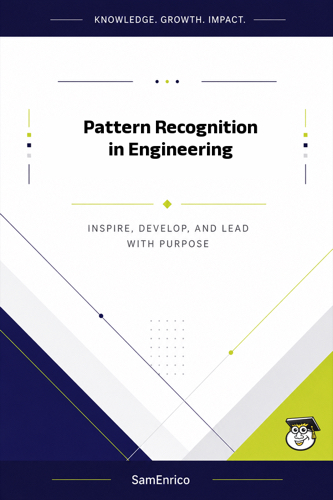
Pattern Recognition in Engineering eBook
undefined
undefined
Formats
Free sample
Chapter 1: The Sensor’s Lie...--–- Every pattern recognition system ever built begins with a lie. Not a malicious lie, but a deception baked into the very physics of measurement. The sensor on your machine, your medical device, your autonomous vehicle—it does not output the truth. It outputs a voltage, a current, a digital number that has been filtered, averaged, scaled, and corrupted by noise before you ever see it. Most engineers spend their careers trying to ignore this lie.
The ones who build systems that actually work learn to embrace it.Welcome to pattern recognition in engineering. This is not a book about abstract mathematics or theoretical proofs. Those books already exist, and they fill the shelves of university libraries where they gather dust while real engineers struggle with real problems. This book is about the messy, beautiful, practical art of turning noisy sensor data into reliable decisions—decisions that control robots, diagnose diseases, find faults in rotating machinery, and keep factories running.If you are reading this, you have likely already tried to build a pattern recognition system. Perhaps you collected thousands of samples, trained a classifier, achieved 95% accuracy on your test set, and then watched it fail catastrophically when you deployed it in the field.
Perhaps you spent weeks tuning hyperparameters, only to discover that your carefully crafted model could not distinguish a failing bearing from a passing truck. Perhaps you are starting fresh, determined to avoid the mistakes that cost your last project six months and a promotion.This chapter will save you from all of that. Not by giving you a magic algorithm—the No Free Lunch theorem we will explore shortly guarantees that no such algorithm exists—but by giving you a framework. A way of thinking about pattern recognition that starts not with equations but with the physical world. A design cycle that forces you to ask the right questions before you write a single line of code.Let us begin with a story.The $10 Million Threshold Several years ago, a team of brilliant engineers at a large manufacturing plant was tasked with building an automated quality control system.
Their production line stamped out metal parts at a rate of one per second. The problem was simple: some parts had microscopic cracks that would cause field failures after a few thousand cycles. The cost of a field failure was enormous—recalls, lawsuits, damaged reputation. The cost of rejecting a good part was trivial: the metal could be melted down and reused.The engineers did everything right by the textbook. They installed high-speed cameras.
They extracted features using wavelet transforms. They trained a support vector machine on ten thousand labeled examples. The SVM achieved 99.8% accuracy on their test set. They deployed it with confidence.Within twenty-four hours, the system had rejected thirty-seven perfect parts and missed two cracked ones. The production line manager was furious.
The plant director demanded answers. The engineers were baffled. Their model was excellent on paper. Why had it failed?The answer, which took them three weeks to discover, was hiding in a place no textbook had taught them to look: the threshold. Their SVM output a probability between 0 and 1.
At 0.5, they classified "good." Below 0.5, "bad." But 0.5 is just a number. It has no special meaning in the physics of cracked metal. The optimal threshold for their problem—given the $10,000 cost of a missed crack versus the $1 cost of a false alarm—was not 0.5. It was 0.006. They needed to reject any part with more than a 0.6% chance of being cracked.
By the time they figured this out, the production line had been down for a week.This story illustrates the first and most important lesson of this book: pattern recognition is not about algorithms. It is about decisions under uncertainty, constrained by physics, economics, and time. The SVM was not the problem. The threshold was. The engineers had focused on the sexy part of the system—the classifier—and ignored the boring part: the decision rule.In this chapter, we will build the mental infrastructure you need to avoid this fate.
We will walk through the complete pattern recognition pipeline, from the sensor to the decision. We will introduce the constraints that separate toy problems from real engineering: speed, memory, power, and cost. And we will meet the No Free Lunch theorem, which will forever inoculate you against anyone who claims to have found the "best" classifier.By the end of this chapter, you will have a decision framework that tells you exactly what to do before you write a single line of code. The rest of this book will fill in the details of each step. But if you master only this chapter, you will already be ahead of most engineers practicing pattern recognition today.The Pattern Recognition Pipeline: From Physics to Decision Every pattern recognition system, regardless of complexity, follows the same fundamental workflow.
I call this the Engineering Pattern Recognition Pipeline, and it consists of five stages:Sensing → Segmentation → Feature Extraction → Classification → Decision Let us examine each stage in detail, because the mistakes that kill real-world systems almost always happen at the boundaries between stages.Stage 1: Sensing The pipeline begins not with data but with the physical world. A sensor of some kind—camera, microphone, accelerometer, thermocouple, pressure transducer, LIDAR, radar, ECG electrode—measures a physical quantity and converts it into an electrical signal. This signal is then sampled, quantized, and converted into digital numbers.Here is the lie I mentioned at the beginning of this chapter. Every sensor introduces distortion. The microphone has a frequency response that attenuates some frequencies and amplifies others.
The camera has a Bayer filter that interpolates color information. The accelerometer has a noise floor below which vibrations cannot be distinguished from thermal fluctuations. The analog-to-digital converter has quantization error and nonlinearity.The practical consequence is this: you cannot simply take the sensor's output at face value. You must understand your sensor's specifications. What is its signal-to-noise ratio?
What is its bandwidth? What is its sampling rate? What are its saturation limits? I have seen engineers spend weeks tuning classifiers only to discover that their sensor was aliasing—sampling a 1000 Hz signal at 500 Hz, causing high-frequency content to masquerade as low-frequency artifacts.The first question you should ask when starting any pattern recognition project is not "Which classifier should I use?" It is "What does my sensor actually measure, and what are its limitations?"Stage 2: Segmentation Once you have a stream of digital samples, you must decide which parts of that stream correspond to individual patterns. Segmentation is the process of isolating meaningful chunks from continuous data.Consider a speech recognition system.
The microphone produces 44,100 samples per second. But speech is not continuous—there are pauses between words, silence between sentences, background noise between utterances. The system must decide when a word begins and when it ends. This is segmentation. Get it wrong, and you will feed your classifier silence (which it will confidently classify as something) or cut off the beginning of a word (which will change its meaning entirely).Segmentation can be trivial or impossibly hard.
In a quality control system where parts pass by on a conveyor belt with a known spacing, segmentation is easy…
This is the end of the free sample. Get the eBook to keep going. Buy now
About this book
Details
- Author
- Williford Tilda
- Publisher
- SamEnrico
- Language
- English
- Genre
- Non-Fiction, Self-Help / Engineering
- Released
- 2026-06-07
- Pages (approx.)
- 149
- Available as
- eBook, Audiobook

Read better in the ZLOADR app
Your eBooks on your phone or tablet. Sign in with your SamEnrico account and start reading.
More by Williford Tilda
 Imposter Syndrome for Social WorkersWilliford Tilda$11.99Imposter Syndrome for Social WorkersWilliford Tilda$11.99
 The Gacy Victim MemorialWilliford Tilda$11.99
 Occupational Therapy Poverty AdaptationWilliford Tilda$11.99
 Belgian Diamond Heist AftermathWilliford Tilda$11.99
 Nicotine Patch To FreedomWilliford Tilda$11.99
 Chronotype and Study TimingWilliford Tilda$11.99
 Mobutu Sese SekoWilliford Tilda$11.99
 RLS Trigger Avoidance GuideWilliford Tilda$11.99RLS Trigger Avoidance GuideWilliford Tilda$11.99
 The Secret Affair of the Royal Society: Love, Rivalry, and the Birth of Modern ScienceWilliford Tilda$11.99
 The Quantum Leap That Changed EverythingWilliford Tilda$11.99