
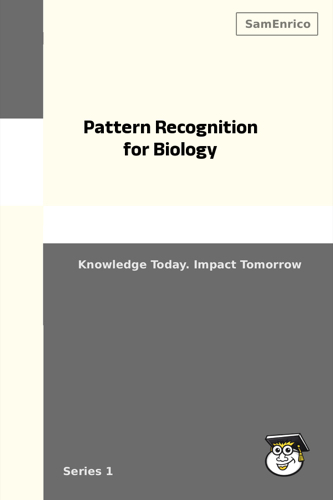
Pattern Recognition for Biology eBook
Remember taxonomy and systems by recognizing biolo
Remember taxonomy and systems by recognizing biological patterns.
Formats
Free sample
Chapter 1: The Deception Orchid--–- The male bee did not make a mistake. He made a perfect, logical, rational decision based on every piece of information available to him. The flower before him looked like a female bee. It smelled like a female bee. Its fuzzy texture felt like a female bee.
It even reflected ultraviolet light in the exact pattern of a female bee’s wings. The bee, programmed by forty million years of evolution to recognize the pattern of a potential mate, attempted to copulate with the flower. In doing so, he brushed against a sticky pollen sac called a pollinium, which attached to his back. When he flew off in confusion and tried again with another Ophrys orchid, he delivered the pollen and fertilized the plant. The orchid had deceived him, and in that deception, the flower reproduced.This is not a story about a stupid bee.
This is a story about the power of patterns.Every living thing on Earth survives by recognizing patterns. The gazelle sees the shape of a lion hidden in tall grass—not the lion itself, but the pattern of tawny stripes against green stems. The mushroom detects the pattern of chemical signals from a nearby tree root and decides to form a mycorrhizal partnership. The newborn human recognizes the pattern of its mother’s face within hours of birth, distinguishing her from every other face on the planet. Pattern recognition is not a skill you learn.
It is the operating system of life itself.But here is the strange truth: while every human being is born with this ancient, powerful cognitive machinery, almost no one is taught how to turn it toward the natural world with intentionality. You can recognize your mother’s face, your dog’s bark, the smell of rain on dry pavement. But can you look at a tree and know whether it is an oak or a maple? Can you look at a bird and tell me its family? Can you hold a mushroom and determine whether it is a delicious morel or a deadly false morel?
Most people cannot. Not because they lack intelligence, and not because biology is too hard, but because no one ever taught them how to see.This book will teach you to see.The Biology of Pattern Recognition Let us return to the bee for a moment. The male bee’s brain contains a neural circuit called a “feature detector.” This circuit is tuned to respond to specific visual and chemical inputs: the shape of a female’s abdomen, the spacing of her wings, the specific blend of hydrocarbons in her cuticle. When the Ophrys orchid evolved to match those features, it hijacked the bee’s pattern recognition system. The bee did not fail.
The orchid succeeded.Your brain contains feature detectors too. They are called “grandmother cells” in neuroscience—neurons that fire specifically when you see your grandmother’s face, or your dog, or your favorite coffee mug. These cells are the product of experience and evolution working together. They allow you to recognize a friend across a crowded room in a fraction of a second.Now imagine if you could build feature detectors for biological classification. Imagine if your brain could automatically recognize the difference between a monocot and a dicot leaf, between a beetle and a true bug, between a warbler and a sparrow.
This is not fantasy. This is what expert naturalists do. They have trained their grandmother cells to fire for biological patterns. And you can too.The first step is understanding the two fundamental types of patterns in biology: homologous and analogous.Homologous Patterns: The Signature of Common Descent Place your hand on the table in front of you, palm down. Spread your fingers.
Now imagine the leg of a cat. Under the fur and muscle, the cat’s leg contains the same set of bones as your arm: one long bone (humerus in you, same in cat), two long bones (radius and ulna), a cluster of small bones (carpals), and five rays of finger bones (metacarpals and phalanges). The cat walks on what amounts to its fingertips. Your hand, the cat’s leg, the horse’s front leg, the bat’s wing, the whale’s flipper—all of these share the same underlying bone structure because they inherited it from a common ancestor that lived approximately 380 million years ago.That ancestor was a four-limbed fish called Tiktaalik. It had a humerus, radius, ulna, carpals, and five rays of finger bones.
Every tetrapod (four-limbed vertebrate) that has ever lived inherited that pattern. Some lineages modified it: birds fused bones for flight, horses reduced their digits to a single hoof, whales elongated their finger bones to form flippers. But the pattern remains, legible to anyone who knows where to look.This is homology: similarity that exists because of shared evolutionary ancestry. Homologous structures may look different and serve different functions, but they are the same structure underneath.Why does homology matter for pattern recognition? Because homology reveals relatedness.
When you see a bat wing and a human arm, you are not seeing two separate creations. You are seeing two versions of the same ancestral blueprint. Recognizing homology allows you to look at a whale’s flipper and know, instantly, that the whale is a mammal, not a fish. The bones inside that flipper tell the story: one humerus, two lower arm bones, carpals, and five digits. That is the mammalian limb pattern.
Fish fins do not have that pattern. Homology is the signature of common descent, and it is everywhere once you learn to read it.Let us practice. Look at your hand again. Now look at the wing of a bird. At first glance, they appear completely different.
But count the bones: bird wings have a humerus, radius, ulna, carpals, and three digits (reduced from five). Your arm has the same bones. The bird’s wing is your arm, modified for flight. This is not metaphor. This is evolutionary history written in bone.Analogous Patterns: When Evolution Solves the Same Problem Twice Now consider the wing of a butterfly.
It is a beautiful, veined structure of chitin and membrane. It allows the butterfly to fly. But the butterfly wing has no bones, no humerus, no radius or ulna. It evolved from an entirely different starting point: outgrowths of the insect exoskeleton. The butterfly wing and the bird wing serve the same function (flight) but have different evolutionary origins.
This is analogy: similarity that exists because of convergent evolution, not common ancestry.Analogous patterns are everywhere. Consider the eye of an octopus and the eye of a human. Both have a lens, a retina, an iris, and a pupil. Both focus light to form images. But the octopus eye evolved independently from the human eye, and the wiring is different: in humans, the light-sensitive cells are behind the nerve fibers (creating a blind spot), while in octopuses, the light-sensitive cells are in front.
Same function, different solution, different ancestry.Why does analogy matter for pattern recognition? Because analogy can deceive you. Two organisms may look similar not because they are related, but because they live in similar…
This is the end of the free sample. Get the eBook to keep going. Buy now
About this book
Details
- Author
- Hagan Deandre
- Publisher
- SamEnrico
- Language
- English
- Genre
- Non-Fiction, Self-Help, Biology
- Released
- 2026-06-09
- Pages (approx.)
- 137
- Available as
- eBook, Audiobook

Read better in the ZLOADR app
Your eBooks on your phone or tablet. Sign in with your SamEnrico account and start reading.
More by Hagan Deandre
 Letting Go of Miscarriage GuiltHagan Deandre$11.99
 Dysfunction to Determination PrimerHagan Deandre$11.99
 Opioid Recovery Motivation PrimerHagan Deandre$11.99
 Bali Remote Work Profit ModelHagan Deandre$11.99
 Resume Remote Global GuideHagan Deandre$11.99
 Anger Cooling Techniques WorkbookHagan Deandre$11.99
 CRE Ground Lease InvestingHagan Deandre$11.99
 Teen Body Image GuideHagan Deandre$11.99
 Echoes of the Forgotten: The Untold Story of the 1977 New York BlackoutHagan Deandre$11.99
 The Nile's Hidden Heart: The Ancient Quest for the River's SourceHagan Deandre$11.99
 Blood and Bandages at Trafalgar: The Surgeons Who Saved the FleetHagan Deandre$11.99
 Understanding Amaurosis Congenita of LeberHagan Deandre$17.99
You may also like
 Hong Kong Handover 1997Dunn Johnnie$11.99
 Zumba For Postnatal Recovery CourseNeal Christian$11.99
 Zumba for BeginnersLadner Nikia$11.99
 YouTube Comment Mining GuideHumes Pandora$12.99
 Worry Box MeditationCarlin Rudy$11.99
 Workplace Stress MeditationNguyen Lynn$11.99
 Workplace Stress and Sleep RepairHawley Ivory$11.99
 Workplace Perfectionism CureDelaney Jeffry$11.99
 Workplace Injustice Anger GuideWallen Isabelle$11.99
 Work Addiction and Burnout LinkGreenwood Ester$11.99
 Women in Yoga and WellnessBeattie Galina$11.99
 Women in Stand Up ComedyChun Evangeline$11.99