
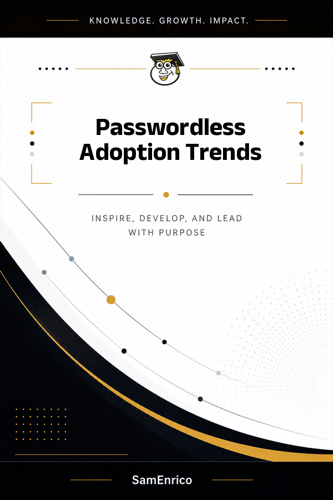
Non-FictionAnnual CheckupAuthentication
Passwordless Adoption Trends
Review passkey deployment and biometric authentica
by Braden Hsiu
Review passkey deployment and biometric authentication breach impacts.
Formats
About this book
Free sample
Chapter 1: The $22 Billion Graveyard--–- Passwords are dying. Not with a dramatic crash or a single obituary, but with the slow, expensive, and increasingly embarrassing realization that the digital keys humanity has relied on for six decades are now the weakest link in the global economy. Every ninety seconds, a credential-stuffing attack occurs somewhere in the world. Each successful breach costs an average of $6 million, and the overwhelming majority trace back to one simple failure: a password that was reused, phished, or simply too weak to resist automated guessing. This chapter is not an obituary, however.
It is an autopsy of why passwords fail, a market analysis of the forces finally killing them, and a roadmap for the specific twenty-four-month window—2025 through 2026—during which organizations must migrate or be left behind. The passwordless market stands at $22 billion today, growing at 17.5 percent annually toward a projected $90 billion. But the tipping point is not about technology alone. It is about economics, regulation, user exhaustion, and the hard math of breach remediation. Understanding these drivers is the first step toward any successful adoption strategy, because without grasping why passwords finally lose, no organization will commit to the difficult work of replacing them.The Anatomy of a Broken System To understand why passwords are collapsing under their own weight, one must first understand what a password actually does—and fails to do.
A password is a shared secret. The user knows it, and the server knows it (or a cryptographically hashed version of it). When the user presents the password, the server compares what it received against what it stored. If they match, access is granted. This model worked reasonably well in the 1970s and 1980s when computers were isolated, networks were small, and malicious actors were mostly curious students.
It does not work in an era of distributed denial-of-service botnets, credential-harvesting phishing kits sold as a service on the dark web, and databases containing billions of previously breached passwords available for download in plain text.The core problem is not complexity. Mandating twelve-character passwords with uppercase, lowercase, numbers, and symbols does not solve the…
This is the end of the free sample. Get the eBook to keep going. Buy now
Contents
- Chapter 1
- Chapter 2
- Chapter 3
- Chapter 4
- Chapter 5
- Chapter 6
- Chapter 7
- Chapter 8
- Chapter 9
- Chapter 10
- Chapter 11
- Chapter 12
Details
- Author
- Braden Hsiu
- Publisher
- SamEnrico
- Language
- English
- Genre
- Non-Fiction, Annual Checkup, Authentication
- Released
- 2026-06-07
- Pages (approx.)
- 151
- Available as
- eBook, Audiobook

Read better in the ZLOADR app
Your eBooks on your phone or tablet. Sign in with your SamEnrico account and start reading.
More by Braden Hsiu
 Creator Legal EssentialsBraden Hsiu$11.99
 The Teen Family Conflict GuideBraden Hsiu$11.99
 The Nonprofit Professional GuideBraden Hsiu$11.99
 Minyanka Animal Mask LoreBraden Hsiu$11.99
 The Velvet Revolution: How Middle Eastern Designers Redefined Global Fashion (1980-2000)Braden Hsiu$11.99
 How to Become a Complaint Evaluation SupervisorBraden Hsiu$11.99
 US Import Sustainability CertificationsBraden Hsiu$12.99
 GA4 Data Retention SettingsBraden Hsiu$12.99
 Understanding Precocious PubertyBraden Hsiu$17.99
 Commercial Credit UnderwriterBraden Hsiu$11.99
You may also like
 Hong Kong Handover 1997Dunn Johnnie$11.99
 Zumba For Postnatal Recovery CourseNeal Christian$11.99
 Zumba for BeginnersLadner Nikia$11.99
 YouTube Comment Mining GuideHumes Pandora$12.99
 Worry Box MeditationCarlin Rudy$11.99
 Workplace Stress MeditationNguyen Lynn$11.99
 Workplace Stress and Sleep RepairHawley Ivory$11.99
 Workplace Perfectionism CureDelaney Jeffry$11.99
 Workplace Injustice Anger GuideWallen Isabelle$11.99
 Work Addiction and Burnout LinkGreenwood Ester$11.99
 Women in Yoga and WellnessBeattie Galina$11.99
 Women in Stand Up ComedyChun Evangeline$11.99