
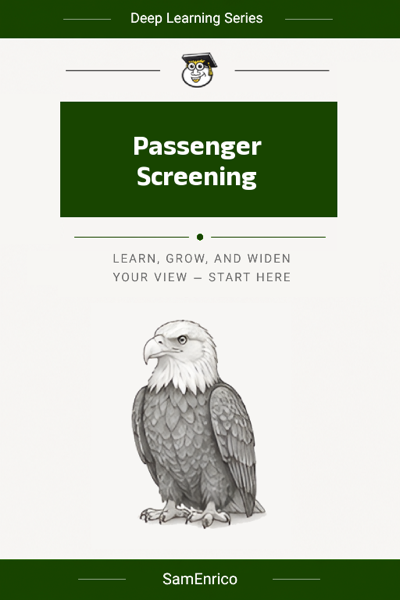
Non-FictionInformativeEducational
Passenger Screening eBook
A Coursebook on Passenger Screening
A Coursebook on Passenger Screening
Formats
Free sample
Chapter 1: The Invisible Queue...--We have all been in the invisible queue. It is not marked by ropes or stanchions. There is no velvet barrier, no digital sign counting down the minutes. Yet every time you walk through an airport terminal, dragging a roller bag and clutching a boarding pass, you enter it. The invisible queue begins the moment you leave your car, or step off the shuttle, or look up at the departures screen and see your flight number blinking.
From that instant until you buckle your seatbelt, you are being sorted. Not by airline status or fare class, but by something far more consequential: your perceived capacity to turn a metal tube filled with jet fuel into a weapon.The strange truth about passenger screening is that almost none of it is designed to catch the average traveler. The pat-downs, the X-rays, the shoe removals, the half-empty water bottles tossed into barrels—these rituals are not calibrated for you. They are calibrated for the one person in ten million who walks into an airport with something other than a vacation on their mind. This creates a fundamental asymmetry that most travelers never appreciate.
The screeners are looking for a needle, but the haystack fights back. The haystack is tired, entitled, anxious, late, distracted, or just profoundly annoyed that someone is touching its carry-on.To understand why passenger screening looks the way it does today—why it feels simultaneously invasive and ineffective, why it humiliates grandmothers and misses weapons, why it costs billions yet fails internal tests at alarming rates—you must first understand something uncomfortable. The system was never designed to be loved. It was designed to be survived. And every single layer of security that stands between you and your gate exists because someone, somewhere, found a way to bypass the layer before it.This is the story of those layers.
But more than that, this is the story of the invisible queue—the psychological, technological, and human gauntlet that 2.5 million passengers walk through every single day in the United States alone. Before we can fix what is broken, we must understand how it was built. And before we can understand how it was built, we must accept that the person who broke it might have been us.The Airport That Didn't See It Coming On the morning of August 5, 1972, three men carrying pistols and grenades walked unchallenged through the security checkpoint at Lod Airport in Tel Aviv. They had no boarding passes. They had no luggage.
They simply walked past the metal detector—which was not turned on—and opened fire on passengers waiting to board an El Al flight to London. Twenty-six people were killed. Seventy-eight were wounded. The attackers had not needed to smuggle weapons through screening because there was no meaningful screening to begin with.Today, Lod Airport is known as Ben Gurion International Airport, and it has arguably the most rigorous passenger screening in the world. The transformation from the site of one of aviation's deadliest attacks to a global gold standard for security did not happen overnight.
It happened through a relentless, often paranoid process of learning the hard way. Every major advancement in passenger screening—every new machine, every new protocol, every new layer—has been written in blood or near-blood. This is not hyperbole. It is the documented history of an industry that waited far too long to realize that the people who wanted to destroy it were patient, creative, and utterly indifferent to convenience.The story of passenger screening is, in many ways, the story of a mismatch. On one side, you have the screener: a human being paid modest wages, working rotating shifts, staring at grainy X-ray images for hours at a time, expected to maintain perfect vigilance.
On the other side, you have the attacker: a person who can plan for months, rehearse in private, choose the exact moment of engagement, and has no obligation to follow any rules. This asymmetry is not a design flaw. It is the insoluble core problem. Every machine ever built, every protocol ever written, every agency ever created has been an attempt to close that gap. And every single attempt has failed to close it completely—because the attacker gets to see what worked last time and do something different.The Three Eras of Incompetence Aviation security scholars, to the extent that such people exist, tend to divide the history of passenger screening into three distinct eras.
The first era, roughly 1920 to 1968, is called the Era of Open Skies. During this period, there was effectively no passenger screening. You bought a ticket, you walked to the plane, you boarded. Metal detectors were not installed at airports because metal detectors had not yet been invented for that purpose. Hijackings were rare and, when they occurred, were treated as criminal matters to be resolved through negotiation.
The assumption, deeply held, was that no one would hijack a plane just to crash it because the hijackers would die too. That assumption was correct for a long time. It was not correct forever.The second era, roughly 1968 to 2001, is called the Era of Reactive Fortification. This period began after a wave of hijackings in the late 1960s, including the first successful hijacking of a US commercial flight in 1961 and the first in-flight homicide in 1964. In response, airports began installing metal detectors and X-ray machines for carry-on baggage.
The newly formed FAA began requiring airlines to screen passengers. But here is the critical detail: the airlines were responsible for their own security. They hired private contractors, often at minimum wage, to run the equipment. Training was minimal. Turnover was astronomical.
The screeners you encountered in 1985 were not government employees. They were the lowest-bidder workforce, and they performed accordingly.This era saw the rise of a peculiar form of theater. Because airlines were liable for security costs but not directly responsible for outcomes (the FAA set minimum standards that were often laughably low), there was a perverse incentive to do just enough to avoid regulatory penalties without actually stopping determined attackers. The result was a system that caught casual criminals—the man who forgot he had a gun in his briefcase—but could be bypassed by anyone with moderate planning and minimal resources. The 1994 bombing of Philippine Airlines Flight 434, which killed one passenger and nearly brought down the plane, was accomplished with a bomb smuggled past screening in a contact lens solution bottle.
The 1996 crash of TWA Flight 800, though ultimately attributed to a fuel tank explosion, triggered a panic about screening that led to the creation of the FAA's own undercover testing program. What those tests found was chilling: undercover agents successfully smuggled fake weapons past airport screeners in nearly 80 percent of attempts.The third era, 2001 to the present, is called the Era of Federalization. But that name is misleading. It is more accurately described as the Era of Expensive Theater. After the September 11 attacks, the United States created the Transportation Security Administration, federalized the screener workforce, and poured billions of dollars into new technology.
The assumption was that government-run security would be better than private security. The outcome was more complicated. TSA screeners, though better…
This is the end of the free sample. Get the eBook to keep going. Buy now
About this book
Details
- Author
- Hebert Elisabeth
- Publisher
- SamEnrico
- Language
- English
- Genre
- Non-Fiction, Informative, Educational
- Released
- 2026-05-09
- Pages (approx.)
- 129
- Available as
- eBook, Audiobook

Read better in the ZLOADR app
Your eBooks on your phone or tablet. Sign in with your SamEnrico account and start reading.
More by Hebert Elisabeth
 WFH Movement BreaksHebert Elisabeth$11.99
 The Curation vs Reality GuideHebert Elisabeth$11.99
 The Fasting Senolytic TriggerHebert Elisabeth$11.99
 Rent Control ConsequencesHebert Elisabeth$11.99
 Titian: The Venetian Sun and His Golden BrushHebert Elisabeth$11.99
 Async Conflict Resolution GuideHebert Elisabeth$12.99
 Learn to Play the Vichitra VinaHebert Elisabeth$11.99
 10 Ways to Use Grapes (Recipe Book)Hebert Elisabeth$11.99
You may also like
 Hong Kong Handover 1997Dunn Johnnie$11.99
 Zumba For Postnatal Recovery CourseNeal Christian$11.99
 Zumba for BeginnersLadner Nikia$11.99
 YouTube Comment Mining GuideHumes Pandora$12.99
 Worry Box MeditationCarlin Rudy$11.99
 Workplace Stress MeditationNguyen Lynn$11.99
 Workplace Stress and Sleep RepairHawley Ivory$11.99
 Workplace Perfectionism CureDelaney Jeffry$11.99
 Workplace Injustice Anger GuideWallen Isabelle$11.99
 Work Addiction and Burnout LinkGreenwood Ester$11.99
 Women in Yoga and WellnessBeattie Galina$11.99
 Women in Stand Up ComedyChun Evangeline$11.99