
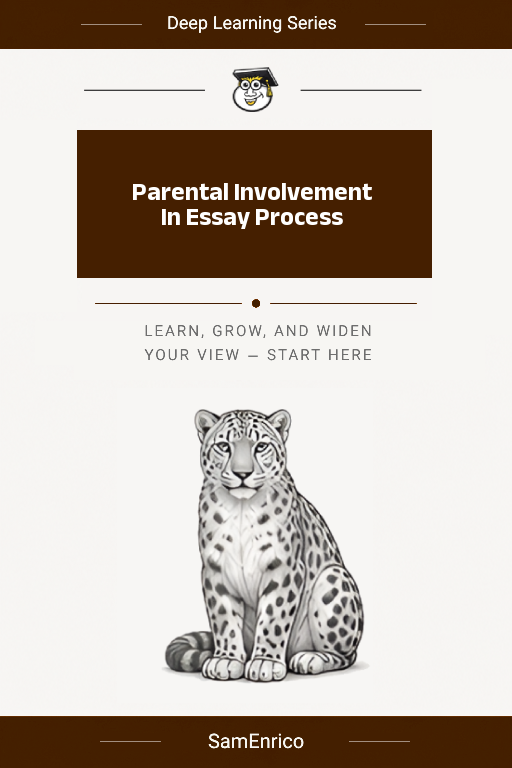
Parental Involvement In Essay Process eBook
Let parents read only for grammar errors not conte
Let parents read only for grammar errors not content to preserve your authentic voice.
Formats
Free sample
Chapter 1: The Anxiety Loop--–- The email arrived at 10:47 PM on a Tuesday. Mia, a forty-two-year-old marketing executive and mother of a ninth grader, had been proofreading her son’s history essay for over an hour. What began as a quick “let me check for commas” had turned into a full-scale rewrite. She had changed “The Boston Tea Party was kinda a big deal” to “The Boston Tea Party represented a pivotal act of colonial resistance.” She had reorganized three paragraphs. She had added a thesis statement where none existed.
When she finally looked up from her laptop, she realized she had written most of the essay herself. Her son had gone to bed two hours ago. She had not even noticed him leave.–- Mia is not a bad mother. She is not a controlling monster or an educational tyrant. She is a loving, exhausted, terrified parent who has been told her entire adult life that every grade matters, that college admissions start in middle school, that the difference between acceptance and rejection can come down to a single well-placed adjective.
She is also, without knowing it, a Voice Thief. And this chapter is about why she—and millions of parents just like her—cannot stop themselves from stealing their children’s words, even when they know better.–- Let us name the invisible force that drives Mia and so many others. It is called the Anxiety Loop. It has three stages, each feeding the next in a self-perpetuating cycle that turns loving parents into accidental hijackers of their children’s authentic voice. Understanding this loop is the first and most essential step toward breaking free of it.
Because you cannot stop a behavior you do not recognize. And you cannot recognize a behavior until you understand what is driving it.The Three Stages of the Anxiety Loop–- The Anxiety Loop operates beneath conscious awareness. Parents do not wake up and say, “Today I will undermine my child’s writing development.” Instead, they feel a vague unease, a gnawing sense that something is not quite right, and they reach for the keyboard to “fix” it. Here is how the loop works.–- Stage One: The Trigger. Something external activates the parent’s fear response.
The trigger can be almost anything: an email from the school about an upcoming deadline, a conversation with another parent about college applications, a glance at the dining room table where an incomplete essay sits, or simply the child saying, “I’m done” in a tone that suggests they are very much not done. For Mia, the trigger was her son’s use of the phrase “kinda a big deal.” Her brain registered this as a problem, a failure, a sign that her child was not taking the assignment seriously. The trigger activates what psychologists call a “threat detection system.” The parent perceives not an essay but an emergency.–- Stage Two: The Hijack. The amygdala, the brain’s fear center, overrides rational thinking. Blood flow shifts away from the prefrontal cortex (responsible for long-term reasoning) and toward the motor centers (responsible for immediate action).
The parent feels an urgent need to do something. This is not a conscious choice; it is a physiological response to perceived threat. The parent’s hands move toward the keyboard. Their eyes scan for errors. Their fingers begin to type.
They are no longer reading as an editor of mechanics; they are reading as a first responder at a crash site. Every sentence becomes a wound that needs suturing. Every informal phrase becomes a liability. Every “I think” becomes a sign of weakness. The hijack stage typically lasts between thirty seconds and three minutes.
In that window, the parent can delete an entire paragraph, change a child’s voice, and fundamentally alter the essay’s direction. Most parents do not even remember making specific changes afterward. They were not fully conscious.–- Stage Three: The Short-Term Relief. After making changes, the parent feels better. The essay now looks “correct.” The language sounds “adult.” The argument appears “sophisticated.” The parent exhales.
The threat has been neutralized. This relief is chemically reinforcing; the brain releases a small amount of dopamine, the same neurotransmitter involved in addiction. The parent learns, at a subcortical level, that editing content reduces anxiety. The loop closes. And the next time a trigger appears, the brain will remember the relief and reach for the same solution—editing—even faster.–- Mia has completed this loop hundreds of times.
Each repetition strengthens the neural pathway. Each repetition makes it harder to stop. She is not weak-willed or foolish. She is caught in a biological and psychological trap that affects parents across every socioeconomic level, every educational background, and every parenting philosophy.Research Behind the Anxiety Loop–- The Anxiety Loop is not metaphorical. It has been documented in peer-reviewed studies across multiple disciplines.
In a 2018 study published in the Journal of Educational Psychology, researchers found that parents who reported high levels of “academic anxiety” were three times more likely to edit their children’s content directly, rather than providing feedback on mechanics alone. The same study found that these parents consistently overestimated the importance of any single assignment; they treated a fifth-grade book report as if it were a college entrance exam.–- A 2020 study from the Stanford Graduate School of Education tracked 120 families over two academic years. Researchers gave half the families a simple intervention: a one-page explanation of the Anxiety Loop and a contract to provide grammar-only feedback. The control group received no intervention. The results were striking.
Families who understood the loop reduced content editing by sixty-seven percent within four months. Their children showed significant gains in writing independence, revision skills, and, perhaps most tellingly, reported lower anxiety about parental involvement. The control group showed no improvement and, in some cases, worsened as parents became more entrenched in their editing habits.–- Perhaps the most sobering finding comes from a longitudinal study out of the University of Virginia. Researchers followed students from sixth grade through twelfth grade, tracking both their writing development and their parents’ editing styles. The study found that students whose parents edited for content in sixth grade were significantly less competent writers by tenth grade than students whose parents provided no feedback at all.
Not the same. Less competent. Parental content editing did not just fail to help; it actively harmed long-term development. The reason, as the study’s authors wrote, is that “content editing replaces student cognition with parental cognition, creating a dependency that precludes the development of independent revision skills.”–- In other words, when you fix your child’s sentence, your child does not learn how to fix their own sentences. They learn that you will do it for them.
They learn that their own words are not good enough. They learn that writing is something to be survived rather than mastered. They learn to hand you the keyboard and say, “Here, you do it.”The High-Stakes Feedback Illusion–- Parents who edit content often believe they are providing “high-stakes feedback” that will prepare their children for the real world. This belief is an illusion. Let us examine it closely.–-…
This is the end of the free sample. Get the eBook to keep going. Buy now
About this book
Details
- Author
- Saldana Zoraida
- Publisher
- SamEnrico
- Language
- English
- Genre
- essays, Student's Shortcut
- Released
- 2026-06-01
- Pages (approx.)
- 135
- Available as
- eBook, Audiobook

Read better in the ZLOADR app
Your eBooks on your phone or tablet. Sign in with your SamEnrico account and start reading.
More by Saldana Zoraida
 Self Hypnosis For Pregame NervesSaldana Zoraida$11.99
 Press Release Embargo GuideSaldana Zoraida$11.99
 Networking for Introverts WorkbookSaldana Zoraida$11.99
 Anapanasati for BeginnersSaldana Zoraida$11.99
 Drug Dependency and Employment ReentrySaldana Zoraida$11.99
 Financial Stress at WorkSaldana Zoraida$11.99Financial Stress at WorkSaldana Zoraida$11.99
 Manifest vs Latent DreamsSaldana Zoraida$11.99
 Czechoslovak Velvet DivorceSaldana Zoraida$11.99
 Driving Anxiety MeditationSaldana Zoraida$11.99
 The Last Stand: Trump’s Impeachment Trials and the Battle for DemocracySaldana Zoraida$11.99
 Frostborn and the Hollow MountainSaldana Zoraida$11.99
You may also like
 YouTube Video Essay DepthLeon Lala$11.99
 TOEFL Independent Essay GuideMintz Alex$11.99
 Music Theory Essay GuideWilkinson Maisha$11.99
 Expository Essay AI PromptsApplegate Dalia$11.99
 Exam Essay MemorizationMcgovern Johna$11.99
 Compare Contrast Essay PromptsOntiveros Marx$11.99
 College Application Essay GuideSisson Aimee$11.99College Application Essay GuideSisson Aimee$11.99
 The 100 Word Essay ChallengeAli Luciana$11.99
 Journalism Essay PromptsThatcher Williemae$11.99
 Finance Essay PromptsShrader Lamont$11.99
 Cause Effect Essay GPT GuideBland Jacelyn$11.99