
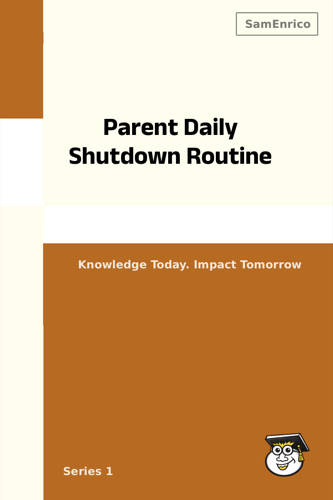
Parent Daily Shutdown Routine eBook
Ends parenting day with reset and rest.
Ends parenting day with reset and rest.
Formats
Free sample
Chapter 1: The 9:30 PM Lie–- You have been told a lie. Not a small, harmless lie, but a corrosive one that has been eating away at your sanity for years. The lie sounds kind, even wise. It sounds like this: “Just sleep when the baby sleeps.” Or its adult equivalent: “Just relax once the kids are in bed.” Or the most insidious version of all: “You’ll have plenty of time for yourself in the evening.”The truth is far uglier. By the time 9:30 PM rolls around, you are not “finally free.” You are a hollow shell standing in the wreckage of the day, holding a cold cup of coffee and staring at a sink full of dishes while your brain plays a highlight reel of every time you lost your patience.
You are too tired to clean, too wired to sleep, and too guilty to enjoy the quiet.This chapter is not about fixing your child’s sleep. It is not about better time management or meal prepping or any of the other well-intentioned advice that assumes you simply need to try harder. This chapter is about understanding why you feel so broken at the end of every single day—and why it is not your fault.Let us name the thing you have been feeling but could not articulate. You are not just tired. You are role-locked.
You are suffering from revenge bedtime procrastination. And you have been sold a complete fantasy about what “rest” actually means for a parent.By the end of this chapter, you will understand the specific mechanism that turns your 9:30 PM “freedom” into a prison of scrolling, guilt, and exhaustion. More importantly, you will see why a parent’s shutdown routine cannot look anything like a non-parent’s relaxation routine. You are not broken. You are just using the wrong map.The Scenario You Know By Heart Let me describe a scene.
Tell me if it sounds familiar.It is 9:27 PM. The last child is finally asleep. You have read three books, fetched four glasses of water, negotiated the release of a stuffed animal from under the crib, and threatened to remove all screen time for eternity at least twice. You close the bedroom door. You stand in the hallway.
And you feel… nothing. Not relief. Not joy. Just a hollow, buzzing emptiness.You shuffle to the living room. The toys are still everywhere.
The kitchen looks like a smoothie exploded. There is a half-eaten cracker on the couch cushion. You tell yourself you will clean it all in just a minute. First, you just need to sit down.You pick up your phone. You tell yourself you will scroll for five minutes.Two hours later, it is 11:30 PM.
You have not cleaned anything. Your eyes are burning. You have read seventeen posts about parents who seem to have it all together, watched three videos about organizing your pantry, and somehow ended up looking at the vacation photos of a woman you barely knew in college. You feel worse than before you sat down. You are angry at yourself for wasting time.
You are exhausted. And now you will get even less sleep.This is not a failure of willpower. This is not laziness. This is not a character flaw. This is a specific psychological phenomenon with a name, and naming it is the first step to dismantling it.The First Lie: “Sleep When the Baby Sleeps”Let us start with the most famous bad advice in parenting history.
“Sleep when the baby sleeps” sounds practical. It sounds like something a wise grandmother would say while patting your hand. But it is based on a fundamental misunderstanding of what exhausts parents.Sleep when the baby sleeps assumes that your exhaustion is purely physical. It assumes that if you could just lie down and close your eyes for twenty minutes, you would wake up refreshed. But anyone who has tried this knows the truth: you lie down, and your brain immediately starts screaming.Did I remember to send that permission slip?
Why did my toddler cry when I dropped them off? Did I sound too harsh when I told them to put their shoes on? I should have played with them more today. I am a terrible parent. I need to meal plan.
I need to call the dentist. The baby will wake up in ten minutes anyway, so what is the point?You cannot nap your way out of emotional exhaustion. You cannot sleep away the feeling of being overwhelmed, unseen, and perpetually behind. Physical rest and cognitive rest are two completely different things, and parenting drains the second one far more than the first.Physical rest is your body recovering from movement, lifting, carrying, and standing. Cognitive rest is your brain switching out of “manager mode”—the constant scanning, prioritizing, predicting, and decision-making that parenting requires.
You can lie perfectly still for an hour and get zero cognitive rest if your brain is still running the household in the background.This is why you can sleep for eight hours and still wake up exhausted. You got physical rest. But your brain never clocked out. It was on duty all night, running through tomorrow’s logistics, replaying today’s mistakes, and listening for the slightest whimper from the next room.Role Lock: Why You Cannot Just “Clock Out”Here is the core problem. In a normal job, you have a clear transition.
You close your laptop, you walk out the door, you drive home. There is a ritual—however small—that signals to your brain: Work is over. You are now a person again.Parenting has no such transition. You do not clock out. You do not leave the building.
The building is your home. The customers are your children. And they live with you.This creates a condition I call role lock. You are locked into the role of “Parent” with no clear off-ramp. Even when your children are asleep, you are not truly off duty.
You are in a state of low-grade vigilance, listening for cries, monitoring the monitor, mentally cataloging what needs to happen tomorrow morning.Your brain cannot distinguish between “actively parenting” and “being available to parent.” As far as your nervous system is concerned, you are still on shift until you do something deliberate to signal otherwise.Think about the last time you tried to watch a show after the kids went to bed. Did you actually watch it? Or did you spend the entire time with one ear listening for footsteps, one hand hovering over the pause button, and your mind running through the checklist for tomorrow’s lunch boxes? That is role lock. You were present in the room, but your brain never left the parenting role.The Second Lie: “You’ll Have Time for Yourself in the Evening”This lie is more subtle but equally damaging.
It is the unspoken promise that the evening hours belong to you. After all, the children are asleep. The workday is over. Surely now you can finally do the things you want to do.But here is what actually happens. By the time you have done the bedtime routine, cleaned…
This is the end of the free sample. Get the eBook to keep going. Buy now
About this book
Details
- Author
- Tijerina Allene
- Publisher
- SamEnrico
- Language
- English
- Genre
- Non-Fiction, Self-Help, Shutdown
- Released
- 2026-06-07
- Pages (approx.)
- 138
- Available as
- eBook, Audiobook

Read better in the ZLOADR app
Your eBooks on your phone or tablet. Sign in with your SamEnrico account and start reading.
More by Tijerina Allene
 IBS Bloating Relief GuideTijerina Allene$11.99
 Francis Crusade CritiqueTijerina Allene$11.99
 Purpose After AddictionTijerina Allene$11.99
 Fun Icebreaker ActivitiesTijerina Allene$11.99
 Space Station Shift SleepTijerina Allene$11.99
 GLP 1 Medications GuideTijerina Allene$11.99
 Catherine French Revolution ReactionTijerina Allene$11.99
 Leaping Into the Void: The Birth of Wingsuit Flying in the Southern SkiesTijerina Allene$11.99
 Nefertiti's Lost Voice: The Silent Pharaoh's CurseTijerina Allene$11.99
 Service Providers Guide to Assisted LivingTijerina Allene$11.99
 A Collector's Handbook to the Hudson Great EightTijerina Allene$11.99
 Portfolio Career Success StoriesTijerina Allene$12.99
You may also like
 Hong Kong Handover 1997Dunn Johnnie$11.99
 Zumba For Postnatal Recovery CourseNeal Christian$11.99
 Zumba for BeginnersLadner Nikia$11.99
 YouTube Comment Mining GuideHumes Pandora$12.99
 Worry Box MeditationCarlin Rudy$11.99
 Workplace Stress MeditationNguyen Lynn$11.99
 Workplace Stress and Sleep RepairHawley Ivory$11.99
 Workplace Perfectionism CureDelaney Jeffry$11.99
 Workplace Injustice Anger GuideWallen Isabelle$11.99
 Work Addiction and Burnout LinkGreenwood Ester$11.99
 Women in Yoga and WellnessBeattie Galina$11.99
 Women in Stand Up ComedyChun Evangeline$11.99