
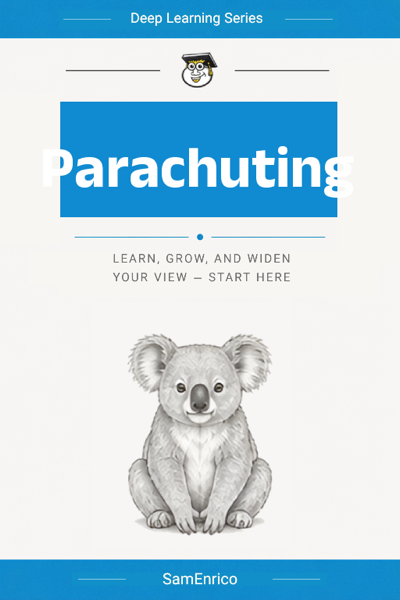
Parachuting eBook
A Coursebook on Parachuting
by Hwang Lucius
A Coursebook on Parachuting
Formats
Free sample
Chapter 1: The Last Taboo...–- The first time you stand in an open aircraft door at 12,500 feet, your brain will lie to you. It will tell you that the aluminum floor beneath your boots is solid, that the doorframe is a barrier, and that the world outside is a painting you are merely observing. Every instinct honed by four million years of human evolution will scream one word: closer. Pull the door shut. Step back.
Sit down. Breathe. The wind will roar past at 120 miles per hour, whipping your jumpsuit against your legs like a flag in a hurricane. Your goggles will press against your face. Your altimeter will beep once, then twice, reminding you that you are running out of sky.
And then the jumpmaster will tap your helmet, and the lie will shatter.The door is not a barrier. It is an invitation. The floor is not solid; it is a launching pad. And the world outside is not a painting—it is a three-dimensional abyss of cold air, invisible currents, and absolute, unfiltered freedom. You will lean forward.
Your knees will bend. Your hands will grip the outside strut. And for one eternal second, you will hang there, suspended between the safety of the metal tube and the terrifying possibility of the sky. Then you will let go.This book is about what happens after that moment.It is not a collection of adrenaline-fueled war stories from drunken drop zone bonfires, though those have their place. It is not a dry military manual filled with stiff diagrams and incomprehensible acronyms, though it will contain both.
And it is not a motivational self-help book pretending that skydiving will fix your marriage or unlock your inner billionaire, because it won’t. What this book is—what it must be—is a complete, honest, and systematic coursebook for the person who has decided to stop standing on the ground and start falling from the sky. Whether you are a seventeen-year-old with a learner’s permit and a death wish (which you should examine carefully), a forty-three-year-old accountant who just realized that life is shorter than your quarterly projections, or a military recruit preparing for airborne school, the information inside these chapters will follow the same arc: from fear to familiarity, from confusion to competence, from passenger to pilot.But before we talk about equipment, or aerodynamics, or the proper way to execute a parachute landing fall without breaking your tailbone, we have to talk about the one thing that every skydiver shares, regardless of experience level. And that thing is fear.The Architecture of Fear Fear is not the enemy. Stupidity is the enemy.
Fear is simply your brain’s threat detection system running a diagnostic check on the environment. When you stand at the door of an airplane, your amygdala—that small, almond-shaped cluster of neurons deep in your temporal lobe—fires a warning signal that travels along two neural pathways. The fast pathway goes directly to your autonomic nervous system, triggering a cascade of physiological responses before you even know what’s happening. Your pupils dilate. Your heart rate spikes from 70 to 170 beats per minute.
Your bronchial tubes expand to maximize oxygen intake. Blood shunts away from your digestive system and toward your large muscle groups. Your body is literally preparing to fight a saber-toothed tiger, except there is no tiger. There is only air.The slow pathway, which arrives about half a second later, goes through your cerebral cortex, where conscious reasoning takes place. This is where you tell yourself: I chose to be here.
I am wearing a redundant parachute system. There is an automatic activation device on my rig that will save me even if I do nothing. The person who tapped my helmet has done this five thousand times. The battle between the fast pathway (instinct) and the slow pathway (reason) is the entire psychological drama of skydiving. And here is the secret that no one tells you before your first jump: that battle never goes away.
It just gets quieter.I have jumped with men and women who have twenty thousand skydives. They still feel the spike. They still hesitate for a fraction of a second. The difference is that they have learned to recognize the fear, thank it for its service, and step through the door anyway. This is not courage in the Hollywood sense—the swaggering, gun-slinging, fearlessness of action movies.
This is courage as a disciplined practice. It is the ability to feel the full force of your evolutionary programming screaming danger and to reply, I know. I have prepared for this.A Brief and Unconventional History of Falling To understand where modern parachuting stands today, you need to understand two parallel histories that only converged relatively recently. The first history is military. The second is recreational.
They share equipment and techniques, but their souls are different.The military history of parachuting begins not with airplanes but with balloons. In 1797, André-Jacques Garnerin jumped from a hydrogen balloon at 3,000 feet over Paris using a silk canopy without any rigid frame. The parachute oscillated violently—Garnerin vomited on the way down—but he landed alive. The French government was unimpressed. It would take another century and the invention of powered flight before anyone took parachutes seriously as life-saving devices.World War I changed that.
Observation balloon observers carried primitive parachutes, though pilots initially did not; military leadership believed that parachutes would encourage cowardice, which remains one of the most spectacularly stupid ideas ever to emerge from a general’s staff meeting. By World War II, however, parachutes had become standardized equipment. The mass tactical jumps at Normandy, Operation Market Garden, and the crossing of the Rhine involved thousands of paratroopers dropping from C-47 Skytrains under round canopies—T-5s, and later T-10s and T-11s. These were not precision instruments. A round parachute descends at roughly 18 to 24 feet per second, regardless of what the jumper does.
You could not steer it, flare it, or turn it. You fell where the wind took you, and you prayed that you missed the trees, the power lines, and the German machine guns.The recreational history begins after World War II, when surplus parachutes became cheap and accessible. Former paratroopers and bored thrill-seekers started jumping not because they had to, but because they wanted to. The first civilian drop zones appeared in California, Arizona, and Florida. The equipment was terrible by modern standards—canvas harnesses, unreliable deployment systems, no reserve canopies to speak of.
People died. But the sport grew anyway, driven by the same impulse that drives it today: the desire to do something that most people consider insane, to master that insanity, and to emerge on the other side with a story.The crucial innovation that changed everything was the ram-air parachute. Developed in the 1960s and refined throughout the 1970s and 80s, the ram-air canopy looked nothing like the round parachutes of World War II. It was rectangular, with cells that inflated with air to form an airfoil. For the first time, a parachutist could steer, brake, and land with precision.
The fatality rate dropped. The learning curve flattened. And skydiving transformed from a fringe activity for daredevils into a legitimate…
This is the end of the free sample. Get the eBook to keep going. Buy now
About this book
Details
- Author
- Hwang Lucius
- Publisher
- SamEnrico
- Language
- English
- Genre
- Non-Fiction, Informative, Educational
- Released
- 2026-05-04
- Pages (approx.)
- 123
- Available as
- eBook, Audiobook

Read better in the ZLOADR app
Your eBooks on your phone or tablet. Sign in with your SamEnrico account and start reading.
More by Hwang Lucius
 Incubating Solutions For Social Anxiety WorkbookHwang Lucius$11.99
 The Transfer Student StressHwang Lucius$11.99
 The Validation Technique CourseHwang Lucius$11.99
 Parental Anger Wisdom CourseHwang Lucius$11.99
 The Birthday Email Automation GuideHwang Lucius$11.99
 The Last Stand of the Frost Giants: Ragnarök’s Forgotten WarriorsHwang Lucius$11.99
 Madrid Representative GuideHwang Lucius$12.99
 Green Credit for Data CentersHwang Lucius$12.99
 Understanding Thalamic Degeneration Symmetrical InfantileHwang Lucius$17.99
 How to Start a Iron and Steel Mills BusinessHwang Lucius$11.99