
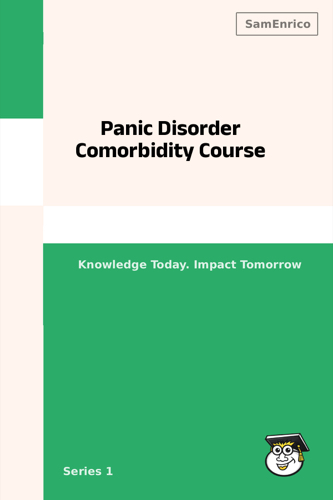
Non-FictionHealth & WellnessComorbid Conditions
Panic Disorder Comorbidity Course eBook
Treat panic alongside depression GAD and substance
by Gipson Mila
Treat panic alongside depression GAD and substance use disorders.
Formats
Free sample
Chapter 1: The Perfect Storm...--–- Sarah was thirty-four years old when she realized she could no longer tell where her panic ended and her drinking began. She sat in my office on a gray Tuesday morning, her hands wrapped around a cold coffee cup she had no intention of drinking, and she described a life that had become a closed loop. Wake at 3:00 AM with a racing heart. Lie in bed for an hour, certain she was dying. Fall back asleep fifteen minutes before her alarm.
Drag herself through the morning. Feel the first twinge of chest pressure by 9:00 AM. Take a deep breath. Feel it fail. Reach for the wine she had started keeping in her desk drawer.
One glass. Then another. Feel the panic subside. Feel the shame rise. Go home.
Promise herself tomorrow would be different. Wake at 3:00 AM."I don't even know which problem is the real one anymore," she told me. "Is the drinking causing the panic? Is the panic causing the drinking? Or am I just broken in some fundamental way that means I'll never get better?"Sarah's question is the central question of this book.
And the answer, as you will see, is both simpler and more surprising than she imagined.The Epidemiology of Togetherness If you have picked up this book, odds are good that you or someone you love has experienced panic attacks. And odds are equally good that panic is not the only visitor at the table. The research literature is unusually clear on this point: panic disorder is a profoundly social condition, by which I mean it rarely travels alone.Let me give you the numbers, because numbers, unlike feelings, do not lie. Among individuals with panic disorder, approximately fifty to sixty percent will also meet diagnostic criteria for major depression at some point in their lives. This is not a small overlap.
This is a majority. If you have panic disorder, the single most likely additional diagnosis you carry is depression.But the comorbidity does not stop there. Up to thirty percent of individuals with panic disorder have a co-occurring substance use disorder, most commonly involving alcohol or benzodiazepines. Generalized anxiety disorder overlaps with panic disorder at rates that have led some researchers to question whether the two are truly distinct conditions or variations on a shared theme. And perhaps most striking of all, the presence of any two of these conditions dramatically increases the risk for the third.
Depression plus panic predicts later substance use. Substance use plus panic predicts later depression. The disorders do not merely coexist. They recruit one another.This chapter is called The Perfect Storm because that is precisely what we are dealing with: a convergence of atmospheric conditions that, when they align, produce something far more destructive than any single weather system alone. Understanding how these conditions align is the first step toward learning how to dismantle them.The Crucial Distinction: Substance-Induced Versus Independent Panic Before we go any further, we need to draw a line that will save you years of confusion and potentially dangerous treatment missteps.
That line divides two conditions that look identical on the surface but require radically different approaches: substance-induced panic and independent panic disorder.Substance-induced panic is exactly what it sounds like: panic attacks that are caused directly by the pharmacological effects of a substance. This includes panic during intoxication (stimulants like cocaine or excessive caffeine can trigger panic while the drug is active), panic during withdrawal (alcohol and benzodiazepine withdrawal are notorious for producing panic attacks that can be indistinguishable from those seen in panic disorder), and panic as a side effect of prescribed medications (some antidepressants, asthma medications, and thyroid hormones can induce panic in susceptible individuals).Here is the critical point: if the panic occurs only during intoxication, only during withdrawal, or only in direct temporal relationship to a medication change, then the diagnosis is substance-induced panic disorder, not independent panic disorder. And the treatment for substance-induced panic is not anxiety-focused therapy alone. The treatment is addressing the substance.Independent panic disorder, by contrast, is panic that exists independently of substance use. It predates the substance use, persists during extended periods of sobriety, and follows its own course regardless of what the person puts into their body.
This does not mean independent panic is untreatable. It means it requires a different treatment pathway, one that addresses the panic itself rather than assuming it will resolve when substance use stops.Why does this distinction matter so much? Because thousands of people have been treated for "panic disorder" when what they actually had was alcohol withdrawal-induced panic, and thousands more have been told their panic would resolve if they "just stopped drinking" when what they actually had was independent panic that happened to co-occur with alcohol use. Getting this distinction wrong leads to years of failed treatment. Getting it right is the first step toward recovery.How do you tell the difference?
The timeline is your best friend. Create a calendar. Mark when the panic attacks began. Mark when substance use began. Mark periods of abstinence (even brief ones) and note what happened to panic during those periods.
If panic disappears completely during two weeks of abstinence and returns only when drinking resumes, you are looking at substance-induced panic. If panic persists after a month of abstinence, you are looking at independent panic disorder with a substance use comorbidity. We will return to this timeline method in Chapter 2, but for now, simply understand that this distinction will determine everything that follows.The Shared Vulnerability Model: Why Some Brains Are Primed for Multiple Disorders Let us return to Sarah. She grew up in a home that was not abusive but was unpredictable. Her father lost jobs frequently.
Her mother worried constantly. Money was tight. Arguments were loud. Sarah learned early that the world could not be trusted to stay stable, and she learned to scan constantly for threats. By age twelve, she was having what she now recognizes as panic attacks, though at the time she called them "freak-outs." By age sixteen, she was drinking at parties in a way her friends did not.
By age twenty-two, she had her first major depressive episode.Sarah was not unlucky. Sarah was vulnerable.The Shared Vulnerability model proposes that a single underlying temperament or neurobiological profile can give rise to multiple different disorders depending on life circumstances, coping strategies, and environmental triggers. That underlying vulnerability typically includes three components.The first is high neuroticism. Neuroticism is a personality trait characterized by a tendency to experience negative emotional states such as fear, sadness, anxiety, guilt, and anger. People high in neuroticism do not just feel things more intensely.
They feel negative things more intensely, for longer durations, and in response to lower levels of provocation. Neuroticism is about sixty percent heritable, meaning it runs strongly in families, and it is the single best predictor of developing any anxiety or mood disorder.The second component is behavioral inhibition. This is the tendency to withdraw from novel, uncertain, or potentially threatening situations. A behaviorally inhibited child is the one who hides behind a parent's leg at a birthday party, who refuses…
This is the end of the free sample. Get the eBook to keep going. Buy now
About this book
Details
- Author
- Gipson Mila
- Publisher
- SamEnrico
- Language
- English
- Genre
- Non-Fiction, Health & Wellness, Comorbid Conditions
- Released
- 2026-06-06
- Pages (approx.)
- 150
- Available as
- eBook, Audiobook

Read better in the ZLOADR app
Your eBooks on your phone or tablet. Sign in with your SamEnrico account and start reading.
More by Gipson Mila
 Psychoeducation for Explosive ParentsGipson Mila$11.99
 The Beit Yosef CompilerGipson Mila$11.99
 Hostage Negotiation LessonsGipson Mila$11.99
 Growth Hormone Deficiency DiagnosisGipson Mila$11.99
 The Hypnos Code: Decoding the Ancient Dream Oracle of DelphiGipson Mila$11.99
 Love Letters from the Front: The Secret Correspondence of Vera Brittain and Roland LeightonGipson Mila$11.99
 Understanding Brachydactyly Type BGipson Mila$17.99
 Fishing GuideGipson Mila$11.99
 10 Ways to Use Cinnamomum Citriodorum (Recipe Book)Gipson Mila$11.99
 Headless Commerce Five Year ForecastGipson Mila$12.99
 Asian Coding Education LandscapeGipson Mila$12.99
You may also like
 Hong Kong Handover 1997Dunn Johnnie$11.99
 Zumba For Postnatal Recovery CourseNeal Christian$11.99
 Zumba for BeginnersLadner Nikia$11.99
 YouTube Comment Mining GuideHumes Pandora$12.99
 Worry Box MeditationCarlin Rudy$11.99
 Workplace Stress MeditationNguyen Lynn$11.99
 Workplace Stress and Sleep RepairHawley Ivory$11.99
 Workplace Perfectionism CureDelaney Jeffry$11.99
 Workplace Injustice Anger GuideWallen Isabelle$11.99
 Work Addiction and Burnout LinkGreenwood Ester$11.99
 Women in Yoga and WellnessBeattie Galina$11.99
 Women in Stand Up ComedyChun Evangeline$11.99