
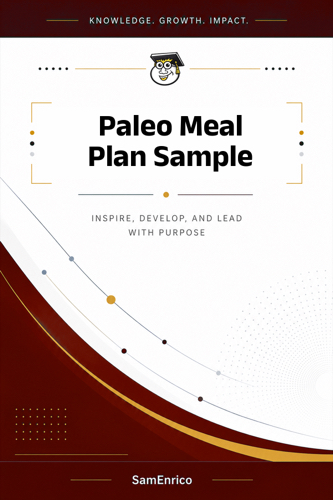
Non-FictionHealth & WellnessMeal Plan
Paleo Meal Plan Sample eBook
Follow 7 day rotation of meat seafood and produce.
Follow 7 day rotation of meat seafood and produce.
Formats
Free sample
Chapter 1: The Chicken-Broccoli Trap--The average person who tries the Paleo diet fails within the first eleven days.Not because the food tastes bad. Not because the cravings are unbearable. And certainly not because the science is flawed. The real reason is almost embarrassingly simple: they get bored. Specifically, they fall into what I call the Chicken-Broccoli Trap—the seemingly logical decision to find one "safe" meal and repeat it into infinity.
Chicken breast. Steamed broccoli. Maybe a drizzle of olive oil if they are feeling adventurous. Day one feels virtuous. Day three feels tolerable.
By day seven, they would commit a minor felony for a slice of bread, not because they need the gluten, but because they cannot face that same pale, dry chicken breast again.This book exists because that trap is entirely avoidable. In fact, avoiding it requires nothing more than a single, elegant strategy: a 7-day rotation of meats, seafood, and produce. Not a complicated spreadsheet of macronutrients. Not a collection of obscure ingredients that require three different specialty stores. Just a deliberate, systematic way of changing what is on your plate, day by day, so that your meals never become a punishment.The Great Monotony Mistake Let me be clear about what goes wrong.
When most people decide to "eat healthier," they instinctively simplify. They look at the long list of foods they are supposed to avoid—grains, sugar, industrial oils, processed dairy—and they panic. In that panic, they grab onto the few foods that seem "safe" and they cling to them like a life raft. For many, that means chicken. Boneless, skinless chicken breast, to be precise, because some well-meaning but misinformed fitness culture has convinced everyone that chicken breast is the ultimate health food.
Paired with broccoli, because everyone knows green vegetables are good for you. And that is where the trouble begins.Eating the exact same protein source every day creates two separate but equally damaging problems. The first is nutritional narrowness. Chicken breast is predominantly protein with very little fat. It contains some B vitamins, but it is almost devoid of iron, completely devoid of vitamin B12 (which is only found in significant quantities in red meat and shellfish), and offers none of the omega-3 fatty acids that reduce inflammation throughout your body.
If you eat chicken every day for a month, you are not following a balanced diet. You are following a deficiency in progress.The second problem is the slow, creeping development of food intolerances. This sounds counterintuitive, because you have probably heard that food intolerances come from "bad" foods like gluten or dairy. But the immune system can develop sensitivities to literally any protein that it encounters too frequently. When you eat the same protein day after day, your gut's immune tissue—which is constantly sampling everything you digest—can begin to flag that protein as suspicious.
Not allergic, not anaphylactic, but mildly inflammatory. You might notice this as bloating, fatigue, joint stiffness, or skin issues that you cannot explain. The conventional advice is to eliminate more foods. The smarter advice is to rotate what you eat so that your immune system never has the chance to become overfamiliar with any single protein source.This is not a hypothetical concern. Clinical observation in functional medicine has repeatedly shown that patients with unexplained low-grade inflammation often improve dramatically when they simply start rotating their protein sources.
The mechanism is straightforward: variety reduces the antigenic load on the gut-associated lymphoid tissue. In plain English, if you keep showing your immune system the same exact protein every single day, it eventually gets annoyed. If you show it beef on Monday, salmon on Tuesday, pork on Wednesday, eggs on Thursday, and shrimp on Friday, it never has time to develop an opinion about any of them.The 7-Day Rotation: Why Seven and Not Five or Ten?Seven days is not an arbitrary number. It emerges from three separate constraints: biology, logistics, and psychology.Biologically, a weekly rotation aligns with the natural rhythms of human metabolism. While daily eating patterns matter, the body's inflammatory and repair cycles operate on longer arcs.
Rotating over seven days ensures that you are not repeating the same protein more than four times in a month (assuming you follow the plan for four weeks). That is infrequent enough to prevent the immune sensitization described above, but frequent enough that you do not need to memorize a thirty-day calendar.Logistically, seven days fits perfectly into the structure of modern life. Most people grocery shop once a week. Most people have a natural rhythm of weekdays versus weekends. A 7-day plan can be written on a single sheet of paper, posted on the refrigerator, and followed without needing a Ph D in nutrition.
It accommodates the reality that Monday looks different from Saturday, and that leftovers from Wednesday become Thursday's lunch without any extra cooking.Psychologically, seven days is long enough to establish a habit and short enough to prevent despair. If you hated Tuesday's seafood, you only have to wait five days before it comes back around, and by then you might have forgotten why you disliked it. More importantly, seven days provides enough variety that you never feel trapped. You are never more than twenty-four hours away from a completely different flavor profile, a completely different cooking method, a completely different texture on your fork.Metabolic Flexibility: The Science You Did Not Know You Needed There is a deeper reason to rotate your foods, and it has to do with something called metabolic flexibility. This is the body's ability to switch between burning carbohydrates for fuel and burning fat for fuel, depending on what is available.
A metabolically flexible person wakes up in the morning, eats breakfast, and seamlessly processes whatever macronutrients are present. A metabolically inflexible person—and this describes the majority of people eating a standard Western diet—has essentially forgotten how to burn fat. They have eaten so many carbohydrates, so frequently, that their cells have downregulated the machinery needed to access stored body fat. They become hungry every three hours. They crash in the afternoon.
They cannot skip a meal without becoming dizzy or irritable.Rotating your protein sources and your produce selections across seven days naturally trains metabolic flexibility because you are constantly changing the macronutrient ratios of your meals. Red meat days tend to be higher in fat and lower in carbohydrates. Seafood days provide unique fatty acid profiles that support mitochondrial function. Pork and poultry days offer moderate fat with clean protein. Egg and offal days deliver fat-soluble vitamins that many people are desperately deficient in.
Starch-focused days (which we will cover later in this book) provide controlled carbohydrate intake that actually improves thyroid function and sleep quality when timed correctly.The goal is not to eliminate carbohydrates forever. The goal is to teach your body that it can handle carbohydrates when they appear and can also handle fat when carbohydrates are absent. A 7-day rotation that deliberately alternates between lower-carb and higher-carb days accomplishes this far more effectively than any extreme approach like keto or high-carb plant-based eating.Eating the Rainbow Without the Hippie Slogan You have heard the phrase "eat the…
This is the end of the free sample. Get the eBook to keep going. Buy now
About this book
Details
- Author
- Delarosa Marine
- Publisher
- SamEnrico
- Language
- English
- Genre
- Non-Fiction, Health & Wellness, Meal Plan
- Released
- 2026-06-08
- Pages (approx.)
- 135
- Available as
- eBook, Audiobook

Read better in the ZLOADR app
Your eBooks on your phone or tablet. Sign in with your SamEnrico account and start reading.
More by Delarosa Marine
 Burnout Recovery Pet TherapyDelarosa Marine$11.99
 Sleep Meditation for High Blood PressureDelarosa Marine$11.99
 Francis of Assisi Verna RetreatDelarosa Marine$11.99
 The Gustav Mahler Symphony GuideDelarosa Marine$11.99
 The Great Serpent’s Gambit: When the Zoo Forgot to Lock the GatesDelarosa Marine$11.99
 Learn to Play the DolluDelarosa Marine$11.99
 Tree ClimbingDelarosa Marine$11.99
 Shape Up for StartupsDelarosa Marine$12.99
 Faceless YouTube Horror ChannelDelarosa Marine$12.99
 How to Become a Gambling DealerDelarosa Marine$11.99
You may also like
 Hong Kong Handover 1997Dunn Johnnie$11.99
 Zumba For Postnatal Recovery CourseNeal Christian$11.99
 Zumba for BeginnersLadner Nikia$11.99
 YouTube Comment Mining GuideHumes Pandora$12.99
 Worry Box MeditationCarlin Rudy$11.99
 Workplace Stress MeditationNguyen Lynn$11.99
 Workplace Stress and Sleep RepairHawley Ivory$11.99
 Workplace Perfectionism CureDelaney Jeffry$11.99
 Workplace Injustice Anger GuideWallen Isabelle$11.99
 Work Addiction and Burnout LinkGreenwood Ester$11.99
 Women in Yoga and WellnessBeattie Galina$11.99
 Women in Stand Up ComedyChun Evangeline$11.99