
Non-FictionSelf-HelpMental Architecture
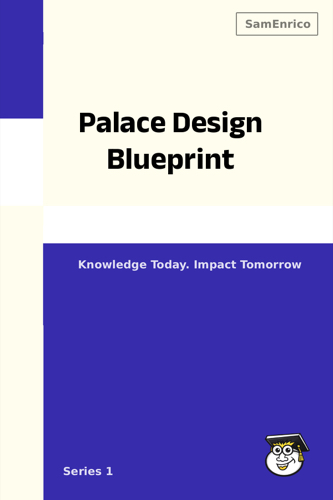
Palace Design Blueprint
Build virtual memory palaces from childhood homes
Build virtual memory palaces from childhood homes to fictional castles.
Formats
About this book
Free sample
Below is the fully revised 12-chapter summary for Palace Design Blueprint. All inconsistencies and repetitions have been resolved through restructuring, clarifying definitions, merging redundant content, and adding a pedagogical scaling ladder. Each summary meets the 250+ word requirement.Part I: The Foundations (Blueprints & Bedrock)Chapter 1: The Architect’s Corner – Why Real Places (Even Old Ones) Beat Empty Rooms In-Depth Summary (285 words):This chapter opens with the story of Simonides of Ceos, the Greek poet who discovered the Method of Loci after a banquet hall collapsed, enabling him to identify every victim by their exact position at the table. The author then makes a critical distinction that most memory books overlook: all memory palaces are "virtual" in the sense that they exist only in the mind, but there is a crucial difference between real-world-derived locations (places you have physically experienced) and purely invented locations (castles, spaceships, or rooms you have never seen). This book defines "virtual palace" as any mental construction—whether based on reality or fantasy—but argues that beginners must start with real-world-derived locations.
The chapter introduces the "Emotional Loci Advantage," explaining that the hippocampus (memory center) is tightly linked to the amygdala (emotion center). A creaky floorboard that terrified you as a child, the smell of your grandmother's kitchen, or the specific angle of afternoon light in your old bedroom creates far stronger neural hooks than any invented marble hall. Readers are guided to their first palace: the home they grew up in. The exercise is deliberately small: close your eyes, mentally walk through your childhood home, and note exactly 10 distinct loci (e.g., front door, hallway mirror, top stair, bathroom sink, bedroom closet). No data is attached yet.
The chapter ends by introducing the "Standard Walkthrough Protocol"—a simple three-step process (enter, touch each locus in order, exit) that will be referenced throughout the book without being re-explained.Chapter 2: The Journey vs. The Stationary Palace – Choosing Your Architecture In-Depth Summary (290 words):This chapter draws a critical distinction between two modes of memory architecture, and importantly, it clarifies that both can be used for speeches—but for different types of…
This is the end of the free sample. Get the eBook to keep going. Buy now
Contents
- Chapter 1
- Chapter 2
- Chapter 3
- Chapter 4
- Chapter 5
- Chapter 6
- Chapter 7
- Chapter 8
- Chapter 9
- Chapter 10
- Chapter 11
- Chapter 12
Details
- Author
- Justus Mammie
- Publisher
- SamEnrico
- Language
- English
- Genre
- Non-Fiction, Self-Help, Mental Architecture
- Released
- 2026-06-11
- Pages (approx.)
- 156
- Available as
- eBook, Audiobook

Read better in the ZLOADR app
Your eBooks on your phone or tablet. Sign in with your SamEnrico account and start reading.
More by Justus Mammie
 Negative Assertiveness TrainingJustus Mammie$11.99
 The Young Men ED GuideJustus Mammie$11.99
 Medical Trauma NightmaresJustus Mammie$11.99
 Validation for TeensJustus Mammie$11.99
 Wholesaling Repair EstimationJustus Mammie$11.99
 Performance Review ProtectionJustus Mammie$11.99
 Gaming and Legal IssuesJustus Mammie$11.99
 Blood and Dust: The Boer Guerrilla War That Defied an Empire (1899-1902)Justus Mammie$11.99
 Galileo's Revolutions: The Man Who Challenged the HeavensJustus Mammie$11.99
 Canva Templates for Pinterest VAsJustus Mammie$12.99
 Co-Founder Confidentiality Breach GuideJustus Mammie$12.99
 How to Produce Retro ColorsJustus Mammie$11.99
You may also like
 Hong Kong Handover 1997Dunn Johnnie$11.99
 Zumba For Postnatal Recovery CourseNeal Christian$11.99
 Zumba for BeginnersLadner Nikia$11.99
 YouTube Comment Mining GuideHumes Pandora$12.99
 Worry Box MeditationCarlin Rudy$11.99
 Workplace Stress MeditationNguyen Lynn$11.99
 Workplace Stress and Sleep RepairHawley Ivory$11.99
 Workplace Perfectionism CureDelaney Jeffry$11.99
 Workplace Injustice Anger GuideWallen Isabelle$11.99
 Work Addiction and Burnout LinkGreenwood Ester$11.99
 Women in Yoga and WellnessBeattie Galina$11.99
 Women in Stand Up ComedyChun Evangeline$11.99